

Fashion forecasting has always been part art, part science. Industry experts study runway shows, scroll through social media, and rely on gut instinct to predict what colors, cuts, and styles will dominate stores in six months. But what if an AI chatbot could do some of that work?
Researchers at South Korea’s Pusan National University decided to find out. They tested whether ChatGPT, the viral AI tool most people use for writing emails and homework help, could predict upcoming fashion trends. The answer? Sort of.
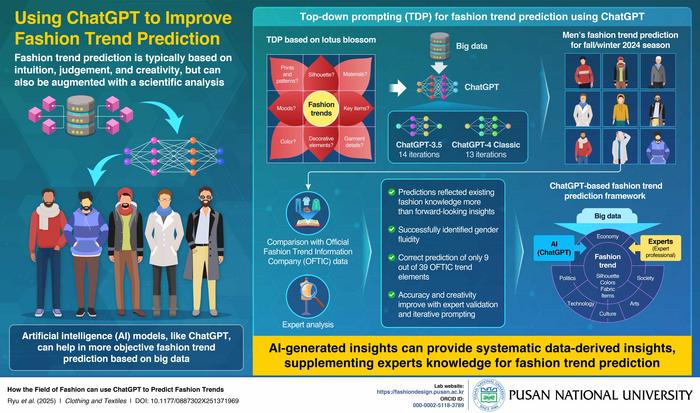
The team, led by Assistant Professor Yoon Kyung Lee and graduate student Chaehi Ryu, didn’t just type “What will be trendy next season?” into ChatGPT and call it a day. Instead, they developed a structured questioning method they call Top-Down Prompting, which breaks the big question into smaller, more specific queries about silhouettes, fabrics, colors, and details.
Teaching AI to Think Like a Trend Forecaster
The researchers borrowed from a brainstorming technique called Lotus Blossom, which starts with a central problem and expands outward into related sub-questions. They asked ChatGPT about eight specific fashion categories: silhouette, materials, key items, garment details, decorative elements, color, moods, and prints and patterns.
When they tested this approach on men’s fall/winter 2024 fashion trends, ChatGPT identified only 9 out of 39 trends that appeared in predictions from a professional trend forecasting company. That’s not exactly impressive accuracy. The AI tended to suggest safe, established styles rather than spotting emerging movements.
But here’s where it gets interesting. ChatGPT did catch a few trends that the professional forecasters mentioned, including the rise of gender-fluid fashion and the comeback of statement coats. These weren’t obvious extrapolations from existing data.
“While the prediction accuracy of ChatGPT is low, what’s intriguing is that it captured new trends not found in existing data. AI can sense cultural shifts and open up new creative directions.”
A Tool for Students and Small Brands
The researchers aren’t suggesting that fashion houses fire their trend forecasting teams just yet. ChatGPT made plenty of mistakes and sometimes offered generic predictions that wouldn’t help a designer create a standout collection. The AI suffers from the same problems it has in other fields: occasional hallucinations, factual errors, and a tendency to play it safe.
But for fashion students or small brands without access to expensive trend forecasting services, ChatGPT could serve as a useful starting point. Traditional big-data analysis tools require technical expertise and significant investment. ChatGPT, despite its limitations, is free and accessible to anyone with an internet connection.
The researchers envision a hybrid approach where AI analysis works alongside human expertise. They’ve developed a conceptual framework for fashion education that combines their Top-Down Prompting technique with traditional expert knowledge. Think of it as AI doing the initial legwork, scanning vast amounts of cultural data, while human designers add the intuition and creativity that machines still can’t replicate.
Fashion forecasting has always required reading the cultural tea leaves, understanding what movies people are watching, what music they’re listening to, what social movements are gaining momentum. ChatGPT, trained on huge swaths of internet data, theoretically has access to all those signals. The challenge is teaching it to connect those dots in meaningful ways.
Will we see AI-generated trend reports replacing human forecasters anytime soon? Probably not. But as these tools improve and researchers develop better ways to prompt them, they might become valuable collaborators in an industry that’s always looking ahead to next season.
Clothing and Textiles Research Journal: 10.1177/0887302X251371969