

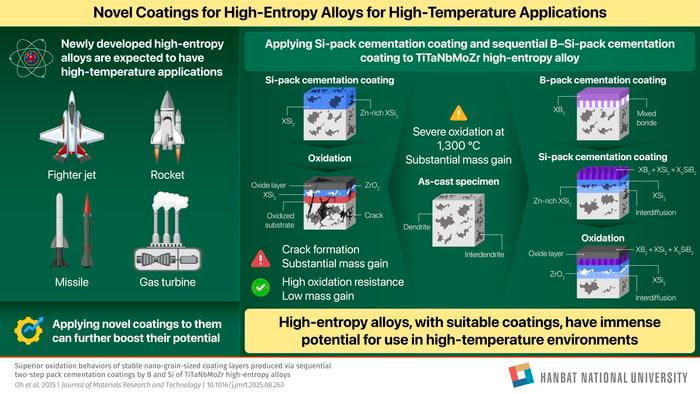
Fighter jets and missiles could soon operate at temperatures that would melt today’s engines, thanks to a double-layered coating system that protects experimental metal alloys in conditions hot enough to vaporize steel.
Engineers in South Korea have demonstrated that a sequential boron-silicon coating keeps a new class of metallic materials intact at 1300 degrees Celsius: roughly 200 degrees hotter than current aerospace alloys can handle. The coating forms a stable nano-grain structure that acts like a heat-resistant shield, preventing the underlying metal from disintegrating in air.
For more than eight decades, nickel-based alloys have dominated high-temperature applications in aviation. Ceramic coatings pushed their limits higher, but the nickel itself softens above 1100 degrees Celsius, creating a hard ceiling for engine performance. The new work, led by Joonsik Park at Hanbat National University, explores whether so-called high-entropy alloys, mixtures containing five or more metallic elements in roughly equal proportions, can break through that barrier with the right protective coating.
The Single-Coating Trap
Park’s team tested a high-entropy alloy called TiTaNbMoZr, named for the titanium, tantalum, niobium, molybdenum, and zirconium it contains. When they applied only a silicon-based coating using a technique called pack cementation, the alloy looked promising at first. But after 10 hours at 1300 degrees Celsius, cracks appeared. The zirconium-rich compounds in the coating reacted with oxygen, forming zirconium dioxide and compromising the protective layer. The uncoated alloy fared even worse, experiencing what the researchers called “extreme oxidation.”
The solution came from adding a boron layer before the silicon coating. This two-step process created a complex surface structure containing three different compounds: metal borides, metal silicides, and a mixed boron-silicon phase. Each layer contributes different protective properties, and together they remain structurally stable even as oxygen attacks the surface.
“Currently, the Ni-based alloys used in missiles can operate at around 1100 degrees Celsius, but the results of our study show that the newly developed material can withstand temperatures far exceeding that limit.”
The difference showed up clearly in mass measurements. After oxidation testing, both the bare alloy and the silicon-only version gained substantial weight as oxygen bonded with the metal. The double-coated version gained far less mass, and the rate of oxidation slowed dramatically once the protective oxide layer formed.
Nano-Grains Hold the Line
What makes the coating unusual is its nano-grain structure, crystals so small that millions would fit across the width of a human hair. Normally, exposing metal to 1300-degree heat causes grain growth, which weakens protective coatings. Park’s team found that their boron-silicon layers maintained their nano-scale structure throughout the high-temperature exposure, a behavior they say has not been documented before in coated high-entropy alloys.
The implications extend beyond aerospace. Any industrial process involving sustained exposure to extreme heat, from power generation to chemical manufacturing, could benefit from materials that remain stable at higher temperatures. Defense applications seem most immediate: components in jet engines, rocket nozzles, and missile systems all operate at the edge of what current materials can tolerate.
“Overall, our results confirm the potential of high-entropy alloys for use in high-temperature environments and emphasize the critical role of selecting suitable coating strategies tailored to the alloy composition.”
The researchers published their findings in September 2025 in the Journal of Materials Research and Technology. They note that matching the coating method to the specific alloy composition appears crucial. A coating that works for one high-entropy mixture might fail on another, depending on which elements dominate the surface chemistry.
Whether these laboratory results translate to practical jet engines remains to be seen. Aerospace components face not just heat but also mechanical stress, vibration, and thermal cycling that can crack even the most carefully designed coatings. Still, the 200-degree temperature advantage over nickel alloys represents the kind of margin that, if it holds up in real-world testing, could reshape how engineers design high-performance engines.
Journal of Materials Research and Technology: 10.1016/j.jmrt.2025.08.263