

Surgeons performing hip replacements face a grim statistic: nearly half of all postoperative thigh bone fractures happen within the first three months after surgery, often forcing patients back into the operating room. Now, a 14-year study tracking more than 4,500 hip replacement procedures suggests a surprisingly simple fix may dramatically reduce this complication.
The answer, according to researchers at Chiba University in Japan, lies in a design feature that sounds almost trivial: a small stabilizing ring, or collar, at the top of the artificial hip stem combined with a bone-friendly coating. When compared head-to-head against the smooth, wedge-shaped stems that many surgeons prefer, the collared versions showed an 85% reduction in early fractures. The difference was stark: just two fractures in the collared group versus 13 in the wedge group, even after researchers carefully matched patients by age, weight, and health status.
One Surgeon, Two Stem Designs, Clear Results
What makes this study particularly compelling is its design. Rather than comparing results across multiple hospitals or surgeons, where technique and patient selection might muddy the waters, lead researcher Rui Hirasawa and his team analyzed 4,511 procedures performed by a single surgeon at one medical center between 2009 and 2023. They used propensity score matching, a statistical technique borrowed from economics, to create two groups of 1,804 patients each who were essentially identical in every measurable way except for which implant they received.
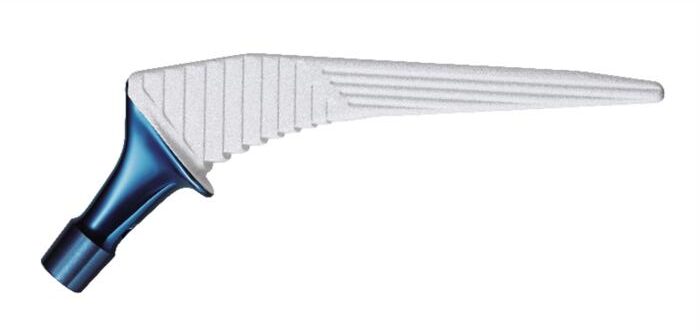
The collared stems feature a ring that rests directly on the patient’s bone, providing immediate mechanical support. They are also fully coated with hydroxyapatite, a calcium-based material that encourages the patient’s bone to grow directly onto the implant surface. The flat-tapered wedge stems, by contrast, rely purely on their shape and tight fit within the bone canal to achieve stability. No collar, no coating, just geometry and friction.
“Based on both our clinical impressions and reports in the literature indicating a lower incidence of post-THR femoral fractures with collared fully HA-coated stems, we were inspired to investigate whether these stems could indeed reduce the risk of these fractures.”
The researchers published their findings in the October 2025 issue of the Bone & Joint Journal, and the implications extend well beyond Japan. With approximately one million total hip replacements performed worldwide each year, even small percentage improvements in safety translate to thousands of patients who might avoid a devastating complication.
The Tradeoff Surgeons Need to Know
Before orthopedic surgeons rush to switch implant types, however, there is a catch. The study found that collared stems were associated with more fractures during surgery itself, when the surgeon is actually inserting the implant into the bone. These intraoperative fractures can usually be managed on the spot with wires or screws, but they complicate the procedure and require careful technique.
This finding suggests that the collared design demands more precision during insertion, possibly because the collar makes it harder to adjust the implant’s position once it starts going in. Hirasawa and his colleagues emphasize that further research is needed to refine surgical techniques specifically for collared stems, and to identify which patients are best suited for each design.
The stakes are high. Femoral fracture after hip replacement is currently the leading cause of revision surgery, an outcome that is physically grueling for patients and enormously expensive for healthcare systems. Many of these patients are elderly, with other health conditions that make any additional surgery risky. Avoiding even one fracture can mean the difference between a patient regaining independence or facing permanent disability.
“Our results have the potential to directly improve patient safety and surgical outcomes in THR by helping surgeons make more informed implant selections, leading to fewer serious complications, faster functional recovery, and reduced need for reoperation.”
Hirasawa believes this research could eventually set a new global standard for implant selection. For now, it offers surgeons concrete data to weigh the tradeoffs: a design that is slightly trickier to insert but far less likely to fail in the critical first months when patients are rebuilding their lives, one careful step at a time.
The Bone & Joint Journal: 10.1302/0301-620X.107B10.BJJ-2024-1494.R1