

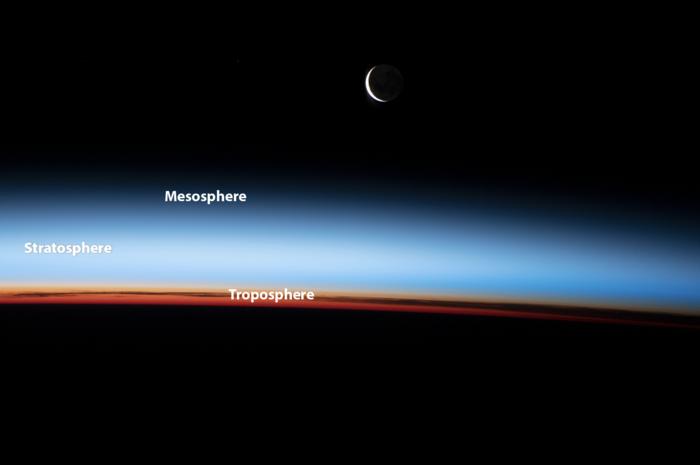
There is something genuinely strange about the upper atmosphere. While Earth’s surface bakes, the stratosphere has been getting colder, shedding roughly two degrees Celsius since the mid-1980s. That number understates it, rather. Without human CO2 emissions, models suggest the cooling would have been perhaps a tenth of that. The gas warming the planet below is, at higher altitudes, acting more like a refrigerator. Scientists have known this for decades. What they could not explain, until now, was the precise mechanism.
A new study from Columbia University’s Lamont-Doherty Earth Observatory, published in Nature Geoscience, has finally closed that gap, working out the actual physics that drive the paradox rather than just describing its broad outlines.
The basic picture, established in Nobel Prize-winning climate models by Syukuro Manabe in the 1960s, goes something like this. In the lower atmosphere, CO2 molecules trap outgoing infrared radiation and send some of it back down toward the surface. That’s the greenhouse effect. In the stratosphere, though, the air is thin enough and the geometry is different enough that CO2 molecules do something else entirely: they absorb infrared energy from below and radiate a good portion of it directly out to space. Add more CO2, and the stratosphere radiates more efficiently. Radiate more efficiently, and the temperature drops. Clean logic, and the observations bear it out. But as Sean Cohen, the postdoctoral researcher who led the work, puts it: “The existing theory was incredibly insightful, but at the moment we lack a quantitative theory for CO2-induced stratospheric cooling.” Known for half a century, and still not properly understood.
The Goldilocks Width
What Cohen and his colleagues Robert Pincus and Lorenzo Polvani actually did was work out the equations from scratch, spending several months building pen-and-paper models, testing them against line-by-line radiative transfer simulations, adjusting the maths, and repeating. The key, it turns out, lies in how CO2 interacts with infrared light at different wavelengths.
Not every wavelength behaves the same way. Some infrared wavelengths pass through CO2 too easily, barely registering. Others are absorbed so completely that they never escape to space from high altitudes. Between those extremes sits a zone the researchers call the “Goldilocks width” (their terminology, and rather apt): wavelengths that are neither too transparent nor too opaque, that sit at just the right optical depth to radiate energy out to space from wherever the molecule happens to be sitting. It is this population of wavelengths that does most of the cooling work.
The critical finding is what happens to that Goldilocks zone as CO2 concentrations rise. At lower pressures in the upper stratosphere, where the air is thinner, more and more wavelengths are drawn into the efficient-emission range. The Goldilocks width expands. More CO2 means a broader window of wavelengths contributing to cooling, which means the stratosphere dumps heat to space more readily, which means temperatures fall. “It’s those changes in efficiency that are going to ultimately be what’s driving stratospheric cooling,” Cohen says.
The team also worked out something subtler: ozone and water vapor, which go through similar physics, end up dampening the CO2 cooling effect rather than amplifying it. As the stratosphere cools, these other gases lose some of their own radiating efficiency, partly compensating. Without that damping, the equations suggest, stratospheric cooling would be more than twice as large as observed. It’s a kind of thermal buffer built into the atmosphere.
A Feedback That Strengthens the Greenhouse Effect
There is also a consequence for the surface, and it is not a comfortable one. Stratospheric cooling amplifies the total warming effect of CO2 below. The mechanism involves the temperature contrast between the cooling stratosphere and the warming surface: as that gap widens, CO2’s effective radiative forcing (the net energy imbalance it creates at the top of the atmosphere) grows larger. The Columbia team calculate that stratospheric cooling boosts CO2’s forcing by roughly 40 to 60 percent above what it would otherwise be. Their equations reproduce that number from first principles.
Robert Pincus, a co-author and research professor at Lamont-Doherty, is clear-eyed about what this adds to the climate change picture, or rather what it doesn’t. “This is really telling us what is essential,” he says, meaning the work is less about adding another brick to the wall of evidence for global warming than about finally understanding which physical processes are load-bearing. “Here’s this process that we’ve known about for 50-plus years, and we had a pretty decent qualitative understanding of how it worked. However, we didn’t understand the details of what actually drove that process mechanistically,” Cohen says.
That distinction matters more than it might seem. Quantitative theories are more useful than qualitative ones for obvious reasons: they let you make predictions you can test, and they tell you which variables to pay attention to when the predictions don’t quite work. This one also, the team points out, implies something about the uniqueness of Earth’s situation. Stratospheric cooling driven by CO2 is not, it turns out, a universal property of greenhouse gases in general. It depends specifically on CO2’s particular spectroscopic fingerprint, the precise way its molecules absorb and emit radiation across the infrared spectrum. A different gas with different spectroscopy might warm a stratosphere rather than cool it.
Beyond Earth
Which opens up a question that ranges considerably further than Earth’s climate policy. The same framework might let researchers model the thermal structure of atmospheres elsewhere in the solar system, or around exoplanets, where direct measurement is all but impossible. “Maybe we can better understand what’s going on in the stratospheres of other planets in our solar system or exoplanets,” Cohen says. The equations derived from Earth’s atmosphere are, in principle, portable.
For now, though, the more immediate value is here at home. Climate scientists use stratospheric cooling as a fingerprint of human influence, a signal that cuts through the noise of natural variability precisely because it is so clearly tied to rising CO2 rather than the sun or volcanic eruptions or shifts in ocean circulation. Until this paper, researchers working with that fingerprint were, in a sense, relying on a thermometer they couldn’t fully explain. The mechanism is somewhat better understood now.
https://doi.org/10.1038/s41561-026-01965-8
Frequently Asked Questions
Why does CO2 cool the stratosphere if it warms the surface?
The difference comes down to atmospheric density and geometry. In the lower atmosphere, CO2 traps outgoing heat and bounces some of it back toward the surface. Higher up in the stratosphere, where air is much thinner, CO2 molecules instead radiate energy directly out to space. Add more CO2, and that radiative cooling becomes more efficient, dropping temperatures. The new Columbia study explains for the first time exactly which spectral properties of CO2 drive this effect and why the cooling is strongest at higher altitudes.
Does a cooling stratosphere make surface warming worse?
Yes, and by a substantial margin. As the stratosphere cools, the temperature contrast between it and the warmer surface below increases, which amplifies the energy imbalance CO2 creates at the top of the atmosphere. The Columbia team calculate this “stratospheric adjustment” boosts CO2’s effective warming force by around 40 to 60 percent compared with what it would be if the stratosphere stayed at the same temperature. It is one reason why climate sensitivity estimates need to account for stratospheric changes, not just surface responses.
Why did it take so long to work out the mechanism?
The cooling has been observed since at least the 1980s and was predicted by Manabe’s models decades before that, but existing theoretical frameworks used simplified representations of how CO2 absorbs and emits infrared light. Those simplifications were good enough to describe the broad pattern but could not reproduce the specific shape of the cooling: why it is strongest near the top of the stratosphere, why it scales roughly logarithmically with CO2 concentration, or why each doubling produces roughly 8 degrees of cooling at the stratopause. Cracking those three linked puzzles required a more precise model of CO2’s spectroscopy.
Could this research change how scientists detect human fingerprints on the climate?
It reinforces rather than revises the fingerprint, but in a useful way. Stratospheric cooling is already one of the clearest signals distinguishing human-caused warming from natural variability, partly because it cannot be explained by solar changes or volcanic eruptions alone. Having a quantitative theory for the mechanism means scientists can now model the signal more precisely and understand what conditions might weaken or strengthen it, which could sharpen detection efforts particularly in the atmospheres of other planets where direct observation is limited.