

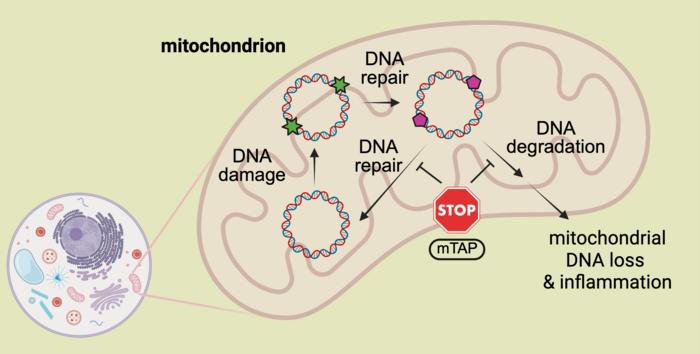
When DNA inside a cell’s mitochondria gets damaged, it often doesn’t get repaired—it gets destroyed. That degradation can trigger inflammation and contribute to diseases from Alzheimer’s to heart failure. Now, researchers at the University of California, Riverside have developed a targeted chemical probe that intercepts this loss before it starts, preserving mitochondrial DNA (mtDNA) and potentially preventing disease.
A strategy to protect DNA, not fix it
Published in Angewandte Chemie International Edition, the study introduces mTAP, a molecule that binds specifically to damaged sites—called abasic or AP sites—in mitochondrial DNA. These lesions are common, but when they accumulate, cells often degrade the entire DNA molecule rather than fix it.
Instead of patching the damage, mTAP binds to the AP sites and blocks the enzymes that would normally chop up the DNA. This protection helps keep mitochondrial DNA intact without interfering with its ability to function.
Cells treated with mTAP maintained higher levels of mtDNA even after exposure to stressors such as nitrosamines, common pollutants found in food and cigarette smoke. Researchers observed that the preserved mtDNA remained capable of supporting essential functions like transcription and replication.
How the molecule works
The success of mTAP lies in its two-part design: one part detects and reacts with abasic sites, forming a stable chemical bond, while another part delivers the probe directly to the mitochondria. This targeted delivery avoids interference with nuclear DNA.
Anal Jana, a postdoctoral fellow and lead author of the study, designed the probe using chemical synthesis techniques tailored to work specifically with mitochondrial biology studied in the Zhao lab.
Key findings from the study
- mTAP formed stable oxime bonds with mitochondrial AP sites, blocking DNA-degrading enzymes like APE1
- No detectable reaction occurred with nuclear DNA, confirming organelle specificity
- Cells treated with mTAP had fewer signs of mitochondrial DNA damage and maintained gene expression
- Even at high concentrations, the molecule did not interfere with mtDNA replication
- mTAP outperformed existing AP-reactive probes in speed and stability under physiological conditions
What this could mean for chronic disease
Loss of mitochondrial DNA is increasingly linked to diseases like diabetes, inflammatory bowel disease, and neurodegeneration. When fragments of mtDNA leak into the cell, they can trigger immune responses that promote chronic inflammation.
Linlin Zhao, the chemistry professor who led the research, noted that degradation happens more frequently than repair in mitochondria. The team’s approach aims to stop the loss before it causes further harm.
Even with a bulky chemical attached, the preserved DNA was still functional. That surprised the researchers and opened the door for potential therapeutic applications that involve preventing—not just repairing—DNA damage.
A chemical way to change the conversation
The probe’s ability to selectively stabilize mtDNA represents a shift in thinking. Rather than fighting damage with biological tools alone, this strategy uses chemistry to intervene before degradation can occur. It’s a move from damage response to damage prevention.
While more studies are needed before clinical applications, the research lays important groundwork. As Zhao put it, this represents a new way to defend the genome under stress.