

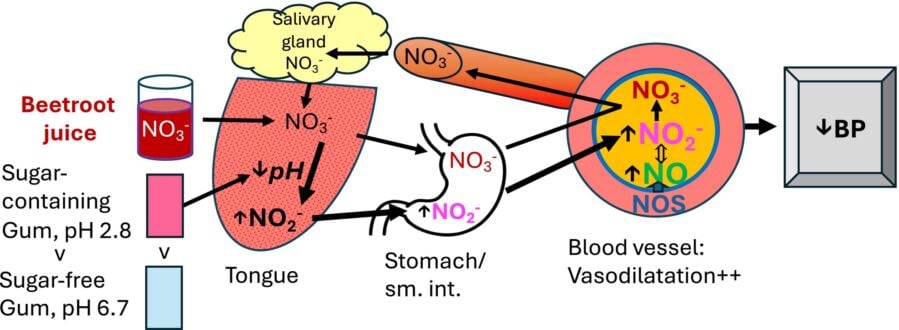
On the tongue of every person reading this sits a small chemical factory, staffed by bacteria, that turns the nitrate in your dinner into something your blood vessels can actually use. Those microbes need the right conditions to work. And a team at King’s College London has now shown that one of the cheapest, oddest ways to nudge them along is to chew a wad of strawberry Hubba Bubba. Sugary gum, of all things, made the conversion run faster and the volunteers’ blood pressure tick downward.
The effect was small but real, and it landed in a place nobody had quite looked before: the whole living body, measured over hours rather than minutes in a test tube. That distinction turns out to matter enormously.
Here is the chemistry, stripped down. Leafy greens and beetroot are loaded with inorganic nitrate, absorbed from the soil. Swallow it, and a good chunk gets concentrated back into your saliva, where bacteria living on the back of the tongue reduce it to nitrite. Nitrite is the useful currency: once it slips into the bloodstream it converts further into nitric oxide, which relaxes and widens blood vessels so blood flows more easily. No mouth bacteria, no nitrite, no benefit. Rinse with antiseptic mouthwash before a nitrate meal and the blood-pressure drop simply vanishes.
So the question Andrew Webb and his colleagues kept circling was deceptively basic. What conditions make those bacteria better at their job?
Acidity, they suspected. The pH of your saliva shifts throughout the day, and the lab literature had a fairly settled answer about which way it pushed nitrate reduction. Trouble is, that answer came almost entirely from isolated experiments, nitrate incubated in buffered solutions, or brief mouth rinses, none of which involve swallowing, absorption, or the slow loop the researchers call the enterosalivary circulation.
“Whether and how the acidity of the saliva in the mouth impacts the conversion of the inactive nitrate, to the more active nitrite, is a fundamental question, as it impacts a range of important physiological functions including blood pressure,” said Webb, a clinical senior lecturer at King’s. “However, this process has not been studied much.”
A grapefruit clue, run backwards
The hunch had a backstory. In an earlier study Webb’s group had paired beetroot juice with grapefruit juice and, somewhat to their surprise, watched the benefit shrink: the grapefruit nudged saliva less acidic, and nitrite production fell. Which suggested an obvious experiment in reverse. If raising the pH dulled the effect, would dropping it sharpen the effect? They needed something reliably, almost aggressively acidic that people would tolerate keeping in their mouths for hours. Sugar-containing bubble gum, with a pH below 3, fit the bill. The logic, as Webb put it, was simply to test the reverse: if raising acidity hurt the conversion, would lowering it help?
Fourteen healthy volunteers, mostly in their early twenties, came in twice. Each time they downed a 70-millilitre shot of concentrated beetroot juice (roughly 400 mg of nitrate) and then chewed near-continuously for hours, swapping in a fresh piece every 20 to 30 minutes. On one visit it was sugary Hubba Bubba; on the other, sugar-free Wrigley’s Extra. Blood, saliva and blood pressure were sampled throughout, the kind of fiddly, drool-into-a-tube protocol that makes you grateful for paid volunteers.
Small numbers, clear direction
The sugary gum dragged salivary pH down by about 1.4 points. Salivary nitrite production jumped 45 per cent; nitrite circulating in the blood rose 25 per cent, peaking around the two-and-a-half-hour mark. And blood pressure fell by roughly 3 over 2 mmHg compared with the sugar-free control. Modest, yes. But for context, that is the sort of shift you would happily take from a dietary tweak, and it points the mechanism in a direction the test-tube studies had got backwards. Lower the pH inside an actual functioning person, and the bacteria work harder, not less.
Charlotte Mills of the University of Reading, a co-author, put the microbial side plainly. “The bacteria that live in our mouths play a critical role in converting nitrate from foods such as beetroot into beneficial compounds that help relax blood vessels and lower blood pressure,” she said. “Our findings suggest that the presence of sugar may create a more favourable environment for this process.”
Now for the inevitable cold water. Nobody on the team wants you reaching for the sweet jar. The effect faded within hours; chronic sugar is plainly terrible for teeth and worse for the metabolic conditions that often travel with high blood pressure in the first place. “We are certainly not suggesting that people should start chewing sugary gum regularly,” Mills said. The gum was a probe, a way to wrench salivary pH in a known direction and watch what happened, not a prescription.
There is also a worth-noting wrinkle in the framing: Webb holds shares in the company that takes a royalty on the beetroot juice brand used in the study. The result stands on its own data, but it’s the sort of disclosure that belongs out in the open. The volunteers were young and healthy too, so reading anything across to people who actually have hypertension is, for now, guesswork dressed as hypothesis.
Where this gets genuinely interesting is the next move. If pH is the lever, the trick is to find a tooth-friendly, metabolically harmless way to pull it, something that mimics the acid hit without the sugar. Athletes are the obvious early beneficiaries: beetroot is already a staple sports supplement, and squeezing more nitrite out of the same dose is free performance. Webb’s group wants a larger trial built around sportspeople next, chasing both the pressure drop and the edge on the track. Mills framed the puzzle as the one now worth solving: “The challenge now is to identify alternative strategies that are both effective and appropriate for long-term use.”
For the rest of us, there’s another implication tucked inside an old habit. A salad starter, then a main heavy on greens, finished with something sweet, possibly just fruit. The traditional shape of a meal, it turns out, may have been tuning your blood vessels all along.
https://doi.org/10.1002/bcp.70640
Frequently Asked Questions
Why would sugar, of all things, help lower blood pressure here?
It isn’t the sugar’s calories or sweetness doing the work, but its acidity. Sugary gum drops the pH of your saliva, and in this study that more acidic environment helped tongue bacteria convert nitrate from beetroot into nitrite more efficiently. More nitrite means more nitric oxide in the blood, which relaxes vessels and eases pressure.
Is it true that lab studies found the opposite effect?
Yes, and that is the heart of why this result matters. Isolated experiments using buffered nitrate solutions or brief mouth rinses suggested higher pH boosted nitrate reduction. This is the first study to test pH across the whole body over several hours, and it found the reverse, which suggests the simplified lab models were missing something real.
Should I actually start chewing sugary gum after meals?
The researchers are firmly against it. The blood-pressure dip lasted only a few hours, while regular sugar exposure damages teeth and harms the metabolic health of exactly the people most likely to have high blood pressure. The gum was a research tool, not a recommendation.
Could athletes get something useful out of this?
Quite possibly. Beetroot is already a well-established sports supplement, and getting more nitrite from the same dose could translate into a performance edge. The team wants to run a larger trial focused on sportspeople to test whether the salivary-pH trick boosts exercise as well as it nudges blood pressure.
