For 59 days before the encounter, the asteroid would not hold still. Lucy’s long-range camera kept watching this faint smudge of reflected light from millions of kilometres out, and the brightness rose and fell the way it should for a rotating lump of rock, except the pattern never quite repeated. One period of about 253 hours, fine. But buried underneath sat a second rhythm, roughly 455 hours, the two beating against each other so the light curve refused to close into a clean loop. That is not how a simple spinning body behaves. That is the signature of something tumbling.
The body in question is (52246) Donaldjohanson, an 8.8-kilometre asteroid in the inner main belt, and on 20 April 2025 NASA’s Lucy spacecraft swept past it at 13.4 kilometres a second, closing to within about 961 kilometres before the team cut the observations short. They had to: thirty-one seconds before closest approach, continuing to track the rock would have swung the instruments toward the Sun. So Lucy got the inbound leg only, a single sunlit hemisphere, and that was enough to reconstruct a strange little world. Simone Marchi at the Southwest Research Institute and a cast of more than fifty colleagues have now laid out what they saw, and the picture is of an asteroid that has been worked over, slowed down and gently knocked off its axis across roughly 155 million years.
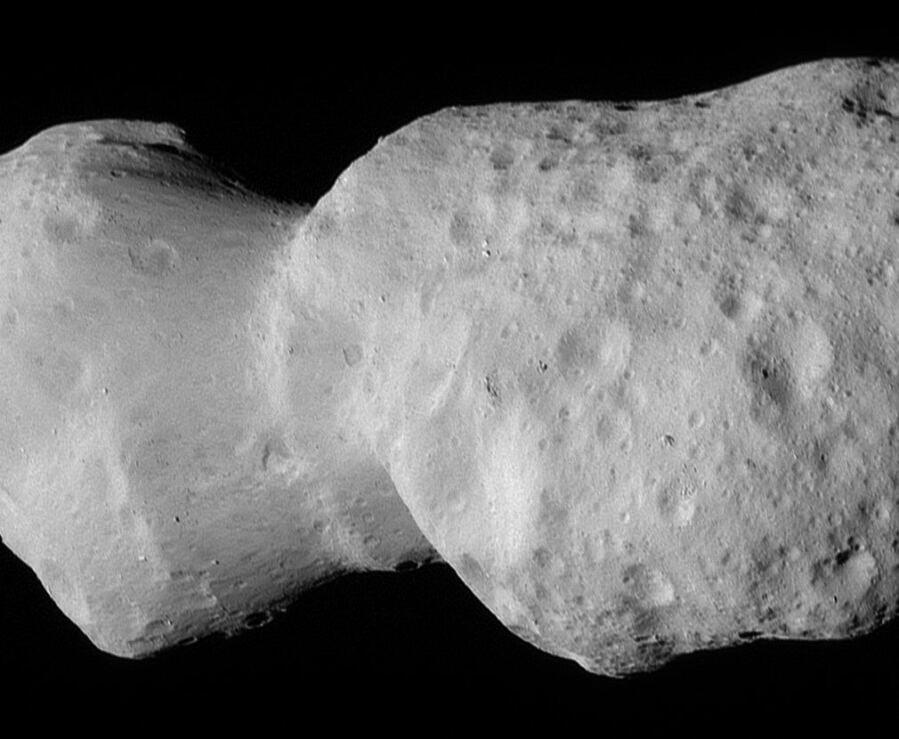
Donaldjohanson, named for the paleoanthropologist who in 1974 dug Lucy the hominin fossil out of the Ethiopian ground, turns out to look a bit like a peanut. Two heavily cratered lobes, one larger than the other, joined by a smoother neck. Contact binaries (two bodies that have drifted together and stuck) are not new in the asteroid catalogue, but the neck here is doing something interesting. It is far smoother than the lobes, and its slopes run at a fairly uniform 25 degrees, the kind of angle you get when loose rubble has slumped downhill and settled.
A Surface That Keeps Tidying Itself
Count the craters and the oddities pile up. Across the big lobe, craters larger than about 0.4 kilometres sit at the density you would expect for a surface this age, a piece broken off the Erigone family’s parent body when a roughly 20-kilometre rock smashed an 80-kilometre one to bits around 155 million years ago. But go smaller, below 0.4 kilometres, and the craters thin out. They have been preferentially erased, wiped from the record faster than they were made. Marchi’s team work the numbers and conclude that something resurfaced the small craters well within the last 40 million years, long after the asteroid itself formed.
What does that to a rock floating in vacuum? The leading suspect is a good hard knock. A later impact somewhere on the body could have sent seismic waves rattling through it, shaking the rims and walls of the smallest craters until they slumped into invisibility, the way a sharp tap settles sand in a jar. The degraded craters clustered on the neck hint that material has shifted there more recently still, perhaps within 20 million years, loose debris creeping downslope and softening every sharp edge it crosses.
Here is the part that complicates the easy story. You might expect a small carbonaceous asteroid to be a rubble pile, a loose heap of gravel barely held together, like the well-studied Bennu and Ryugu. Donaldjohanson does not seem to be. Its craters imply a surface considerably stronger than those two, strong enough that it probably is not the same shattered, barely bound interior. It is several times larger than Bennu, which may be the whole point: bigger bodies can hold themselves together in ways the little ones cannot.
Slowed by Its Own Shadow
Then there is the tumble. Donaldjohanson rotates ploddingly, once every ten-or-so Earth days, and not around a fixed axis but in the wobbling, precessing motion physicists call non-principal-axis rotation. The asteroid Toutatis does much the same. The natural question is how a body gets into such a state and, more puzzlingly, stays there, because the team calculate it would take something like 20 billion years for Donaldjohanson to relax back into a tidy spin. That is longer than the age of the Solar System. Whatever set it tumbling, the tumble is effectively permanent.
The culprit appears to be sunlight. Absorb a photon on your warm afternoon side, re-radiate it as heat a little later as you turn, and you feel a feather-light push. Over millions of years those pushes add up. This is the YORP effect, and on Donaldjohanson it seems to have done two things at once: dragged the spin period out from something under ten hours at birth to its current crawl, and tipped the spin axis until it sits almost perpendicular to the orbit. Slow a top down far enough and its motion gets sloppy. The reconstruction the team favour has the asteroid spinning fast and clean at first, its neck slopes failing as it slowed and shed material onto the lobes, then drifting into the excited tumble it shows today, all driven by the steady torque of reflected and re-emitted light.
The spectra fill in the asteroid’s deeper past. Donaldjohanson’s surface carries iron-bearing phyllosilicates, clay minerals that form when rock meets liquid water, which means the parent body was wet enough, once, for water to start rebuilding its minerals. But only start. On Bennu and Ryugu that alteration ran further, swapping iron for magnesium and erasing the telltale absorption bands; here the reaction stalled early, as though the parent ran short of water or heat before the job was done. Two carbonaceous bodies in the same neighbourhood, then, with quite different watery histories, which suggests their parents formed in different places or at different times before settling into today’s orbits.
None of this would be readable on an old asteroid, where billions of years would have smeared every clock. Donaldjohanson is young, a fragment with a known birthday, and that is what makes it such a useful test case: the same processes thought to shape Bennu, Ryugu and Toutatis, caught here with the timestamps still legible. Lucy, meanwhile, has barely started. Donaldjohanson was a warm-up, a target of opportunity on the way to the main event, and the spacecraft now coasts toward the Trojan asteroids that share Jupiter’s orbit, where the real quarry of this twelve-year tour is waiting.
Frequently Asked Questions
Why does it matter that an asteroid is tumbling rather than simply spinning?
The way a small body rotates is a record of its history. A tumble that should take 20 billion years to settle tells researchers the asteroid was pushed into that state and will stay there, and it points to sunlight, through the YORP effect, as a force strong enough over millions of years to reshape how whole asteroids move.
How can sunlight possibly slow down an asteroid?
An asteroid absorbs sunlight on its warmer side and radiates that heat away as it rotates, and each tiny release of energy gives a faint push. Individually these are negligible, but acting steadily over tens of millions of years they can drag a spin period from hours to days and tilt the rotation axis, which is what seems to have happened here.
Is Donaldjohanson a loose rubble pile like Bennu and Ryugu?
Probably not. The pattern of craters on its surface implies a material strength well above that of Bennu or Ryugu, so its interior is likely less of a barely bound gravel heap. Being several times larger may be why it can hold itself together more firmly.
What happened to all the small craters?
Craters smaller than about 0.4 kilometres are scarcer than they should be, which the team read as evidence they were erased within the last 40 million years. The favoured explanation is seismic shaking from a later impact, jolting the surface hard enough to slump the smallest craters out of existence.
Why is the asteroid named Donaldjohanson?
It honours Donald Johanson, the paleoanthropologist who discovered the famous hominin fossil Lucy in 1974. The Lucy spacecraft is named for the same fossil, so the flyby paired the namesake asteroid with its namesake mission.