


Heat storage materials have a fundamental problem: they leak. When phase change materials absorb energy by melting, they tend to flow out of their containers, fouling equipment and degrading performance. That simple physics has limited their use in everything from temperature-regulating buildings to solar energy systems. A new approach uses carbon made from crustacean shells to trap the liquid in place while improving how quickly heat moves through the material.
Researchers at Shenyang Agricultural University report that a carbon aerogel derived from chitin can stabilize stearic acid, a widely studied organic phase change material, preventing leakage during melting while maintaining high heat storage capacity. The work, published December 29 in Sustainable Carbon Materials, turns seafood processing waste into a durable thermal energy storage component.
Pores and nitrogen keep the liquid locked
Chitin is a structural polymer found in crab shells, shrimp shells, and fungal cell walls. It is abundant, renewable, and naturally rich in nitrogen. The team dissolved chitin in sodium hydroxide and urea, then freeze-dried the solution to create an ultralight aerogel. That aerogel was carbonized at controlled temperatures, producing a porous framework with interconnected cavities ranging from nanometers to several micrometers.
When molten stearic acid is infused into this carbon structure, capillary forces within the pores physically hold the liquid in place. Nitrogen-doped sites on the carbon surface form hydrogen bonds with stearic acid molecules, anchoring them chemically. The combination prevents flow even when the material is heated above the melting point.
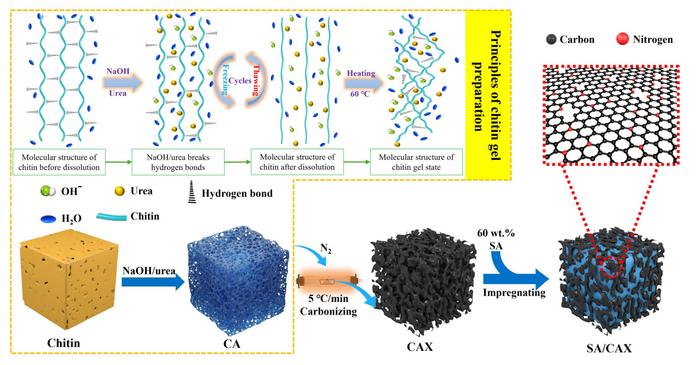
The composite held 60 percent stearic acid by weight with no visible leakage. Thermal measurements showed a melting enthalpy of about 118 joules per gram, higher than many previously reported biomass-derived phase change composites. Thermal conductivity improved by 61 percent compared with pure stearic acid, meaning the material can absorb and release heat more quickly.
“Our goal was to design a low-cost and environmentally friendly support that can hold large amounts of phase change material without leakage,” corresponding author Hui Li explains. “Chitin is abundant, renewable, and naturally rich in nitrogen, which makes it especially attractive for this purpose.”
100 cycles without degradation
After 100 heating and cooling cycles, the material retained more than 97 percent of its original heat storage capacity. The phase change temperature remained essentially unchanged, and structural analyses showed no chemical degradation or breakdown of the carbon framework. The carbon aerogel increased the activation energy required for stearic acid to melt and solidify, a sign of enhanced thermal stability arising from nanoscale confinement and hydrogen bonding.
Because chitin can be sourced from seafood processing waste, the approach offers a route to convert biological byproducts into energy storage materials. The same strategy could be adapted for other phase change materials and tuned for different temperature ranges depending on application needs. Phase change materials store and release energy by melting and solidifying at specific temperatures, making them candidates for building temperature regulation, solar energy storage, and electronic thermal management.
The work suggests that combining natural polymers with engineered carbon structures may address energy efficiency challenges while reducing dependence on fossil-derived materials. Chitin’s nitrogen content, once a chemical footnote, becomes a functional advantage when the material is carbonized and deployed as a thermal storage scaffold.