

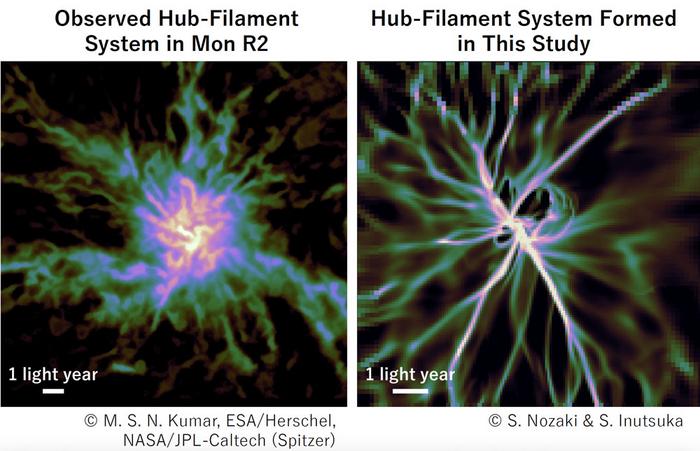
Point a submillimetre telescope at almost any region of active star formation and you’ll notice the same odd geometry. Gas doesn’t collapse inward uniformly, the way you might expect if gravity were simply pulling a cloud together. Instead it organizes itself into spokes, long narrow filaments of dense gas radiating toward a bright central knot like the frame of a wheel without a rim. Astronomers have catalogued these structures in region after region: Mon R2, various high-mass protoclusters, low-mass nurseries scattered across the galaxy. They called them hub-filament systems. And for years, nobody could quite work out how they got that way.
A new study from Kyushu and Nagoya universities now offers what might be the clearest explanation yet, one that implicates an unlikely sculptor: the death of a previous generation of stars.
The research, published in March in The Astrophysical Journal Letters, used three-dimensional magnetohydrodynamic simulations to model what happens when a fast-moving shockwave slams into a molecular cloud that already has a particular magnetic field shape. The field matters a lot here. Real molecular clouds aren’t threaded by neat, parallel field lines; gravity pulls the field inward at the cloud’s denser center, bending it into something like an hourglass. When a shock arrives and hits this curved geometry, the interaction is anything but uniform. Different parts of the field meet the incoming wave at different angles, producing what physicists call oblique shocks: angled collisions that redirect compressed gas and amplify the tangential component of the magnetic field, creating invisible channels along which dense material is then funnelled inward.
The result, in simulation, looks remarkably like what astronomers actually observe.
The filaments that emerge are roughly 1 to 3 parsecs long (a parsec being about 3.26 light years) and perhaps 0.07 parsecs wide, consistent with measurements from Herschel and other observatories. More telling is the kinematics. Dense gas within the filaments moves steadily inward, accelerating as it approaches the hub, reaching speeds of perhaps 1 to 4 kilometres per second near the center; the diffuse gas between filaments barely moves at all. Mass isn’t flowing into the hub from every direction equally, in other words. It’s being piped there, selectively, through the dense spokes. That distinction matters: it probably explains why star formation is such an inefficient business, converting only a few percent of a cloud’s mass into actual stars. The simulation returns a star formation efficiency of around 4 percent, which is about what nearby molecular clouds show in observations.
Stars are born inside molecular clouds, Shingo Nozaki explains, vast and cold and adrift in space. Nozaki is a doctoral student at Kyushu University’s Graduate School of Sciences and a Research Fellow of the Japan Society for the Promotion of Science. “But they only form in the coldest and densest parts of those stellar nurseries, where gas can collapse under its own gravity. In some of these star-forming regions, gas is organized into characteristic hub-and-spoke patterns known as Hub-Filament Systems (HFS).”
The idea that shocks might be responsible for shaping these systems isn’t entirely new. Earlier work showed that a shock propagating perpendicular to a uniform magnetic field can generate complex filamentary structures, though disordered ones rather than radially aligned. What Nozaki and his Nagoya University collaborator Shu-ichiro Inutsuka found is that the geometry of the pre-existing field is what makes the difference. The hourglass shape, induced by the cloud’s own gravity before any shock arrives, is the thing that imposes order on what would otherwise be chaos.
There’s also a secondary mechanism at work, something the simulations reveal in the cross-sectional slices of the forming filaments. The shock doesn’t hit a perfectly smooth cloud; weak turbulence has already introduced small density variations throughout. When the wave strikes these corrugations, it amplifies them through a process resembling what’s known as Richtmyer-Meshkov instability (a phenomenon also familiar from inertial confinement fusion research, where shocks hit imperfect surfaces). The density ridges grow; gas accumulates along them; separate filaments form. The oblique-shock mechanism and the instability work together, one imposing radial order, the other generating the multiplicity, the many spokes rather than just one.
The team tested what happens when the shock arrives at an angle to the magnetic field rather than head-on. Radial alignment still develops at 15 degrees off-axis, and even at 30 degrees the tendency is preserved, just asymmetric. Given that the probability of a shock arriving within 30 degrees of the field axis is roughly 13 percent for any given geometry, the mechanism doesn’t require implausible precision.
The simulations were run on ATERUI III, an astronomy-dedicated supercomputer at the National Astronomical Observatory of Japan. The next steps involve systematically varying shock strength, direction, and cloud properties to map how different environments produce different hub-filament architectures. More massive clouds, stronger shocks, different initial density profiles: each should produce something distinct, and the goal is eventually to connect those differences to the range of massive stars and star clusters that observations actually reveal.
As for where the shocks come from, the two candidates are both violent endpoints of stellar evolution. Expanding bubbles driven by radiation from newly formed massive stars can sweep out into surrounding molecular gas. Supernova remnants, the explosive debris of stars that have run out of fuel entirely, can do the same thing more dramatically. “There are two main sources of these shock waves: radiation-driven ‘bubbles’ from newly formed massive stars, and expanding supernova remnants formed when a massive star reaches the end of its life,” says Nozaki. “There is something almost like a life cycle in this. What a star leaves behind can go on to shape the next cradle of stars.”
It’s a kind of galactic inheritance: the death of one stellar generation arranging the conditions for the birth of another, not randomly but in a specific geometry that determines where mass concentrates, how efficiently it forms new suns, and perhaps something about what kind of stars emerge. Whether this mechanism operates across a wide range of cloud masses, and how it interacts with other processes known to influence star formation, is something the models can’t yet fully address. But the spokes now have an explanation. The wheel, it turns out, is built by a shockwave.
https://doi.org/10.3847/2041-8213/ae4c84
Frequently Asked Questions
Why do stars form in these spoke-like patterns rather than just collapsing uniformly?
The short answer is magnetic fields. Molecular clouds are threaded by magnetic field lines that bend inward under gravity, forming an hourglass shape. When a shockwave strikes this curved geometry, compressed gas gets redirected along the field lines rather than flowing uniformly, channelling material into discrete spokes converging on a central hub. The result is that mass accretion is selective: dense filament gas funnels inward rapidly while the gas between filaments barely moves.
What actually triggers the shockwave that sets all this in motion?
Two main culprits, both products of stellar death. Radiation from newly formed massive stars can drive expanding bubbles outward into surrounding molecular gas. Supernovae, the explosive endpoint of massive stellar evolution, generate even more powerful remnant shockwaves that can travel parsecs through the interstellar medium. The implication is that new star formation is partly a downstream consequence of old stars dying, a generational cycle baked into galactic structure.
Is a 4 percent star formation efficiency really that low?
It sounds low, but it matches what astronomers actually measure in nearby star-forming regions, and the new simulations offer a reason why the number stays so modest. The kinematic segregation between dense and diffuse gas limits how quickly mass can reach the central hub, essentially throttling the rate of collapse. Most of the cloud’s gas never makes it into a star at all, which is why stellar nurseries are far more gas than stars.
Could astronomers use this to predict what kind of stars will form in a given cloud?
That’s the direction the research is heading. The team plans to vary shock strength, cloud density, and field geometry systematically to see how different initial conditions produce different hub-filament architectures. If those differences can be mapped to particular outcomes, such as whether the hub collapses into one massive star or a cluster of smaller ones, the simulations could eventually inform how we interpret real observations and predict stellar populations.
Does the magnetic field geometry have to be perfect for this to work?
No, and that’s one of the more reassuring results. The radial alignment of filaments persists even when the shock arrives at up to 30 degrees off the main field axis, and the probability of finding a shock within that angle range is roughly 1 in 8 for any given cloud orientation. The mechanism is robust enough to operate across a wide range of conditions, which helps explain why hub-filament systems are observed so commonly across different star-forming regions.