

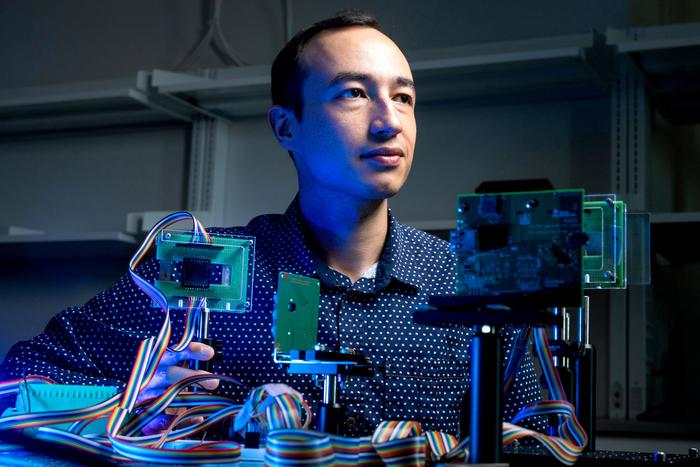
Think lighthouse, not laser. In a study out of Rice University, researchers show that carefully randomized radio waves can help next-generation wireless devices find each other almost instantly at terahertz frequencies, with angle estimates finer than one tenth of a degree.
The promise of 6G rests on higher frequencies that carry far more data, but those same signals fade fast and need tight, line-of-sight alignment. The Rice-led team and collaborators at Los Alamos, Sandia, and Brown report a pragmatic workaround: generate wave patterns that are both fast-changing and frequency-diverse, then let receivers match the incoming pattern to a prerecorded library to pinpoint the transmitter’s direction. The result, according to their experiments, is order-of-magnitude better precision than conventional approaches, delivered in picoseconds-scale patterning windows.
At the heart of the demo is a thin, electronically tunable metasurface. When a broadband signal hits this engineered sheet, it scatters into a distinct, direction-dependent fingerprint. Because the pattern also varies across time and frequency, each direction produces a rich signature that a receiver can compare against a codebook to estimate angle of departure. In tests spanning roughly 127 to 152 GHz, the system reached mean absolute errors below 0.1 degrees using a simple least-squares matching step.
“The method we introduce in our paper unlocks extremely rapid angle estimation with unprecedented accuracy.”
That claim comes from first author Burak Bilgin, who frames the physics with a concrete image: a lighthouse broadcasting many colors, randomized in intensity. Ships on the water, by measuring which colors and how strongly they arrive, can deduce their exact bearing. The team’s twist is to make that rainbow change with time as well as across frequencies. Even if the channel is noisy or bandwidth is constrained, repeated, brief measurements using new randomized patterns quickly drive down error, offering a tunable latency-accuracy tradeoff.
Why Random Beats Deterministic At Terahertz
Classical millimeter and terahertz localization often leans on smoothly varying beams, such as leaky-wave antennas that sweep angle with frequency. Those are elegant, but the correlations between nearby angles limit precision, and taking multiple measurements does not help much because the pattern is fixed. By contrast, low-coherence wavefronts intentionally scramble the angular response. When those scrambled responses are also decorrelated across frequency bands and across short time windows, the codebook grows in discriminative power without adding heavy computation at the receiver.
There is a practical engineering benefit too. Real metasurfaces rarely achieve full 2π phase control; the device here tops out around 50 degrees of phase swing in the D band, which would ordinarily slow the decay of angular correlation and cap precision. The team sidesteps that limitation by stacking diversity in frequency and time. In other words, they do not need a perfect modulator to get remarkable localization, they need a smart way to exploit the imperfect one.
To stress-test the idea, the researchers evaluated performance across bandwidth and noise levels. With just two frequency components, errors were large. But as the codebook expanded to include dozens of distinct frequency samples, errors plummeted toward 0.03 degrees, and multi-shot operation gave further gains under low signal-to-noise ratios. The approach remained line-of-sight by design, a realistic assumption as systems push beyond 100 GHz and obstacles attenuate heavily.
From Sensing To Joint Communication And Sensing
The broader vision is appealing: a single reconfigurable aperture that can both communicate and sense. Because the metasurface patterns are repeatable, devices can share or learn codebooks and then bootstrap near-instantaneous links that also reveal geometry. That opens doors to untethered VR headsets that never lose alignment, centimeter-scale robotic swarms that coordinate at high data rates, and mobile networks that recover connections in the blink of an eye after blockage.
“Returning to the lighthouse analogy, our work is the first to have both multicolor and time-varying transmission.”
I appreciate the modest caveats the authors include. Left-right symmetries from the aperture can subtly confuse the estimator at very low SNR, packaging and apodization matter, and today’s device is one-dimensional in its tunable axis. Yet none of that blunts the central takeaway: engineered randomness can be a feature, not a bug, when you need both speed and precision. As data hunger grows, the physics of the signal will increasingly shape what networks can do, and inventions like this turn that constraint into an advantage.
Funding came from Cisco, Intel, the U.S. National Science Foundation, the Army Research Office, and the U.S. Department of Energy through Los Alamos and Sandia National Laboratories. The content, as the release notes, remains the authors’ responsibility.