

IT LOOKS like a three-dimensional puzzle of a prehistoric giant. Seishiro Tada sits at his desk at the University of Tokyo Museum, Surrounded by 3D-printed fragments of a Triceratops skull. As he pieces together the intricate white plastic shapes of the dinosaur’s snout, he notices something that shouldn’t be there: a strange arrangement of internal canals that defies the standard blueprint of reptilian anatomy. “I remember the basic patterns of reptiles,” Tada says. “But I couldn’t figure out how the organs fit within it”.
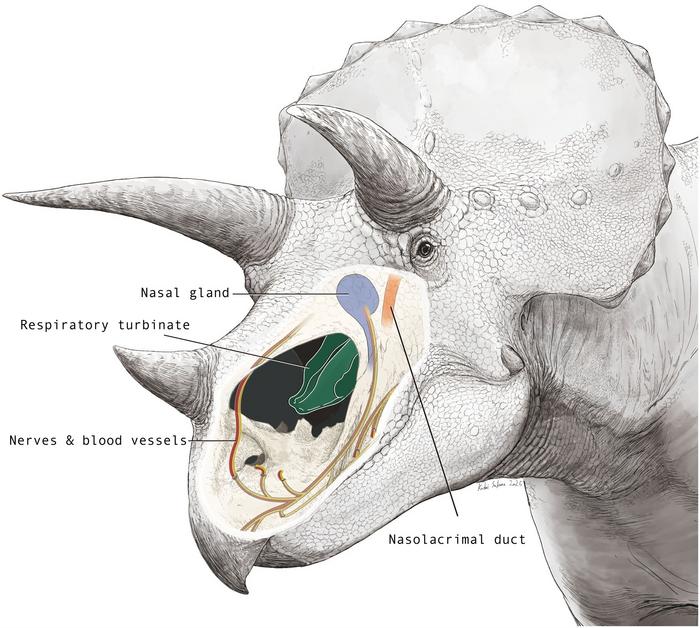
The mystery lies in the cavernous nose of the most iconic of the horned dinosaurs. For over a century, the sheer size of the Triceratops nasal cavity has baffled palaeontologists. While other dinosaurs make do with modest nostrils, the ceratopsids evolved narial openings that take up a huge portion of their massive skulls. Now, by combining high-resolution CT scans of a disarticulated Triceratops premaxilla with a deep dive into the anatomy of modern birds and crocodiles, Tada and his team have provided the first comprehensive map of the soft tissues that once filled that void.
What they found suggests that Triceratops wasn’t just using its nose for smelling. Instead, it seems these dinosaurs had rewired their entire facial anatomy to support a sophisticated internal cooling system. In a typical reptile, the nerves and blood vessels that supply the nostrils take a shortcut from the jaw. But in Triceratops, the unique architecture of the skull creates a literal roadblock. “The skull shape blocks the jaw route,” says Tada, “so nerves and vessels take the nasal branch”.
This anatomical detour was a necessary adaptation for a creature that was essentially a biological tank. As ceratopsids grew larger and their skulls more elaborate—complete with those famous horns and frills—they faced a growing problem: overheating. A massive head with thick bone is difficult to cool down, especially in the humid heat of the Late Cretaceous. The solution was an evolutionary upgrade to the nasal plumbing.
Hidden within the CT scans, the researchers identified a crucial clue: a bony ridge at the back of the nasal cavity. In modern birds, this ridge serves as the anchor for a respiratory turbinate—a thin, curled structure made of cartilage or bone that is covered in a rich layer of blood vessels and moist tissue. As the dinosaur inhaled, these turbinates would have acted as a heat exchanger, cooling the blood before it reached the brain and preventing precious moisture from being lost to the atmosphere.
The presence of these turbinates is a revelation. While they are a standard feature in mammals and birds, they are almost never seen in dinosaurs. Their discovery in Triceratops suggests a level of physiological complexity that we are only just beginning to grasp. “Although we’re not 100 per cent sure Triceratops had a respiratory turbinate,” Tada admits, “some birds have an attachment base for the respiratory turbinate and horned dinosaurs have a similar ridge at the similar location”.
This nasal air conditioner would have been vital for a large-bodied herbivore. We can imagine a Triceratops moving through the ferns, its massive head swinging low. With every breath, the air rushing through those enormous nostrils was being scrubbed of heat and moisture, allowing the animal to maintain a stable internal temperature even as it exerted itself. It is a portrait of a dinosaur that was much more than just a collection of horns and shields; it was a finely tuned machine.
The team’s work has effectively filled one of the last major gaps in our understanding of dinosaur soft-tissue anatomy. By applying the “Extant Phylogenetic Bracket”—a method of inferring the traits of extinct animals by looking at their closest living relatives—they have moved beyond guesswork and into the realm of precise biological reconstruction. It is a process of “piecing together the puzzle,” as Tada puts it, one that requires both the latest technology and a deep respect for the continuity of life.
Yet, the nose is just the beginning. The ceratopsid skull remains one of the most complex structures in the history of vertebrate evolution. Behind the snout lies the frill, a massive expanse of bone that has been variously interpreted as a radiator, a shield, or a flamboyant display for attracting mates. Now that the team has mapped the internal “wiring” of the nose, they are turning their attention to these other regions.
“Next, I would like to tackle questions around the anatomy and function of other regions of their skulls like their characteristic frills,” says Tada. The goal is a complete, three-dimensional understanding of how these animals functioned as living, breathing entities. Each discovery brings us closer to a version of the past that is less about static fossils and more about the dynamic reality of prehistoric life.
For now, the image of the “big-nosed” Triceratops stands as a reminder of how evolution often finds ingenious solutions to the problems of scale. As we look at those iconic three-horned faces, we can now see past the bone to the complex network of vessels and tissues that kept them cool in a warming world. The prehistoric puzzle is nearly complete, but the more we learn, the more we realize just how remarkable these “nosy” giants truly were.
Study link: https://anatomypubs.onlinelibrary.wiley.com/doi/10.1002/ar.70150