

GEN-ICHIRO ARIMURA is staring at a series of illuminated plots in his lab at the Tokyo University of Science, and the numbers are doing something extraordinary. For years, the world of nutrition science has been haunted by a nagging skepticism: we know that the “Mediterranean diet” or the spice-heavy cuisines of Southeast Asia are healthy, but when we test their individual components in the lab, the results are often underwhelming. You would have to eat an impossible mountain of turmeric or mint to see the anti-inflammatory effects observed in a petri dish.
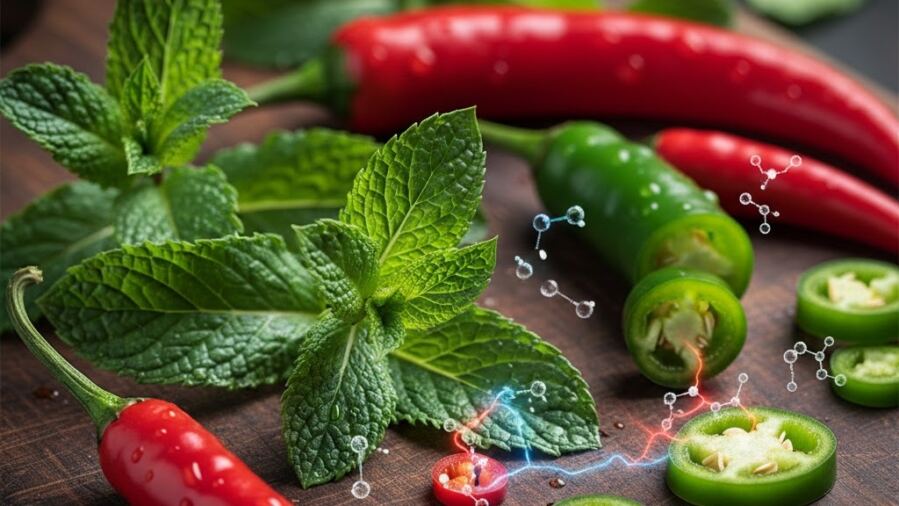
But Arimura and his team have just found a missing link. It isn’t about one “superfood”; it’s about the hidden conversations happening between them. When they combined capsaicin—the heat from chili peppers—with menthol from mint, the results didn’t just add up. They multiplied.
“When capsaicin and menthol or 1,8-cineole were used together, their anti-inflammatory effect increased several hundred-fold compared to when each compound was used alone,” says Arimura. Specifically, the combination with menthol slashed the amount of the compound needed to suppress inflammation by a staggering 699-fold.
To see this in action, the team looked at macrophages—the “first responders” of our immune system. When these cells detect trouble, like the bacterial lipopolysaccharides used in the study to simulate infection, they pump out pro-inflammatory cytokines like TNF-α and IL-6. It’s a vital response, but when it doesn’t turn off, it becomes the “silent killer” behind type 2 diabetes, heart disease, and even cancer.
The researchers treated these stimulated macrophages with a cocktail of familiar ingredients: menthol, capsaicin, and 1,8-cineole (the aromatic heart of eucalyptus). Using calcium imaging, they watched as the cells’ internal signaling lit up. They discovered that menthol and cineole work by toggling “TRP channels”—molecular gatekeepers on the cell surface that control the flow of calcium. Capsaicin, meanwhile, seems to take a different, independent back door into the cell’s machinery.
By hitting both pathways at once, the compounds create a biological pincer movement. “We demonstrated that this synergistic effect is not a coincidence, but is based on a novel mode of action resulting from the simultaneous activation of different intracellular signaling pathways,” Arimura explains.
This molecular double-act explains why traditional recipes—think of a spicy Thai curry infused with cooling mint and aromatic herbs—might be doing much more than just pleasing the palate. They are likely calibrated to trigger these synergies at the low concentrations actually found in a normal meal.
“This provides clear molecular-level evidence for the empirically known effects of combining food ingredients,” says Arimura. The finding suggests that “specific combinations of plant-derived functional components can markedly enhance anti-inflammatory efficacy,” offering a new blueprint for how we might design supplements or even fragrances that punch far above their weight.
As we move toward a more “functional” way of eating, the secret may not be in finding the next exotic berry, but in the way we pair the humble ingredients already in our spice rack. It seems that when it comes to fighting inflammation, the whole really is significantly greater than the sum of its parts.
Study link: https://www.mdpi.com/2072-6643/18/3/376