

A two-month drought in a Minnesota bog has revealed an unsettling vulnerability in one of Earth’s most important carbon vaults. Despite covering just 3% of the planet’s land surface, peatlands store more than 30% of the world’s soil carbon, some of it locked away for tens of thousands of years. Now researchers have found that extreme drought under future climate conditions could erase between 90 and 250 years of carbon accumulation in just a few months.
The findings, published October 23 in Science, suggest that warming temperatures combined with higher atmospheric carbon dioxide levels create a dangerous multiplier effect. In experimental conditions mimicking a future climate, extreme drought increased carbon release from peatlands by nearly three times compared to current conditions.
“As temperatures increase, drought events become more frequent and severe, making peatlands more vulnerable than before,” said Yiqi Luo, the Liberty Hyde Bailey Professor at Cornell University and senior author of the study. “We add new evidence to show that with peatlands, the stakes are high. We observed that these extreme drought events can wipe out hundreds of years of accumulated carbon, so this has a huge implication.”
A Bog Under Glass
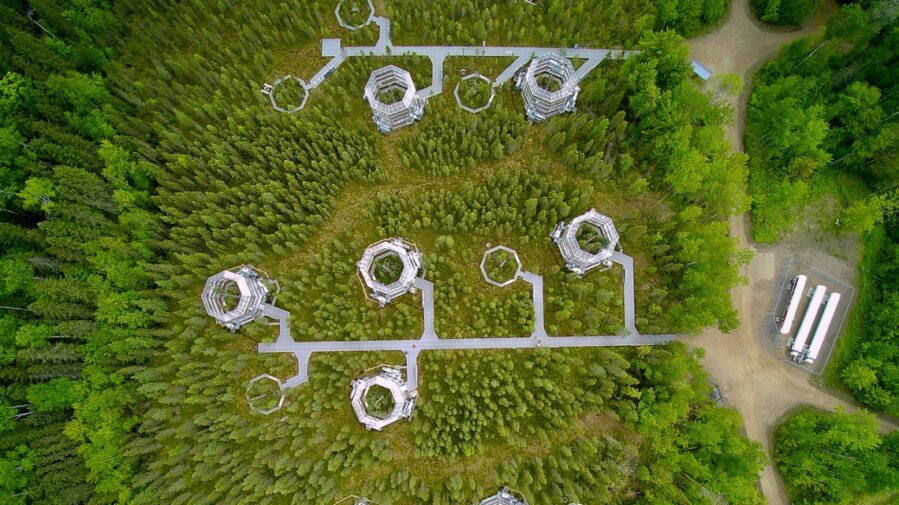
The research team used data from an unusual field experiment in northern Minnesota, where Oak Ridge National Laboratory has constructed 10 yurt-like chambers, each 20 meters wide, over a natural boreal spruce bog. Inside these chambers, scientists can manipulate both temperature and carbon dioxide levels, creating windows into possible futures.
During July and August 2021, the site experienced an extreme drought. The researchers tracked what happened across 10 different future climate scenarios, watching as the water table dropped and stayed low longer in warmer conditions. The extended exposure allowed more organic matter to come into contact with oxygen, releasing stored carbon back into the atmosphere.
The temperature effect was expected. What caught the researchers off guard was carbon dioxide’s role as an accomplice rather than a buffer.
In upland ecosystems at higher elevations, elevated carbon dioxide typically helps plants photosynthesize more efficiently and use water more carefully, cushioning some of drought’s worst impacts. Previous studies had suggested this protective effect might apply broadly. Peatlands, it turns out, play by different rules.
When More CO2 Makes Things Worse
First author Quan Quan, a postdoctoral researcher, dug into the data to understand why elevated carbon dioxide was amplifying rather than dampening the drought’s effects. The answer lay in the bog’s chemistry. Higher carbon dioxide levels had boosted plant growth and increased the amount of dissolved carbon substrate in the waterlogged peat. When drought exposed this substrate-rich environment to oxygen, it became fuel for microbial decomposition, releasing carbon dioxide at accelerated rates.
The most dramatic effects appeared in the warmest, most carbon dioxide-rich conditions. At 9 degrees Celsius above current temperatures with elevated carbon dioxide, the 2021 drought reduced the bog’s net ecosystem productivity by 736.6 grams of carbon per square meter. That represents a 381.9% increase compared to the carbon loss under current temperature and carbon dioxide levels.
“Previous studies indicated that elevated carbon dioxide can usually make extreme events less impactful, but our results indicate the opposite,” Luo said.
The Intergovernmental Panel on Climate Change estimates that extreme droughts will become 1.7 to 7.2 times more likely in the near future. If peatlands respond as this study suggests, drought events could flip these ecosystems from carbon sinks into carbon sources, creating a feedback loop that accelerates warming.
Picture a peatland as a carbon savings account built up over centuries through deposits of slowly decomposing plant matter. Under normal waterlogged conditions, the bog preserves this organic wealth. But extreme drought acts like a bank run, allowing centuries of savings to drain away in months. The warmer and more carbon dioxide-rich the future climate, the faster the drain.
The research team, which includes more than 250 scientists collaborating through Oak Ridge National Laboratory since 2015, continues to monitor the site and integrate its findings into climate models. Their goal is to better predict how these critical carbon stores will respond as environmental conditions shift.
Luo emphasizes the broader significance of these findings. “It’s a huge reservoir of carbon compared to any other ecosystem,” he said. “We need to find a way to mitigate climate change and bend the warming curve.”
The study was funded by the U.S. Department of Energy, the National Science Foundation, the U.S. Department of Agriculture, and state agencies in New York. Co-authors include researchers from Oak Ridge National Laboratory, Florida State University, Georgia Institute of Technology, ETH Zurich, Northern Arizona University, the Australian National University, the University of Western Ontario, and Duke University.