

Imagine trying to recreate the Pacific Ocean on something smaller than a grain of rice. That is essentially what physicists at the University of Queensland have done, building what they call the world’s smallest wave tank on a silicon chip. The device uses a layer of superfluid helium just a few millionths of a millimetre thick to study the same kinds of wave physics that govern tsunamis, rogue waves, and the swirl of hurricanes.
The technique sidesteps one of the biggest headaches in fluid dynamics research: scale. Traditional wave laboratories use enormous flumes, sometimes stretching hundreds of metres, to model shallow-water dynamics. Those experiments can take days to run and still only capture a fraction of the complexity found in nature. The Queensland team’s microscopic wave tank, by contrast, compresses the same observations into milliseconds.
Why Superfluid Helium Works Where Water Cannot
The secret ingredient is superfluid helium, a quantum fluid that flows without resistance. Regular fluids like water become sluggish and sticky at microscopic scales, a problem called viscosity. Superfluid helium does not have that issue. It glides across surfaces with no friction, which makes it ideal for studying wave behaviour in spaces so small they would otherwise be impossible to work with.
Dr Christopher Baker, who led the research, described the advantage in plain terms:
“Using laser light to both drive and measure the waves in our system, we have observed a range of striking phenomena. We saw waves that leant backward instead of forwards, shock fronts, and solitary waves known as solitons which travelled as depressions rather than peaks.”
Those behaviors, he added, had been predicted by theory but never directly observed. The chip-scale setup allowed the team to dial up the nonlinearities that drive complex wave motion by more than 100,000 times compared to what you would see in a conventional flume. That amplification opens the door to studying wave dynamics that are otherwise too subtle or too fleeting to measure in a traditional laboratory.
From Laser Light to Programmable Oceans
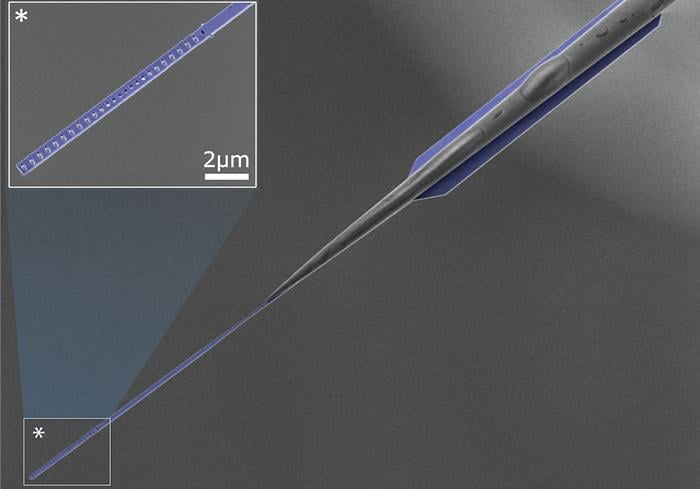
The device itself is a marvel of miniaturisation. An electron microscope image shows a photonic crystal resonator coupled to an optical fibre, all coated with just five femtoliters of superfluid helium. That is a volume ten billion times smaller than a raindrop. The entire assembly fits on a chip 100 microns long, about the width of a human hair.
Laser light plays two roles in the setup. It generates the waves and also measures them, a technique borrowed from optomechanics. Because the chip is manufactured using the same lithography techniques used to make semiconductor circuits, the team can engineer the fluid’s effective gravity, dispersion, and nonlinearity with extraordinary precision. Professor Warwick Bowen, who directs the Queensland Quantum Optics Laboratory, pointed to the practical possibilities:
“Future experiments could use the technology to discover new laws of fluid dynamics and accelerate the design of technologies ranging from turbines to ship hulls.”
The implications extend beyond engineering. Turbulence and nonlinear wave motion shape weather patterns, climate systems, and even the efficiency of wind farms. Being able to study these effects at chip scale, with quantum-level precision, could transform how scientists model and predict them. The researchers also suggest the platform could be used to explore quantum vortex dynamics, a phenomenon that sits at the intersection of classical and quantum fluid mechanics.
The findings were published in Science and represent a rare convergence of quantum physics, nanophotonics, and classical hydrodynamics. The approach is not just smaller and faster than traditional methods. It also makes certain kinds of experiments possible that were previously out of reach. If the team’s vision holds, future researchers might design programmable wave flumes the way engineers design circuits today, tweaking parameters on the fly to explore new regimes of fluid behavior. For now, though, the simplest achievement is also the most striking: they built an ocean that fits on a chip.