

Key Takeaways
- The Fukushima disaster caused significant psychological stress for pregnant women, leading to measurable biological impacts on fetal development.
- Babies born to mothers during this period showed higher rates of premature birth and lower birth weights, attributed to anxiety rather than physical radiation exposure.
- Socioeconomically disadvantaged mothers were disproportionately affected, highlighting the connection between anxiety and social inequality.
- Research identified a ‘U-shaped vulnerability’ where both first and third trimesters were most impacted by stress, while the middle trimester was relatively buffered.
- Effective risk communication is crucial; poor messaging during crises can amplify anxiety and harm future generations.
On March 15, 2011, no radiation reached Osaka. The reactors at Fukushima were 850 kilometres to the northeast, and the atmospheric release, while serious, stayed largely contained to a much smaller zone. Yet pregnant women across Japan were terrified. They called their obstetricians. They searched obsessively for information about nuclear power plants. They lay awake wondering what, exactly, invisible contamination might do to a developing fetus, and whether it was already doing it. The fear was real. What researchers at Waseda University have now shown, after analysing more than a million births, is that the fear was also biologically consequential, quite apart from any physical exposure at all.
This is a study about something genuinely difficult to measure: pure psychological stress, stripped of every confounding factor. The problem has long bedevilled prenatal research. Disasters harm fetuses, that much is established. But do they harm through anxiety, or through the disruption they cause, the lost income, the damaged housing, the interrupted healthcare? Untangling those threads is nearly impossible, because disasters tend to bundle all of them together in the same place.
Fukushima offered a rare exception. Physical radiation exposure was geographically circumscribed, limited to a relatively small exclusion zone in northeastern Japan. The researchers, led by Associate Professor Rong Fu of Waseda University and her colleagues from Seoul National University and Kanagawa University of Human Services, carefully excluded all affected municipalities from their analysis, along with regions where the tsunami had caused direct physical damage. What remained was the rest of Japan, a country where the actual radiation risk was negligible but where the psychological impact was anything but. The United Nations Scientific Committee on the Effects of Atomic Radiation later concluded that no adverse health effects among Fukushima residents could be directly attributed to radiation exposure. The anxiety, though, was a different matter entirely.
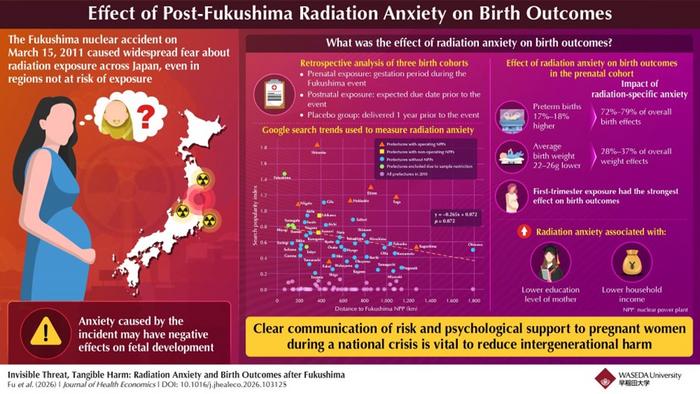
The Fukushima study provides some of the clearest evidence yet that it can. By isolating regions where psychological anxiety was high but actual radiation exposure was negligible, researchers showed that maternal stress alone increased preterm birth rates by roughly 17 to 18 percent. The mechanism appears to run through neuroendocrine pathways rather than any behavioral change by mothers, which makes it harder to simply “manage” through lifestyle adjustments.
The study found a steep socioeconomic gradient, with the lowest-income and least-educated mothers experiencing birth weight reductions roughly double those of the highest-income group. Higher education likely provides better access to accurate risk information, reducing anxiety, while higher income allows for private healthcare and more flexible responses to perceived threats. Because disadvantaged families also have fewer resources to compensate through later-life investments in healthcare and education, the inequality compounds over time.
Not quite, though the question is a real one. The study’s point isn’t that risks should be hidden, but that delayed and unclear risk communication, which is what happened after Fukushima, generates a specific kind of anxiety that’s particularly harmful. Clear, timely, accurate information appears to be protective; it’s the uncertainty and rumor that drives the kind of persistent anxiety the researchers measured. Getting communication right matters as much as getting the physical response right.
The researchers specifically argue for exactly this application. The Google Trends-based Search Popularity Index they developed is scalable to any crisis involving an invisible or uncertain threat, whether a pandemic, a pollution event, or a climate disaster. Pandemic anxiety among pregnant women is already well-documented as a concern; what this framework offers is a way to quantify it, track it geographically, and estimate its biological dose-response relationship with birth outcomes.
The data showed a U-shaped pattern: first-trimester exposure produced the strongest effects, consistent with disruption to early developmental programming and placental formation, while third-trimester exposure also caused significant harm, likely through impaired placental blood flow during rapid fetal growth. The middle trimester appeared relatively buffered. This means the window of concern effectively spans most of a pregnancy rather than being concentrated in one critical period.
“Living and working in Japan, I witnessed firsthand how profoundly the Fukushima accident shook the public, particularly pregnant women and young mothers, even in regions far from any physical danger,” Fu explained. “Fukushima’s unique geography created a rare scientific opportunity to answer whether fear alone could harm a developing fetus.”
The answer, it turns out, is yes. Babies born to mothers who were pregnant during the accident were roughly 17 to 18 percent more likely to arrive prematurely than those born just before. Birth weights dropped by an average of 22 to 26 grams. More striking were the effects at the severe end: rates of very low birth weight (under 1,500 grams) were about 50 percent higher, and extremely low birth weight (under 1,000 grams) approximately 77 percent higher, compared to control cohorts. These are not negligible numbers. Infants at those extremes face substantially elevated risks of lasting cognitive and physical difficulties.
To confirm that anxiety, specifically radiation anxiety, was the mechanism rather than general disaster stress, the team built a measure they called a Search Popularity Index, using Google Trends data for searches related to nuclear power plants across Japan’s 47 prefectures in the month following the accident. The index behaved exactly as you’d expect radiation fear to behave: it declined systematically with distance from Fukushima, was higher in prefectures that already had operating nuclear facilities, and was essentially flat in the same period one year earlier. It spiked immediately after March 15 and gradually fell. Prefecture by prefecture, as radiation-related search intensity went up, birth outcomes went down, in a clean dose-response relationship. Radiation anxiety alone accounted for roughly 72 to 79 percent of the overall increase in preterm births, and somewhere between 28 and 37 percent of the reduction in average birth weight.
The team also confirmed the mechanism wasn’t behavioral, which is a genuinely important detail. Anxious mothers might, in principle, have changed their diets, or drunk more, or stopped exercising; any of those pathways could account for fetal effects. But analyses of national health and nutrition survey data showed nothing of the kind: no significant changes in smoking, alcohol consumption, sleep, physical activity, medication use, or nutrient intake. What did change was self-reported stress. The biological pathway appears to run through neuroendocrine stress responses affecting fetal development directly, not through anything mothers consciously did or didn’t do.
Timing within pregnancy mattered, producing a pattern that researchers call U-shaped vulnerability. First-trimester exposure produced the strongest effects on birth weight, roughly 7 to 8 grams per standard deviation increase in anxiety intensity, consistent with the idea that early prenatal stress disrupts fundamental developmental programming and placental formation. Third-trimester effects were also substantial (around 5 grams), probably through a different mechanism: impaired placental blood flow during the period of most rapid fetal weight gain. The middle trimester showed relatively modest effects, which might reflect a developmental window that’s somewhat buffered against external stressors, sitting between organ formation and the intensive growth phase.
Then there’s the question of who was most affected, and here the data become rather uncomfortable. The effects were strongly concentrated among socioeconomically disadvantaged mothers. Women with university degrees showed nearly zero impact on birth weight from radiation anxiety. Those with only a high school education saw reductions of 6 to 7 grams. The pattern was similar for income: the highest-earning families were mostly protected, while the lowest quartile bore the heaviest burden. “Higher education may offer advantages through better access to accurate information about radiation risks and stronger coping resources,” Fu noted, “while higher household income may enable access to private healthcare and greater flexibility in responding to perceived threats.”
A back-of-envelope calculation the researchers include in the paper suggests the economic consequences are not trivial. Even modest birth weight reductions are associated, through established research, with reduced lifetime earnings, higher healthcare costs, and lower educational attainment. Across the 340,000 births in the prenatal cohort, the implied aggregate losses run to tens of billions of yen, affecting primarily the families least equipped to absorb them. Psychological stress from an invisible threat, in other words, doesn’t just distribute anxiety evenly: it concentrates harm among people who were already vulnerable, and it does so through mechanisms largely invisible to the individuals experiencing them.
What Fukushima demonstrated, the researchers argue, was how modern information systems can amplify psychological impacts far beyond physical danger zones, a pattern that played out again during COVID-19 and may become a recurring feature of how societies respond to invisible threats, from pathogens to environmental contamination to climate change. The lesson isn’t simply that stress is bad for pregnant women, which nobody doubted. It’s that risk communication during crises has measurable biological consequences for the next generation, concentrated among those who can least afford them. “Whether by triggering earlier delivery among at-risk fetuses or by intensifying growth restrictions in vulnerable populations,” Fu said, “radiation-related psychological stress substantially increased the incidence of severe birth outcomes associated with elevated risks of lasting developmental challenges.” The implication is as clear as it is unsettling: when governments botch crisis communication, fetuses pay part of the price.
Source: Invisible threat, tangible harm: Radiation anxiety and birth outcomes after Fukushima, Journal of Health Economics, Volume 107, May 2026. DOI: 10.1016/j.jhealeco.2026.103125