

Key Takeaways
- Traffic heat contributes significantly to urban climate change, as it doesn’t just vanish but affects temperatures in surrounding areas.
- A new study included traffic heat in the CESM model, finding it raises air temperatures, especially during heatwaves and at night.
- The study showed that 10% of the fleet shift to EVs or hybrids decreases traffic heat flux substantially, comparable to cutting traffic volumes.
- Traffic heat can raise indoor temperatures too, especially in dense urban areas where heat accumulates more effectively.
- The research emphasizes planning for traffic heat in urban design, linking it to climate adaptation strategies like low-emission zones.
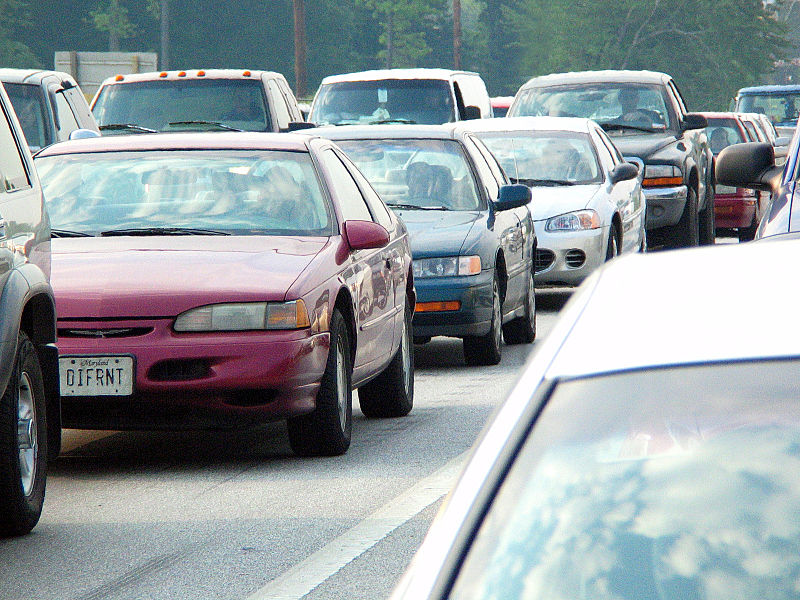
Every time a driver brakes, something happens to the energy involved. It doesn’t disappear. Friction converts it to heat, and that heat goes somewhere: into the brake disc, into the road surface, into the air sitting in the canyon between buildings. The same is true of exhaust gases, of the waste heat radiating off an engine block idling at a red light. A single car generates perhaps 20 kilowatts of waste heat in ordinary urban driving. Multiply that by a city’s worth of traffic, sustained across the morning and evening rush, and you have something that climate models have, until now, largely ignored.
A new study from the University of Manchester has done something straightforward but overdue: it added traffic heat directly into one of the world’s most widely used climate models, ran it against real-world temperature data from two European cities, and found that the effect is measurable, seasonally variable, and relevant to what happens to people inside buildings during heatwaves.
The model in question is the Community Earth System Model, or CESM, a global climate simulation framework maintained by the US National Center for Atmospheric Research and used by research groups across dozens of countries. CESM already included a building energy model that could simulate waste heat from heating and cooling systems. What it didn’t have was any representation of traffic. “Research on urban heat has traditionally focused on buildings, materials and land surfaces,” said Dr Zhonghua Zheng, who led the work. “However, the direct heat produced by vehicles — from engines, exhausts and braking — has received far less attention in large-scale climate models.” The new module, described in the Journal of Advances in Modeling Earth Systems, inserts vehicle heat directly into the street-level energy budget, letting it interact dynamically with road surfaces, building walls and the air above.
The team validated the model against observations at two sites: the Capitole district of Toulouse in southern France, and a commercial street near Manchester city centre. Both cities have well-documented traffic flow data, which the researchers used to calibrate the module. In Toulouse, using 2004 traffic patterns, the annual average heat flux from vehicles worked out at around 22 watts per square metre. In Manchester, using 2022 data, it was about 16 watts per square metre, owing partly to differences in fleet composition: Toulouse in 2004 had an almost entirely diesel-and-petrol fleet, while Manchester 2022 had a small but growing share of hybrids and electric vehicles, which generate considerably less waste heat.
The resulting temperature effects were modest but not negligible. In Manchester, traffic heat raised simulated air temperatures by roughly 0.16 degrees Celsius in summer and 0.35 degrees in winter. The winter figure is higher because cooler background air means vehicle heat represents a larger fraction of the total thermal budget; buildings aren’t pumping out as much warmth from heating systems during milder periods, so traffic’s relative contribution grows. “Our model will allow scientists to simulate how heat released by vehicles interacts with streets, buildings and the surrounding atmosphere,” Zheng said.
The heatwave analysis is perhaps the most practically striking part of the study. During the July 2022 UK heatwave, when Manchester recorded temperatures it hadn’t seen before, the model suggests traffic heat pushed the National Weather Service Heat Index (a composite measure of temperature and humidity often called the “feels like” figure) above the danger threshold of 40 degrees Celsius for a cumulative 1.9 extra degree-hours during the peak event. That’s not a catastrophic number, but it’s not trivial either. And there’s a reason the effect is strongest at night: traffic peaks in the late afternoon, the road surface absorbs heat during the day and releases it slowly overnight, so the thermal contribution lags the traffic itself by several hours, keeping the city warmer during the small hours when human bodies most need to cool down.
The model also captures something less obvious: traffic heat gets indoors. Heat at street level raises road and wall surface temperatures, which in turn warm the air inside adjacent buildings. In Toulouse, the simulation showed indoor air temperatures rising by about 0.42 degrees Celsius on summer nights; in Manchester, the effect was smaller (around 0.14 degrees) because the buildings are less densely packed, allowing more heat to escape into the surrounding area rather than accumulating in a narrow canyon. Dense, compact urban forms trap traffic heat more effectively than open, low-rise neighbourhoods, which has implications for which kinds of development are most exposed during extreme heat.
One of the more useful features of the module is its ability to distinguish between vehicle types. A petrol engine releases around 18.9 kilowatts of waste heat; diesel slightly more at 19.34 kilowatts; a hybrid around 5.24 kilowatts; and a battery-electric vehicle about 0.67 kilowatts. These are enormous differences. The sensitivity analysis in the paper found that shifting 10 percent of the fleet from internal combustion to electric or hybrid vehicles reduced daily average traffic heat flux by 1.5 watts per square metre in winter. Equivalent reductions required cutting total traffic volumes by about 10 percent. In other words, electrification and congestion reduction are roughly comparable interventions at current fleet compositions, though the relative value of electrification grows as EV adoption accelerates.
The study has real limits. Both test sites are single-point simulations, not regional or global runs, and the model hasn’t yet been applied outside temperate European climates. Cities in tropical or subtropical zones behave differently: buildings use more air conditioning, there’s less seasonal variation in heat flux, and the relative contribution of traffic may shift considerably. Zheng and his colleagues acknowledge that global traffic input datasets don’t yet exist in the form needed to run the module at full scale; building those is described as a major task for future work.
There are also some simplifications baked into the physics. Vehicle speed is fixed at 40 kilometres per hour regardless of congestion, which means the model likely underestimates heat during rush-hour gridlock, when engines idle or crawl and heat output per unit distance travelled is substantially higher. A traffic jam is, thermally speaking, rather worse than moving traffic. These are acknowledged trade-offs against computational cost.
Still, the study establishes something useful: traffic heat is not a rounding error in urban climate. It doesn’t dominate the heat balance, but it contributes, it concentrates at night during the moments that matter most for health, and it interacts with the built form in ways that can be predicted, mapped, and potentially managed. “We would like to highlight the importance of considering transport systems when planning for climate adaptation, urban cooling strategies and net-zero transitions,” said Yuan Sun, the paper’s first author. Cities designing low-emission zones or congestion pricing schemes now have, at least in principle, a way to model not just the air quality benefits of those policies, but the thermal ones too. Whether transport planning and urban heat management end up being joined-up decisions remains, for now, rather an open question.
Source: Modeling Urban Traffic Heat Flux in the Community Earth System Model: Formulation and Validation for Two Test Sites, Journal of Advances in Modeling Earth Systems, April 2026. DOI: 10.1029/2025MS005435
Does switching to an electric vehicle actually reduce the heat your car adds to the city?
Significantly, yes. A petrol engine releases roughly 19 kilowatts of waste heat in urban driving; a battery-electric vehicle releases less than 1 kilowatt. The Manchester study found that shifting 10 percent of a city’s fleet to EVs or hybrids cut traffic heat flux by about 1.5 watts per square metre in winter, comparable to reducing total traffic volumes by 10 percent. As EV adoption grows, the thermal benefit is expected to compound.
Why is traffic heat worse for cities at night than during the day?
Road surfaces absorb heat from traffic during the afternoon peak, then release it slowly overnight rather than immediately. This means the thermal contribution of rush-hour traffic shows up in air temperatures hours later, when the city should be cooling down and people are trying to sleep. During the July 2022 Manchester heatwave, traffic heat pushed heat stress indices above dangerous thresholds for nearly 2 extra degree-hours, concentrated in late-night hours.
Does traffic heat affect indoor temperatures too, or just outdoor air?
Both. Heat released at street level raises road and wall surface temperatures, which transfer warmth into adjacent buildings through convection and radiation. The effect is more pronounced in dense, compact urban areas where narrow street canyons trap heat; the Manchester study found indoor temperatures rose by up to 0.42 degrees Celsius on summer nights in the denser Toulouse test site, versus 0.14 degrees in Manchester’s more open street layout.
Why haven’t climate models included traffic heat until now?
Two obstacles: the absence of real-time traffic input data at the global scale, and the computational cost of representing vehicle-by-vehicle heat generation within a model designed to simulate the entire Earth system. Most global climate models treated urban anthropogenic heat as a fixed constant or ignored it entirely. The Manchester team’s bottom-up approach, calibrated against actual traffic monitoring data from Transport for Greater Manchester and a Toulouse traffic detector network, offers a practical route around both problems.
Could this model be used to help design cooler cities?
That’s the stated ambition. Because the module can simulate different vehicle mixes and traffic volumes, it could in principle be used to evaluate the thermal consequences of low-emission zones, congestion charges, or shifts toward public transit and active travel, alongside the air quality benefits those policies are usually assessed for. The main constraint is that global traffic datasets needed for city-scale planning don’t yet exist in the required format.