

What if meaning in life isn’t something we find, but something we feel our way into?
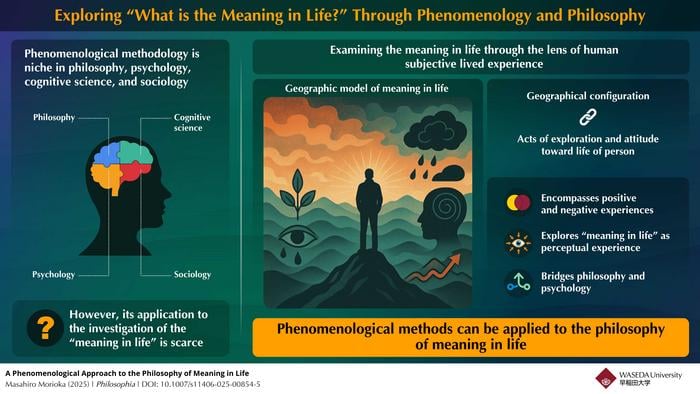
A new philosophical study from Waseda University proposes that the sense of meaning in life arises through a kind of perceptual dialogue between ourselves and our lived experience—much like a blind person tapping her way through a space with a cane. Published in Philosophia, the study introduces a “geographic model of meaning in life,” drawing on phenomenology, affordance theory, and enactivism to argue that how we approach life shapes what it reveals to us in return.
The Landscape of Meaning
Philosopher Masahiro Morioka suggests we think of life’s meaning as a geography: a shifting landscape of emotions, moods, and actions that depends on our orientation toward it. Whether we are hopeful, despairing, defiant, or apathetic, our experience of life’s “worthfulness” responds in kind. This experience, he argues, is not fixed, but unfolds through our actions and attitudes in the present moment.
“Meaning in life is a lived experience of the worthfulness of living a life that is experienced being activated by my action of probing into my life in the here and now,” Morioka writes. “This action is similar to the action of a blind person probing her way with a cane.”
Affordance and Solicitation
To understand this perceptual process, Morioka borrows concepts from psychology and embodied cognition. He introduces the idea of life affordances—possibilities that our lives offer us, such as loving, grieving, dreaming, or regretting. These affordances are shaped not just by what’s possible, but by how our life “solicits” us, sometimes gently, sometimes forcefully.
- A life may solicit survival or surrender when we face despair.
- It may solicit reflection or reinvention when we feel stagnant.
- Or it may provoke existential questioning after a personal loss.
We do not passively perceive these invitations, Morioka argues. We respond to them, and in that response, meaning is generated—or lost.
The Enactive Turn
This interactive view of meaning is grounded in enactivism, a theory from cognitive science that says perception is shaped by our bodily engagement with the world. Philosopher Alva Noë, for instance, compares perception to a blind person navigating a room by touch. Meaning, Morioka proposes, works the same way: we probe into our lives, and different attitudes reveal different aspects of life’s value.
Consider grief: if one responds to the death of a loved one with determination to go on living, the same event might eventually take on a redemptive quality. But if one responds with withdrawal, it may instead reinforce meaninglessness. “Meaning in life,” Morioka writes, “requires a corresponding attitude or commitment being taken towards my life.”
Mapping the Inner Terrain
From this, Morioka builds his geographic model of meaning: a conceptual map composed of all the lived experiences—actual and imagined—that arise through different ways of engaging with life. Just as a mountain vista looks different depending on which way you face, life presents different emotional landscapes depending on how we orient ourselves toward it.
“Each pattern of lived experience consists of a combination of the actual experience of my life and the possible experiences of my life,” Morioka writes. “I can experience meaning in life when I question the subjective worth of my life in response to a life solicitation I receive from my life.”
A New Direction for Philosophy and Psychology
This approach marks a shift from traditional philosophical debates about whether life’s meaning is subjective, objective, or both. Instead, Morioka emphasizes how meaning arises in practice, through a person’s ongoing, moment-by-moment engagement with life. His geographic model blurs the line between philosophy and psychology, offering new directions for both disciplines.
“What we have attempted to do is illustrate theoretically how a meaningful life and a meaningless life, or a meaningful life event and a meaningless life event, are intertwined to create a single phenomenological geography,” he concludes.
Looking Ahead
Morioka hopes to expand this model by integrating it with other philosophical approaches, including solipsistic and recollective perspectives on meaning. His goal is to develop a more comprehensive framework for understanding how people experience and construct the significance of their lives.
For readers searching for meaning—or wrestling with its absence—this study offers not answers, but a map. One that reminds us: how we look changes what we see.
Journal: Philosophia
DOI: 10.1007/s11406-025-00854-5
Publication Date: June 4, 2025
Author: Masahiro Morioka, Faculty of Human Sciences, Waseda University