

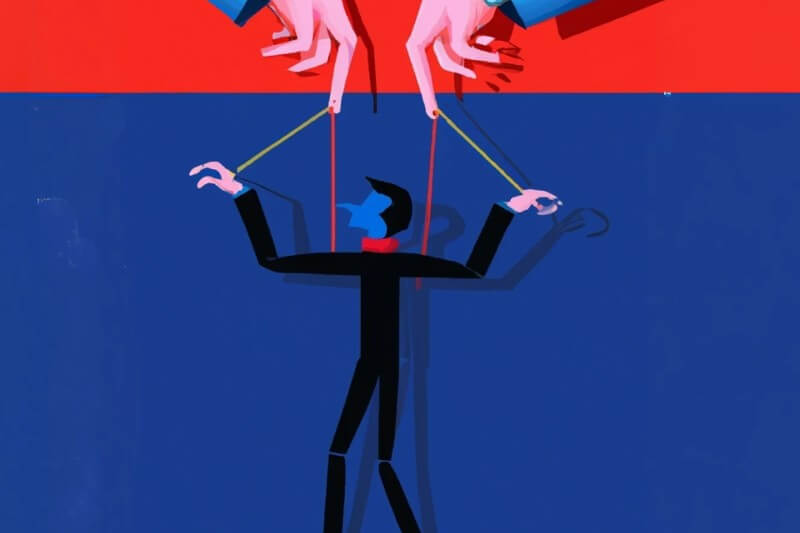
Five. That’s roughly the number of consistent social media posts it may take before your opinion on an unfamiliar topic begins to set. Not five days of exposure, or five news cycles, or five in-depth articles. Just five scroll-stopping moments, maybe spread across a single evening, and something in the mind starts to calcify. Researchers studying online opinion formation have now put a number on a process most of us suspected was happening but probably hoped was slower than this.
The study, published in Information Systems Research, suggests that in the fast, low-effort environment of social media, people can form durable impressions about topics they’ve never encountered before reaching any real evaluation of whether the underlying information is true.
Venu Puthineedi at NEOMA Business School and Ashish Kumar Jha at Trinity Business School ran three controlled experiments using Instagram-style posts to simulate everyday scrolling. Participants were exposed to unfamiliar information under conditions close to genuine social media use: a bit distracted, moving quickly, not sitting down to really think. The team was looking for what they call the Point of Critical Information, or PCI, the threshold at which an emerging opinion becomes sticky enough to resist contradiction. Around five consistent exposures, that threshold appears in the data.
What happens after that point is, arguably, the genuinely uncomfortable part.
Once users crossed the PCI, subsequent posts reinforcing the emerging opinion became easier to accept and more likely to be shared. Contradictory information, meanwhile, became easier to dismiss. In other words, the mind doesn’t keep an open ledger indefinitely; it tips relatively early and then, sort of quietly, starts working to defend what it already thinks it knows. The direction of that tipping had remarkably little to do with whether the information was accurate.
“People tend to assume opinions develop gradually through deliberate evaluation,” said Jha. “What we found is that under typical social media conditions, people can begin forming durable impressions very quickly, often before they have meaningfully assessed whether the information itself is accurate.”
This matters because it upends the rough mental model that most platforms and many researchers have operated on: that misinformation is primarily a problem of falsehoods spreading among people who already hold a view, rather than a problem of false views forming in the first place. The intervention timeline gets compressed dramatically if the opinion lock-in happens after five posts rather than after sustained exposure. Fact-checks and corrections are typically deployed after content has spread and generated engagement. By that point, according to these findings, many users will already have processed the original claim through an evaluative filter that was not, in any meaningful sense, evaluating facts.
The third experiment added a layer that’s harder to dismiss as a mere laboratory artefact. Participants were more likely to trust information coming from profiles that displayed professional titles, specifically the unverified “Dr.” prefix, than from verified expert influencers with large followings. Think about what that means: a throwaway credential, one that nobody has checked, can outperform the kind of verified authority that platforms invest considerable effort in cultivating. Users were, in effect, activating mental shortcuts about expertise that the actual architecture of social media platforms provides almost no tools to interrogate. Not that users are fools for doing this; humans have always used context cues to assess credibility. The problem is that those cues are extraordinarily cheap to fake online.
Puthineedi notes that by the time platforms act, it may already be too late. “Our findings suggest the earliest exposures users encounter online may carry far more weight than platforms currently recognize,” he said. “By the time corrections, warnings or fact-checks appear, an initial evaluative framework may already be in place.”
It is worth noting that the experiments used controlled conditions with a finite number of posts, which is tidier than the actual experience of scrolling, where repetition is partly algorithmic and partly accidental. Whether the PCI holds at roughly five in naturalistic settings, or shifts with emotional valence, topic familiarity, or individual cognitive style, remains to be worked out. Three studies can establish a pattern; they can’t exhaust one.
The implications fan out in directions that make for uncomfortable reading if you work in platform design, public health communication, or electoral integrity. Elections and public health emergencies are precisely the contexts where novel claims about unfamiliar things circulate at high volume and high speed, which is also where the conditions for rapid opinion lock-in are most fully met. The window in which early exposure shapes what a person will later accept as plausible may be shorter than anyone building an intervention has so far designed for.
Five posts. It’s the kind of number that sounds almost too clean, too neat, to be trusted. But the research doesn’t claim a hard threshold so much as a zone in which the ball, as the paper’s authors put it, starts rolling. And rolling, as anyone who has watched a news cycle metastasize knows, is considerably easier than stopping.
https://doi.org/10.1287/isre.2024.1589
Frequently Asked Questions
Why doesn’t fact-checking stop misinformation if people form opinions so quickly?
Fact-checks almost always arrive after content has already circulated and generated engagement, which this research suggests may be too late for many users. By the time a correction appears, the original claim has likely been processed through an evaluative framework that wasn’t really assessing factual accuracy to begin with. The new findings imply that the window for effective intervention is narrower than most platform correction systems are designed to address.
Does this mean people on social media are gullible?
Not exactly. The study found that users rely heavily on familiarity, repetition, and mental shortcuts about credibility, which is how humans have always navigated information overload. The problem is that social media environments are unusually efficient at triggering those shortcuts at scale. A fake “Dr.” prefix can outperform a verified expert account, not because users are naive but because the cognitive tools we use to assess credibility evolved for very different contexts.
Could platforms realistically change their design to slow this down?
The research raises that question without settling it. The findings point to repetition and early exposure as the key variables, which suggests interventions timed to the first few exposures rather than viral spread could be more effective. What that looks like in practice, and whether platforms would adopt it, is a much harder problem. The researchers highlight elections and public health emergencies as the highest-stakes testing grounds.
Is five posts really a reliable threshold, or just an average?
Closer to an observed pattern than a hard rule. The researchers describe a “Point of Critical Information” around which opinions begin to stabilize, but the exact number likely varies with the topic, the user, and the emotional charge of the content. The three experiments established the pattern under controlled conditions; whether it holds consistently in the genuinely messy environment of real-world scrolling is still an open question.