

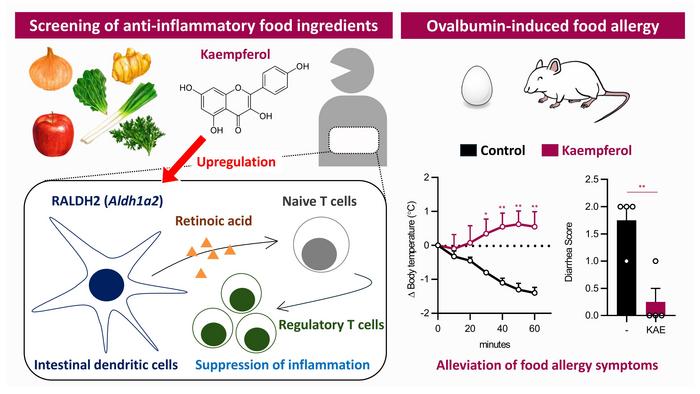
Scientists have discovered that kaempferol, a natural compound found in everyday foods like kale, broccoli, and tea, could help combat food allergies through a sophisticated cellular mechanism. This breakthrough research reveals how this dietary compound works at the molecular level to promote immune tolerance, offering hope for millions affected by food allergies worldwide.
Published in Allergy | Estimated reading time: 5 minutes
A Natural Solution to a Growing Problem
As food allergies continue to rise globally, researchers at Tokyo University of Science, led by Professor Chiharu Nishiyama, have uncovered how a common dietary compound might help regulate our immune response. Their research shows that kaempferol, a flavonoid found in many vegetables, works by enhancing the body’s natural defense against allergic reactions.
The study focused on specialized immune cells called dendritic cells (DCs), which play a crucial role in regulating immune responses. These cells produce an enzyme called RALDH2, which helps develop regulatory T-cells – the body’s natural peacekeepers that prevent excessive immune reactions.
After screening approximately 40 different flavonoids, the research team identified kaempferol as the most effective compound for increasing RALDH2 levels in dendritic cells. “When taken as a daily food, they are expected to reduce allergies, inflammation, and autoimmune diseases that are caused or aggravated by excessive immune response,” explains Professor Nishiyama.
The Molecular Dance
The researchers revealed a complex molecular mechanism behind kaempferol’s effects. The compound works by blocking a receptor called AhR (aryl hydrocarbon receptor), which normally suppresses the production of RALDH2. By inhibiting AhR, kaempferol allows for increased production of RALDH2, ultimately leading to better immune regulation.
The team validated their findings through experiments with mice, demonstrating that kaempferol administration significantly reduced allergic symptoms, including the prevention of rapid temperature drops and allergic diarrhea typically seen in food allergy responses.
Glossary
- Flavonoids
- Natural compounds found in fruits and vegetables that possess various health benefits, including anti-inflammatory properties.
- Dendritic Cells (DCs)
- Specialized immune cells that help regulate immune responses and can promote tolerance to harmless substances.
- RALDH2
- An enzyme that converts vitamin A derivatives into retinoic acid, which helps develop regulatory T-cells that suppress excessive immune responses.
Test Your Knowledge
What common foods contain kaempferol?
Kaempferol can be found in kale, beans, tea, spinach, and broccoli.
How does kaempferol influence dendritic cells?
Kaempferol increases the expression and efficiency of RALDH2 enzyme in dendritic cells.
What is the molecular mechanism through which kaempferol affects RALDH2 production?
Kaempferol acts as an antagonist to AhR (aryl hydrocarbon receptor), blocking its ability to suppress RALDH2 production.
How does the PU.1/IRF-4 pathway contribute to kaempferol’s effects?
PU.1 and IRF-4 are enhanced by kaempferol treatment and regulate the Aldh1a2 gene, which produces RALDH2, thus promoting regulatory T-cell development.
Enjoy this story? Subscribe to our newsletter at scienceblog.substack.com.