

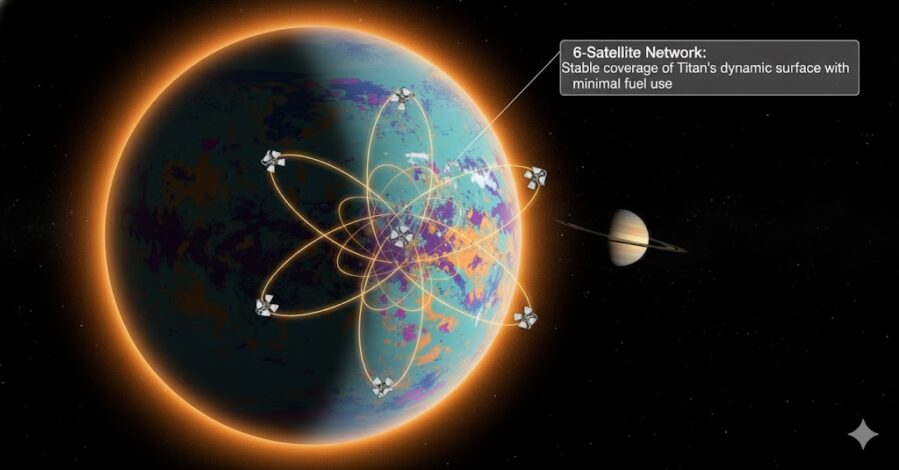
Titan’s harsh skies may soon feel less distant thanks to a new satellite choreography built for its strange gravity and thick haze.
A new study published in Satellite Navigation in 2025 by researchers from UNESP in Brazil, Universidad de Zaragoza in Spain, and INPE introduces a 2D Necklace Flower Constellation architecture designed specifically for Titan’s chaotic orbital environment. The team shows that synchronized frozen orbits can maintain stable coverage of Titan’s lakes, dunes, and methane rich atmosphere while using only six satellites and minimal fuel. DOI: 10.1186/s43020-025-00180-x
Titan is one of the most compelling worlds in the Solar System, with an Earth like nitrogen atmosphere and a methane cycle that shapes seas, dunes, and labyrinth terrains. Yet those same features make Titan notoriously difficult to orbit. Its gravity field is lopsided. Saturn tugs at every spacecraft. And its dense hydrocarbon haze swallows sunlight and scrambles communications. Traditional single satellite missions struggle to hold steady paths amid those conditions. What the new study proposes is something closer to a dance than an orbit, a carefully tuned formation that uses resonance and symmetry to reduce the need for constant course corrections.
The researchers built their approach on Flower Constellation Theory, a mathematical framework that arranges satellites so they share the same repeating ground track in a rotating reference frame. They extended this with a 2D Necklace variant that introduces flexible phasing and symmetry rules drawn from number theory. In practical terms, this method allows mission designers to spread multiple spacecraft across orbital planes that behave as one cohesive path. Because each satellite occupies a predictable position along that shared route, coverage becomes steady and fuel use drops sharply. The team then folded Titan’s known gravitational harmonics into the system, especially the J2 and J3 perturbations driven by its uneven mass distribution, to identify altitudes between about 1400 and 20000 kilometers where these flower like formations remain stable over long periods.
Frozen Orbits for a Wild Moon
To survive Titan’s gravitational and atmospheric turbulence, the study relies on frozen orbits, trajectories where a spacecraft’s eccentricity and argument of pericenter remain nearly constant over time. This minimizes drifting and lowers the risk of a spacecraft dipping too close to Titan’s dense upper atmosphere. Using these constraints, the researchers designed two example networks called Titan I and Titan II. Titan I is tuned for the polar hydrocarbon seas such as Kraken Mare and Ontario Lacus. Titan II focuses on the equatorial dunes and hummocky terrains mapped by Cassini. Numerical simulations showed that in both cases the satellites maintain stable, repeating paths that return over each science target with reliable periodicity.
“Our study demonstrates that carefully designed satellite constellations can transform how we explore distant moons like Titan,” said Lucas S. Ferreira of UNESP. “By combining mathematical elegance with orbital realism, the Necklace Flower Constellation approach balances stability, coverage, and efficiency under extreme conditions. This could guide future planetary missions where continuous surface monitoring is essential but environmental constraints are severe.”
The simulations used the IAS15 integrator to test how each constellation responds to Titan’s lumpy gravity, Saturn’s strong third body pull, and the influence of nearby moons like Rhea and Dione. Even under these compounded forces, the networks held their repeating patterns over extended periods. Only the more polar Titan I model showed drift toward atmospheric drag after several months, a result the authors note can be addressed through periodic station keeping. The equatorial Titan II system remained stable for the full five year simulation window without crossing hazardous altitude thresholds.
A New Blueprint for Outer Planet Exploration
In contrast to large fleets like GPS or Starlink, the proposed Titan networks require only six satellites to achieve global coverage. Because each spacecraft shares a coherent repeating trajectory, the formation acts as a distributed sensor that can revisit key regions with predictable timing. This matters because Titan’s methane cycle is dynamic and seasonally active. Polar seas rise and fall. Dunes migrate. Clouds form and vanish. The ability to monitor these changes regularly, without burning significant fuel, turns a distant and complex moon into a tractable observational target.
“We hope our framework can support initiatives for missions around Saturn’s natural satellites and inspire new cooperative orbital designs across the Solar System,” Ferreira said.
The study’s broader value lies in its generality. The 2D Necklace Flower approach can be adapted to moons, small bodies, or even planets with irregular gravity fields where traditional orbits degrade quickly. For Titan, it opens the door to sustained mapping, atmospheric monitoring, and communication relay roles that could support future landers, balloons, or submersibles. And for mission planners wrestling with tight budgets and long travel times, it offers something just as important, a path toward doing more science with fewer spacecraft, less fuel, and far greater stability. Titan’s skies may remain orange and murky, but with the right constellation, they no longer need to be unpredictable.