

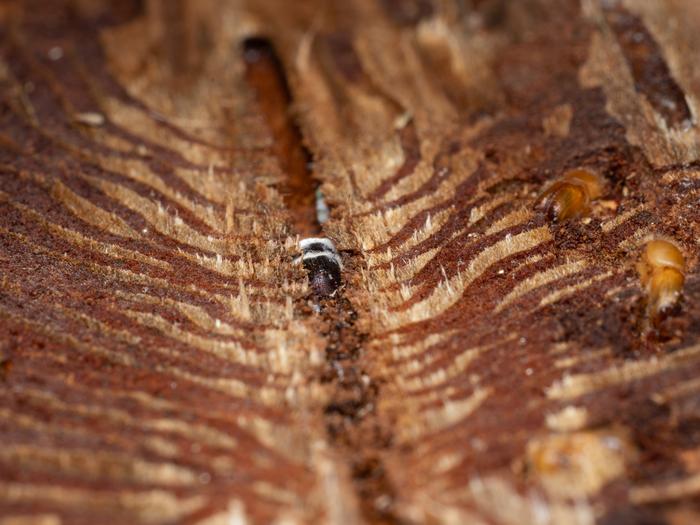
Bark beetles have spent millennia perfecting a survival trick: they eat spruce tree defenses and weaponize them against their own predators. But a common soil fungus has evolved a workaround that renders the beetles’ chemical shield useless, allowing the pathogen to infect and kill them from the inside out. The discovery, published in the Proceedings of the National Academy of Sciences, reveals how a forest pest’s clever adaptation became its fatal weakness.
When Eurasian spruce bark beetles tunnel through tree phloem, they encounter tissue loaded with antimicrobial compounds like stilbenes and flavonoids. Rather than succumbing to these toxins, beetles use enzymes to strip sugar molecules from the plant chemicals, converting them into highly toxic “aglycones.” This transformation increases the compounds’ ability to kill fungi by several orders of magnitude, effectively sanitizing the beetle’s environment. The insects accumulate these modified toxins in their bodies and waste, creating a potent antifungal barrier.
Researchers at the Max Planck Institute for Chemical Ecology tracked this chemical conversion using mass spectrometry and nuclear magnetic resonance. Lead author Ruo Sun noted the beetles’ precision: they don’t just tolerate spruce defenses, they systematically upgrade them into more powerful weapons. This explains why many biological control attempts using fungi have failed against bark beetles, the pests arrive pre-armed with enhanced protection.
Two Genes That Break the Beetle’s Defense
The fungus Beauveria bassiana, a natural insect parasite found in soils worldwide, has developed a two-step detoxification pathway that neutralizes the beetle’s chemical arsenal. First, the fungus reattaches a sugar molecule to the toxic aglycones. Then it adds a methyl group to that sugar, creating harmless methylglycosides that resist reactivation by beetle enzymes.
To test this mechanism, the team created mutant fungal strains lacking the genes for glycosyltransferase and O-methyltransferase, the enzymes responsible for detoxification. Without these genes, the mutant fungi grew poorly in beetle environments and killed far fewer insects. Wild-type strains, however, thrived even at high toxin concentrations, sometimes showing enhanced growth as they neutralized the threat.
“We have demonstrated that a bark beetle can co-opt a tree’s defensive compounds to make defenses against its own enemies. However, since one of the enemies, the fungus Beauveria bassiana, has developed the ability to detoxify these antimicrobial defenses, it can successfully infect the bark beetles and thus actually help the tree in its battle against bark beetles,” Jonathan Gershenzon explains.
Why This Matters for Devastated Forests
The findings arrive as bark beetle outbreaks ravage temperate forests across Europe, fueled by warming temperatures that stress trees and accelerate beetle reproduction. Previous biocontrol efforts produced inconsistent results, likely because many fungal strains couldn’t handle the beetle’s enhanced chemical defenses.
By identifying the specific detoxification genes, scientists can now select or engineer fungal strains with proven ability to bypass beetle defenses. This approach could lead to more reliable biological controls, though researchers caution that widespread deployment requires understanding how common these genetic adaptations are across different B. bassiana populations.
The study also challenges assumptions about how plant defenses move through ecosystems. Rather than flowing unchanged from tree to insect to pathogen, these chemicals are repeatedly modified and countered in an ongoing arms race. The spruce tries to poison the beetle, the beetle converts that poison into better fungicide, and the fungus eventually learns to neutralize the weapon entirely. Each step represents millions of years of evolutionary pressure, compressed into a chemical conversation that plays out in millimeters of bark tissue.
Proceedings of the National Academy of Sciences: 10.1073/pnas.2525513122