

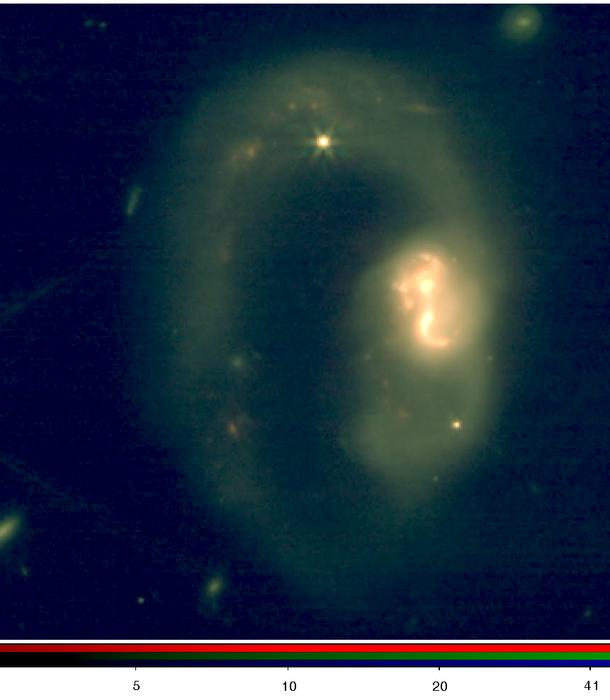
THE NUCLEUS of galaxy IRAS 07251-0248 sits buried beneath such vast amounts of gas and dust that conventional telescopes can barely glimpse what’s happening inside. Hardly the sort of place you’d expect to find abundant organic molecules. The material absorbs most of the radiation blasting from the central supermassive black hole, creating a cosmic fortress that’s kept its secrets remarkably well. Until now, that is.
Peer through infrared wavelengths with the James Webb Space Telescope, though, and something rather unexpected emerges. An extraordinary richness of organic molecules (benzene, acetylene, methane and others) floods the galactic core in abundances far higher than anyone predicted. The discovery is pushing chemists to reconsider how complex carbon chemistry unfolds in some of the universe’s most extreme environments.
“We found an unexpected chemical complexity, with abundances far higher than predicted by current theoretical models,” says Ismael García Bernete at the Centro de Astrobiología in Spain, who led the work. “This indicates that there must be a continuous source of carbon in these galactic nuclei fuelling this rich chemical network.”
The galaxy in question belongs to a class called ultra-luminous infrared galaxies, objects that shine predominantly in infrared wavelengths because they’re so deeply obscured. IRAS 07251-0248 ranks among the most dust-choked nuclei in the nearby universe. The very thing that makes it difficult to study, all that intervening material, also creates ideal conditions for detecting molecular absorption lines. As infrared radiation from the galaxy’s core passes through the surrounding gas, molecules absorb specific wavelengths, leaving telltale signatures.
García Bernete and colleagues used two of JWST’s instruments to capture spectra covering wavelengths from 3 to 28 micrometres. In that range, they detected gas-phase benzene, triacetylene, diacetylene, acetylene, methane and the methyl radical. That last molecule, CH₃, marks the first time it’s been spotted outside our own galaxy. Alongside the gas-phase detections came evidence of carbonaceous grains and water ices in solid form, plus deep absorption from hydrogenated amorphous carbon.
Now, finding organic molecules in space isn’t itself revolutionary. Benzene and various acetylenes have turned up in objects from protoplanetary disks around infant stars to regions in our own galactic backyard. What startled the researchers was the sheer abundance. Methane appeared at levels roughly 100 times higher than standard chemical models predict for this environment.
The team ran through the usual explanations. Perhaps high temperatures were driving gas-phase chemistry? The measured kinetic temperatures hovered around 150 to 250 Kelvin, warm certainly, but not the blistering heat needed to explain the observations through standard gas reactions alone. Not even close. Maybe oxygen depletion was creating a carbon-rich environment? Temperatures in the warm shell where molecules reside exceed water ice sublimation points, making this mechanism unlikely. Could ices be evaporating and releasing stored hydrocarbons? Possible, but the abundance ratios don’t match what’s typically locked in interstellar ices.
Instead, the evidence points toward something more violent: the grinding down of dust grains and the shattering of polycyclic aromatic hydrocarbons, or PAHs. These are large carbon molecules, essentially benzene rings stuck together, that account for about 10% of carbon in interstellar space (give or take). They’re tough molecules, but not indestructible. Cosmic rays, which permeate even deeply shielded regions, can fragment them into smaller pieces.
The Oxford team’s analysis of PAH features in the spectrum revealed an unusual pattern. The ratio of different PAH emission bands suggested a population dominated by large, neutral molecules. More tellingly, when the researchers compared hydrocarbon abundance with cosmic-ray ionization rates across a sample of ultra-luminous infrared galaxies, a clear correlation emerged. Higher cosmic-ray bombardment matched higher concentrations of acetylene, one of the primary fragmentation products.
“Although small organic molecules are not found in living cells, they could play a vital role in prebiotic chemistry representing an important step towards the formation of amino acids and nucleotides,” notes Dimitra Rigopoulou at Oxford, who contributed to the analysis. The comment hints at why this matters beyond pure chemistry. If deeply obscured galactic nuclei act as molecular factories, churning out organic building blocks, they might play a previously unrecognised role in how galaxies evolve chemically.
There’s an outflow angle to consider, too. All the gas-phase molecules measured by JWST are streaming outward at roughly 160 kilometres per second. As this carbon-rich material flows into colder outer regions, hydrocarbon fragments might stick to existing grains or freeze out, potentially creating the hydrogenated amorphous carbon grains detected in the spectrum. It’s a cycle: cosmic rays shatter complex carbon structures in the hot core, fragments get swept outward, they refreeze or reaggregate in cooler zones, and the process continues.
The chemical complexity García Bernete’s team measured approaches what’s found in hot molecular cores around forming stars in our galaxy, but with a twist. Acetylene and hydrogen cyanide (also detected in abundance) exceed typical hot core values, while maintaining water abundances comparable to those star-forming regions. The derived carbon-to-oxygen ratio of roughly 1.03 in the gas phase suggests a chemistry skewed toward carbon, though this represents a local measurement of the warm shell rather than the galaxy as a whole.
Whether IRAS 07251-0248 is unique or representative remains an open question. The researchers suspect it’s actually an extreme example of chemistry that’s fairly common in buried galactic nuclei; we just haven’t looked carefully enough before. Most previous infrared spectroscopy lacked the sensitivity and wavelength coverage to detect these molecules beyond our own galaxy.
JWST changes that equation. Its infrared instruments can punch through obscuring dust to reveal chemistry in objects scattered across cosmic distances. Early results suggest many ultra-luminous infrared galaxies host rich molecular environments. The challenge now shifts to understanding whether the processes creating these molecules vary systematically with galaxy properties, and what role this organic chemistry plays in how galaxies process their gas.
There’s something deeply satisfying about the irony here. The most hidden, obscured places in the universe might be churning out complex carbon chemistry at prodigious rates. You’d think the harshest environments (radiation-blasted cores of ultra-luminous galaxies) would be molecular deserts. Instead they’re chemical factories, assembling the same sorts of building blocks that, in gentler settings, eventually contribute to life.
For astrochemists, IRAS 07251-0248 offers a laboratory to test ideas about carbon grain evolution, PAH processing, and the limits of where complex organic chemistry can flourish. For astronomers studying galaxy evolution, it suggests an overlooked pathway for how galaxies distribute and transform their carbon inventory. And for anyone pondering life’s origins, it’s a reminder that the universe has been running organic chemistry experiments on scales we’re only beginning to grasp.
The researchers published their findings in Nature Astronomy. Next steps include extending the census to more ultra-luminous infrared galaxies, building more detailed models of how cosmic rays process carbonaceous materials, and watching how these molecular factories evolve over cosmic time. JWST’s five-year prime mission has barely started; there are dozens more obscured galactic nuclei waiting to reveal their chemical secrets.
Study link: https://www.nature.com/articles/s41550-025-02750-0