

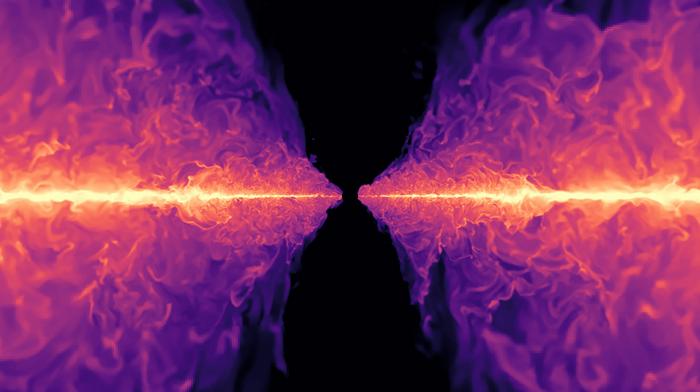
Astrophysicists have created the most detailed simulations ever made of how black holes produce some of the universe’s brightest light shows, using calculations that track every photon’s journey through the twisted fabric of space-time.
The findings could explain hundreds of mysterious faint red objects spotted in the early universe by the James Webb Space Telescope, and shed light on how stellar-mass black holes behave when gorging on material at extreme rates.
Researchers at the Flatiron Institute’s Center for Computational Astrophysics and the Institute for Advanced Study developed algorithms that solve Einstein’s equations of general relativity without taking shortcuts, a first for black hole accretion simulations. Their results appear December 3 in The Astrophysical Journal.
“This is the first time we’ve been able to see what happens when the most important physical processes in black hole accretion are included accurately,” says Lizhong Zhang, lead author of the study and a research fellow at the Simons Foundation’s Flatiron Institute in New York City.
Zhang, who is a joint postdoctoral research fellow at both institutions, says the breakthrough came from combining decades of accumulated insights into new computational methods. The team gained access to two of the world’s most powerful supercomputers, Frontier and Aurora, which can perform a quintillion operations per second.
Bright Objects From Extreme Gravity
Black holes themselves emit no light, but scorching gas and dust spiraling toward them glow intensely across the spectrum. The new simulations tracked how this material behaves around black holes approximately 10 times the sun’s mass, though the principles apply to supermassive black holes millions of times heavier.
Unlike previous studies relying on approximations, the researchers calculated exactly how light moves and interacts with matter within Einstein’s curved space-time. Zhang notes that oversimplifying assumptions can completely change outcomes.
“What’s most exciting is that our simulations now reproduce remarkably consistent behaviors across black hole systems seen in the sky, from ultraluminous X-ray sources to X-ray binaries,” Zhang explains. “In a sense, we’ve managed to ‘observe’ these systems not through a telescope, but through a computer.”
The simulations revealed three distinct disk structures depending on how fast material falls onto the black hole. At the highest rates, exceeding 100 times the Eddington limit (a theoretical maximum for spherical accretion), thick radiation-dominated disks form that drive powerful equatorial outflows. A narrow funnel-shaped photosphere results in very low radiative efficiencies, sometimes below 0.5%.
Mysterious Red Dots Explained
The super-Eddington models may help explain little red dots discovered by JWST, compact sources at high redshift showing broad emission lines suggesting active supermassive black holes. The simulations show such objects could be producing more light than the Eddington limit through a balance between gravitational inward pull and outward radiation pressure.
“Now the task is to understand all the science that is coming out of it,” says James Stone, an IAS professor and co-author of the new paper.
The research required approximately 120,000 node hours on Frontier for the highest-resolution simulations, each running to 60,000 gravitational radii in time (roughly 3,000 seconds for a 10 solar mass black hole). Christopher White of the Center for Computational Astrophysics led the design of the radiation transport algorithm, while Patrick Mullen of Los Alamos National Laboratory implemented the code optimization.
Jets and Winds Carry Energy
The simulations captured how matter spirals toward black holes, forming turbulent radiation-dominated disks, launching powerful winds and sometimes producing relativistic jets. Models with rapidly spinning black holes and strong vertical magnetic fields generated jets with velocities reaching 10 times the speed of light in coordinate-frame measurements.
At near-Eddington accretion rates (around 70-90% of the theoretical limit), the disk structure depends critically on magnetic field geometry. With net vertical magnetic flux, thin dense layers form at the midplane surrounded by magnetically dominated coronae. Without such flux, disks remain magnetically dominated throughout.
The team found radiation efficiency drops dramatically as accretion rate increases, from over 5% at sub-Eddington rates to less than 0.5% for highly super-Eddington flows. This suggests super-Eddington sources should never appear intrinsically much brighter than the Eddington luminosity, though beaming effects can make them appear brighter from certain viewing angles.