

The compressed air hissing through industrial pipes carries more than pressure. Tucked inside that flow, invisible to the naked eye, particulate matter tumbles along, each microscopic speck acquiring an electric charge as it rushes past surfaces. For decades, this electrostatic phenomenon has been a nuisance at best and a safety hazard at worst, occasionally sparking unwanted discharges in factories. But a team of researchers in South Korea has found a way to turn this industrial annoyance into useful electricity.
Sangmin Lee from Chung-Ang University in Seoul started with a simple question. His group had been studying triboelectric nanogenerators that harvest energy from gentle breezes, the sort of low-speed wind that might drift through a building or across a field. The devices work by using friction between materials to generate static electricity, much like rubbing a balloon on your hair. But what if you cranked up the pressure?
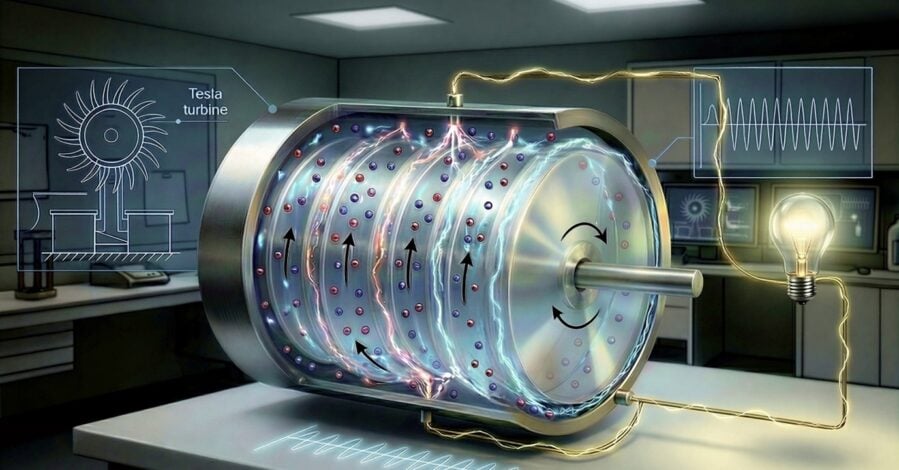
“During the research, we were curious about what would happen if high-speed—or high-pressure—wind blows onto the triboelectric nanogenerator,” Lee says. So his team built something inspired by a century-old design: the Tesla turbine. First patented by Nikola Tesla in 1913, this bladeless turbine uses closely spaced parallel disks. Fluid flowing between the disks creates viscous drag, causing the whole assembly to spin. Tesla’s original design never quite matched the efficiency of traditional turbines, but for Lee’s purposes, the architecture offered something else entirely.
The team fabricated a Tesla turbine structure specifically to work with high-pressure air. As they analyzed the data, they spotted something unexpected. The particulate matter naturally present in compressed air was generating surface charge on the triboelectric layer, without any frictional sliding between parts. This “particulate static effect” meant the device could operate as a contactless generator, spinning freely whilst harvesting electricity from the very dust particles that typically cause problems in industrial systems.
Here’s how it works. When compressed air rushes into the device, its viscous force sets the turbine disks spinning. Inside, tribo-negative and tribo-positive layers acquire electric charge from those tiny particles tumbling through. “The viscous force of compressed air induces rotational motion within the device,” Lee explains. The layers acquire surface charge “without the need for frictional sliding, allowing operation similar to non-contact tribo-electric generators.” Because there’s no friction to slow things down, the device can spin up to 8,472 revolutions per minute, generating electricity via electrostatic induction in the rotating electrodes.
The numbers are striking. Peak outputs reached 800 volts and 2.5 amperes at a frequency of 325 hertz. To put that in perspective, that’s enough voltage to power various electronic devices, or to do something rather more practical in dusty industrial environments: generate negative ions. These ions can pull moisture from the air and capture airborne dust particles, meaning the same device harvesting energy from dirty compressed air could simultaneously help clean it up.
The work, published in Advanced Energy Materials last December, marks the first demonstration of electricity generation using the particulate static effect in a Tesla turbine structure. Previous attempts to harness energy from particulate matter typically involved adding extra particles or water to the system, which limited where the technology could be used and didn’t address the ignition risks from high electric potentials. Lee’s approach sidesteps both problems. It uses only the compressed air that’s already ubiquitous in industrial settings, transforming a waste stream into a power source.
Industrial facilities generate vast amounts of compressed air and wasted airflow. Pneumatic tools, control systems, cleaning operations—all of these pump air through buildings, and much of that energy simply dissipates. If Tesla turbine generators could tap into even a fraction of this flow, they’d convert industrial waste into usable electricity whilst potentially solving two problems at once: power generation and air quality.
The team measured the particulate static effect by tracking the transferred charge in compressed air and mapping the triboelectric layer with electrostatic force microscopy. What they found suggests the effect is robust enough for real-world application. The device demonstrated successful operation powering electronic equipment, collecting water from moisture, and removing dust—three separate functions from a single piece of kit operating on compressed air alone.
There’s something fitting about using a Tesla-inspired design to harvest electricity from invisible particles. The Serbian inventor spent much of his career chasing ways to transmit and generate power wirelessly, working with principles that seemed almost magical to his contemporaries. This turbine bears his name not because it captures his original vision, but because it transforms his mechanical concept into something he might not have imagined: a generator that touches nothing yet harvests energy from the very air moving through it.
For Lee’s team, the next steps involve scaling up and finding industrial partners willing to test the system in actual facilities. The laboratory demonstrations prove the concept works, but industrial environments are messier, with varying air quality, pressure fluctuations, and maintenance constraints. Whether a frictionless turbine can hold up to continuous operation in a factory remains to be seen.
The particulate static effect opens doors beyond energy harvesting. If dust particles in moving air reliably generate charge, other researchers might exploit that phenomenon for sensors, air quality monitoring, or processes that need electrostatic fields. Lee’s work suggests we’ve been overlooking a resource that’s been rushing past us all along, carried along in the compressed air that powers modern industry. We just needed a century-old turbine design to show us how to catch it.
Study link: https://advanced.onlinelibrary.wiley.com/doi/epdf/10.1002/aenm.202506275