

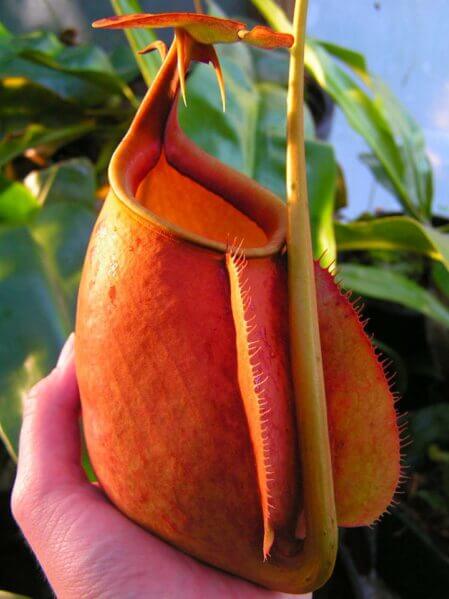
The pitcher plant species knows as Nepenthes Bicalcarata can be found in parts of eastern India is quite unique. It harbors colonies of ants in the hollow stem of its urn-shaped leaf, which, in regular times, allows it to capture and digest other kinds of insects. Still, ants are free to roam this carnivorous plant. The reason for this “permission to stay” is that the plant and the ants engage in mutually beneficial exchanges. So, while this plant might devour them, it shelters them and offers them space and prey. In return, ants protect against herbivores by defending their “nest-plant.”
Nepenthes Bicalcarata in its Natural Habitat
The pitcher plant is a kind of “insect trap.” However, this plant does not constitute a danger for all insects: for example, the ant that we see in the image can live with a pitcher plant, which does not take into account the presence of the ant.
