

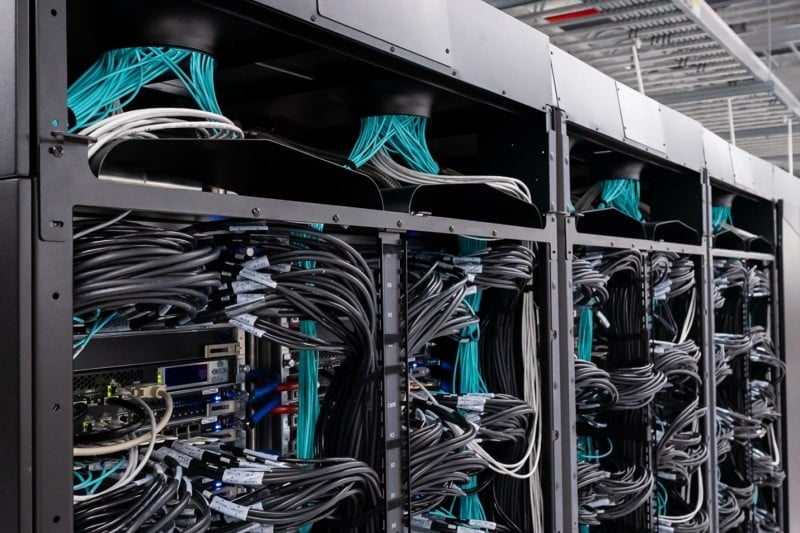
For scientists running massive simulations, there is nothing more frustrating than waiting. Even on the world’s most powerful supercomputers, like the Frontier system at Oak Ridge National Laboratory, months of work can stall because of a simple problem: the machine can’t retrieve data fast enough. This “memory bottleneck” is now the number one obstacle to major scientific breakthroughs, draining time and resources. But a new software framework is solving the problem, and its impact is stunning: it has already made complex computations up to seven times faster in some scenarios.
The core issue is that modern supercomputers use incredibly complex, multi-layered memory systems. This isn’t just one big memory block anymore. Instead, the machine juggles data across a hierarchy of devices, including slow, high-capacity storage, standard working DRAM, and lightning-fast High-Bandwidth Memory (HBM). Each device has a unique set of trade-offs, making the job of placing data correctly a logistical nightmare for the older software.
The old operating systems were never designed for this maze. They usually make bad guesses about where to store the data that’s needed most frequently. This is why a key piece of information can get stuck in the slowest storage lane, forcing the entire operation to grind to a halt while the machine waits. Clearly, scientists needed a solution that could think like a logistics expert, one that could watch an application and make smart, real-time decisions about where its data should live.
The breakthrough came from the Exascale Computing Project in the form of the Simplified Interface to Complex Memories, or SICM. Researchers created SICM to be a universal data manager for all these messy memory devices. The framework automatically monitors an application’s data use. It instantly figures out which pieces are “hot” (used constantly) and which are “cold” (used rarely). Then, it automatically moves that data to the most appropriate memory type. This intelligent tiering happens completely on its own; a programmer doesn’t have to change their program code at all.
The Data Logistics Manager That Learns on the Job
The SICM project is divided into two distinct parts. The first is the “lower tier,” a foundational interface meant for system developers and memory experts. This part gives them the granular control they need to allocate specific memory types and configure custom data pools. By keeping this low-level access clean and efficient, the researchers ensured their new tool wouldn’t slow the machine down further. Tests confirmed the low-level API adds only negligible performance overhead.
The true genius, however, lies in the “upper tier,” the automated, high-level interface. This component uses real-time intelligence to create the data placement scheme. To understand how it works, imagine the supercomputer as a giant, bustling warehouse. The SICM upper tier acts like a dedicated logistics manager watching every worker with a thermal camera. It sees, in real time, which data (or files) are most in demand. It constantly profiles memory usage and converts that into smart movement decisions.
This “online” approach is critical. It runs at the exact same time as the scientific program, avoiding the huge delays of older systems that required researchers to profile an application offline, recompile it, or manually update their code. By watching and acting concurrently, SICM keeps the workflow moving.
Developing this automatic management system meant tackling problems the hardware vendors themselves created. For instance, the SICM team originally focused on building their tool for a unified memory architecture, which vendors had promised for the newest, most powerful machines. To the team’s disappointment, supercomputers like Frontier and Aurora launched with the older, more difficult separate-address-space design. This necessitated a major pivot in how the software communicated with the hardware.
Despite these hardware hurdles, the SICM team pressed forward. They realized their work also required them to influence the industry to provide better, more dynamic performance information. One of the Oak Ridge researchers suggested their ability to affect the wider hardware ecosystem was vital:
The SICM team attempted to influence vendors to provide memory-hierarchy performance information so memory domains and their performance characteristics could be discovered dynamically rather than statically defined.
From Months to Weeks: The Sevenfold Speedup
SICM’s ultimate success stems from its approach to context. Competing methods, often run by the operating system kernel, can automatically tier data, but they lack the full picture. They only manage data at the physical memory page level, without understanding the application’s actual logic or data structures. SICM, by coupling a custom allocator with its system-wide management, provides transparent control that truly understands the program’s data objects.
When the team tested the framework with demanding scientific simulation proxies, the performance benefits were undeniable. Its online tiering approach showed significant improvements over static memory allocation methods. Impressively, it even outperformed the transparent page migration support that is built right into the operating system kernel. This proves that adding smarter functionality does not automatically mean adding a performance tax.
One researcher noted that the tool’s utility was well worth the minimal performance price:
This is an encouraging result because it shows that SICM can deliver increased functionality-the ability to allocate from different memory devices without imposing undue performance overheads on applications.
Today, the framework is proven robust across many modern, complex memory platforms. For major scientific codes that move massive data sets constantly, such as physics simulations or materials modeling, SICM provides an essential advantage. By deciding, in real time, where to stash the data, the framework has been shown to accelerate computations up to seven times, depending on the workload and memory setup. This speedup isn’t just a number; for exascale science, where researchers are already pushing the limits of possibility, a sevenfold increase in efficiency can turn a project that takes months into one that takes weeks. The SICM project has delivered a massive upgrade to the efficiency of supercomputing, giving researchers crucial time back to focus on the work of discovery.
ACM SIGPLAN International Symposium on Memory Management: 10.1145/3591195.3595277