

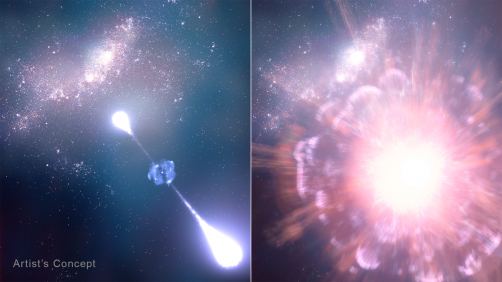
When the cosmos was a mere infant, 730 million years young, a massive star violently ended its life. This cataclysmic event, observed by NASA’s James Webb Space Telescope, is now the earliest and most distant supernova ever directly detected. It pushes the boundary of stellar observation deep into the universe’s past, breaking Webb’s own previous record. Yet, the profound surprise wasn’t its distance, but its familiarity. After rushing to pinpoint the blast, astronomers were stunned to find that this ancient stellar death looked nearly identical to modern explosions happening close to home.
This finding forces astrophysicists to question their fundamental assumptions about the earliest stars. For years, theory predicted that stars born from gas lacking heavy elements would be unique giants, collapsing in ways never before observed. These unique deaths should have produced strange, perhaps super-bright, supernovae. If a star’s violent end from the universe’s infancy is so similar to one from today, the entire process of stellar death must be far more universal and stable than anyone had realized.
The cosmic hunt began on March 14, 2025, with a fleeting flash of light: Gamma-Ray Burst 250314A. Scientists believe these long-duration bursts are the tell-tale signature of a massive star’s core collapsing to form a black hole. Alerts from the new Franco-Chinese SVOM satellite and NASA’s Neil Gehrels Swift Observatory quickly confirmed the source’s sky coordinates. From there, an international network of ground-based facilities raced to confirm the distance. Telescopes in the Canary Islands and Chile worked against the clock, eventually placing the event only 730 million years after the Big Bang.
The timing was crucial. Because the light had traveled so far across an expanding universe, its time was stretched. This meant the supernova that followed would brighten and dim not over a few weeks, but over many months for Earth observers. Detecting such a faint, redshifted signal was immensely difficult. The light came from deep inside the Era of Reionization, where gas often blocks light, making every observation feel like a gamble.
Webb’s team had secured rapid, high-priority access to the Near-Infrared Camera (NIRCAM). When the NIRCAM data finally came in on July 1, three and a half months after the initial burst, the tension in the room broke. The first clear images delivered immense relief and intense curiosity as the team realized they had resolved the supernova and its faint host galaxy, a crucial step for comparison.
A Window Into the Universe’s First Stellar Nurseries
The key finding lay in the comparison. In the local universe, core-collapse supernovae linked to GRBs, called Type Ic events, show very little variation in peak brightness. After separating the host galaxy’s glow, the ancient explosion’s brightness curve and spectral shape-the way its light was distributed across colors-matched the modern SN 1998bw prototype with striking precision. This near-identical look was deeply counterintuitive.
Theory predicted that a star this old would be metal-poor, lacking the heavy elements that normally absorb shorter wavelengths of light. This deficit should have produced a much bluer, much brighter supernova. But the light was stubbornly normal. The consistent results placed a major constraint on stellar evolution. Trying to reconcile the theoretical expectations with the observational facts, Nial Tanvir, a professor at the University of Leicester, stated the core puzzle plainly:
And lo and behold, Webb showed that this supernova looks exactly like modern supernovae. Before researchers can determine why, more data is needed.
This suggests the progenitor star was not drastically different from modern ones, arguing against more exotic scenarios, such as the collapse of a gigantic, theoretical Population III star. The observations also helped dismiss the alternative theory that the light was entirely dominated by the faint host galaxy, as the colors did not match typical early-universe galaxy light.
The detection confirmed Webb’s unique power for this kind of time-sensitive, distant work. As lead author Andrew Levan noted, the telescope achieved something previously impossible:
Only Webb could directly show that this light is from a supernova – a collapsing massive star. This observation also demonstrates that we can use Webb to find individual stars.
Beyond the supernova, Webb delivered the first clear view of the faint host galaxy where the star was born. The galaxy appears as a small, marginally extended source in the infrared. Its low brightness is typical for other galaxies at such high redshift-the measure of its distance-but capturing it at all is a tremendous advance, showing Webb’s ability to succeed where past telescopes like Hubble had often failed.
The team plans to use future bursts as a bright background light. This light will pass through the host galaxy’s gas and dust, allowing Webb to capture a precise “fingerprint” of the galaxy’s chemistry and composition. This will yield exquisite details about the interstellar medium of the most distant galaxies, offering a chemical blueprint of the universe at only five percent of its current age.
The key takeaway is that the universe has a surprisingly consistent memory. The violent deaths of these stars seem to have followed a predictable script, suggesting that even the first massive stars had efficient mechanisms for mass loss-perhaps through binary systems or sustained stellar winds-just like their contemporary counterparts. Though the discovery simplifies the variety of early cosmic events, it deepens the mystery of how those massive stars evolved to look so much like their modern counterparts.