

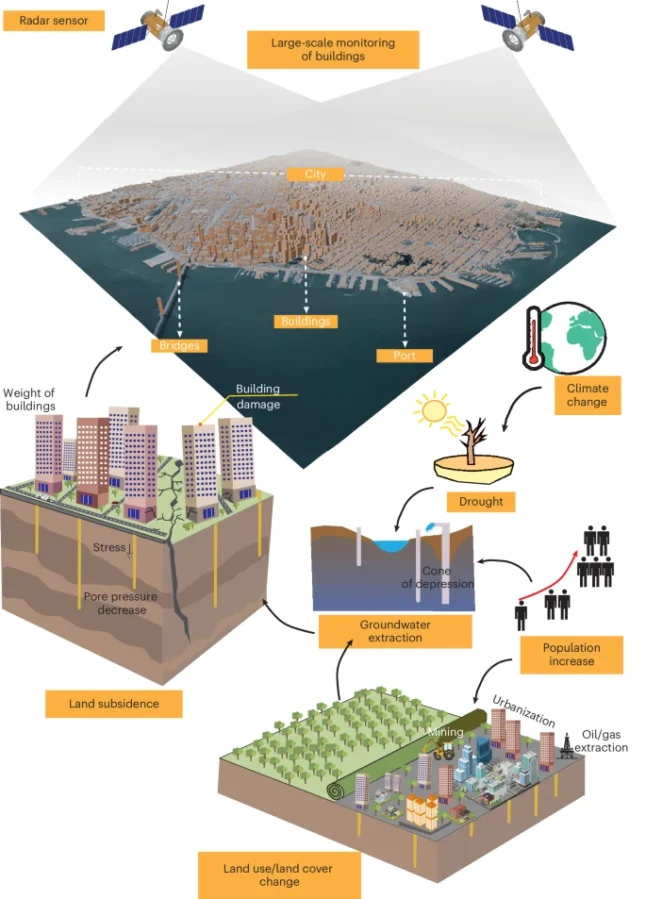
The ground beneath some of India’s largest cities is collapsing, inch by invisible inch, threatening to destabilize thousands of buildings and endanger millions of residents who have no idea the earth is shifting under their feet.
A new study tracking land subsidence across five Indian megacities reveals an alarming pattern: nearly 339 square miles of urban land is sinking, driven primarily by one resource that cities cannot live without but are draining far too quickly. Groundwater.
“When cities pump more water from aquifers than nature can replenish, the ground quite literally sinks,” said Susanna Werth, assistant professor of geosciences at Virginia Tech and co-author of the research published October 28 in Nature Sustainability. The study examined New Delhi, Mumbai, Chennai, Kolkata, and Bengaluru, home to nearly 80 million people and more than 13 million buildings.
Invisible Damage, Measurable Risk
Using satellite radar data collected between 2015 and 2023, researchers identified something most city planners would rather not see: differential ground sinking that weakens foundations, cracks utility lines, and compounds risks from flooding and earthquakes. The numbers are stark. Nearly 1.9 million people live in areas experiencing subsidence rates exceeding 4 millimeters per year. That may sound trivial, but over decades, millimeters add up to meters.
Already, the study estimates that 2,406 buildings in New Delhi, Mumbai, and Chennai face high risk of structural damage. If current trends hold, that figure could balloon to more than 23,000 buildings within the next 50 years. These are not abandoned warehouses or empty lots. These are homes, offices, schools, and hospitals standing on ground that is quietly giving way.
Lead author Nitheshnirmal Sadhasivam, a graduate student working with Werth, put it plainly:
“The silent strain we see today could lead to tomorrow’s disasters if cities do not adapt their infrastructure and groundwater management policies.”
A Global Warning Written in Satellite Data
The research team did not rely on guesswork or infrequent ground surveys. They used cutting-edge satellite radar techniques to map subsidence patterns across vast urban landscapes, revealing risks that remain hidden until something catastrophic happens. A cracked foundation here, a burst water main there. By the time the damage becomes obvious, the underlying problem has often been years in the making.
Co-author Manoochehr Shirzaei, an associate professor at Virginia Tech, emphasized the preventive power of this technology:
“Our research shows how satellite-based ground mapping techniques can reveal risks that are otherwise hidden until collapse occurs. Investing in adaptation now, through groundwater regulation, resilient design, and proactive monitoring, will save lives and resources in the long run.”
The implications stretch far beyond India. Cities worldwide are expanding rapidly, often in regions where aquifers are already stressed. Jakarta, Mexico City, and Bangkok have all experienced severe subsidence. As urban populations grow and climate patterns shift, the pressure on underground water reserves will only intensify. What is happening in India may be a preview of challenges facing dozens of other megacities in the coming decades.
The question is whether cities will act before the ground gives way, or wait until the cracks become too large to ignore. Right now, satellites are watching. The data is clear. What remains uncertain is whether policymakers will listen before the damage becomes irreversible.