

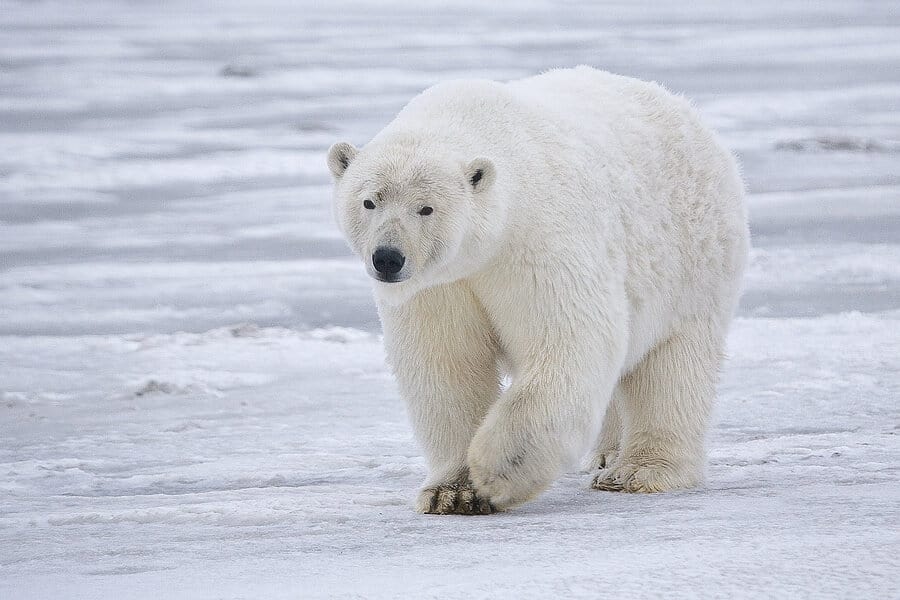
Polar bears might seem like solitary hunters, padding across the ice in pursuit of their next seal. But new research reveals they’re inadvertently running one of the Arctic’s largest food banks, abandoning roughly 7.6 million kilograms of seal carcasses each year for a sprawling network of grateful scavengers.
The study, published in Oikos, maps out for the first time just how much energy polar bears funnel from ocean to ice. Each adult bear kills an average of 1,001 kilograms of marine mammal biomass annually. They eat what they want, mostly the calorie-dense blubber, and leave the rest. About 30% of each kill becomes carrion, free for the taking on the sea ice surface.
That adds up to a staggering buffet: roughly 7 million kilograms of usable food, delivering 155 million megajoules of energy across the polar bear’s range. To put that in perspective, it’s enough to sustain at least 11 known scavenger species, from Arctic foxes to ravens, plus another eight potential diners researchers suspect are cashing in on the leftovers.
A Unique Hunting Style Creates a Unique Food Web
What makes polar bears irreplaceable isn’t just the volume of food they provide. It’s how they hunt. Unlike other predators, polar bears haul their prey from the water onto the sea ice, creating a temporary but reliable feeding station for species that would otherwise struggle to access marine resources. Picture an Arctic fox, too small to hunt seals itself, gnawing on the remains of a bearded seal while ivory gulls pick at the scraps nearby. It’s a vivid snapshot of ecological interdependence.
“What is apparent from this review is that there is no other species that adequately replaces how a polar bear hunts, in which they drag their prey from the water to the sea ice and leave substantial remains for other species to access.”
Holly Gamblin, the study’s lead author and a PhD candidate at the University of Manitoba, emphasizes that this behavior is unique in the Arctic. No other predator performs this crucial transfer of energy from sea to ice in quite the same way. The sea ice acts as a platform, a kind of communal dining hall where terrestrial and marine food webs collide.
The research, a collaboration between the University of Manitoba, San Diego Zoo Wildlife Alliance, Environment and Climate Change Canada, and the University of Alberta, paints a picture of an ecosystem far more interconnected than previously understood. Polar bears aren’t just apex predators. They’re ecological engineers, sculpting the food web with every abandoned carcass.
When the Caterer Disappears
But here’s the darker side of the story: polar bear populations are declining. Two subpopulations have already seen significant drops in abundance, and researchers estimate that translates to more than 300 tonnes of lost carrion annually. That’s 300 tonnes of food that Arctic foxes, ravens, and other scavengers can no longer count on.
The implications ripple outward. As the Arctic warms and sea ice vanishes, polar bears lose their hunting grounds. Fewer bears mean fewer seal kills, which means less carrion. Scavengers that rely on this seasonal windfall, especially during lean times, may face their own declines. The food web, already strained by climate change, loses one of its most reliable safety nets.
“The sea ice acts as a platform for many species to access scavenging resources provided by polar bears, and ultimately, declines in sea ice will reduce access to this energy source.”
Dr. Nicholas Pilfold, a scientist at San Diego Zoo Wildlife Alliance, points out that the loss isn’t just about polar bears. It’s about the entire ecosystem they support. When the ice disappears, so does the platform that makes this carrion accessible in the first place.
The study underscores an uncomfortable truth: conservation efforts aimed at saving polar bears aren’t just about preserving a charismatic megafauna. They’re about protecting the intricate web of life that depends on them, from the smallest scavenging bird to the foxes that cache seal blubber for winter. Lose the bears, and you lose the caterers. And in the Arctic, where every calorie counts, that’s a loss the ecosystem can’t afford.