

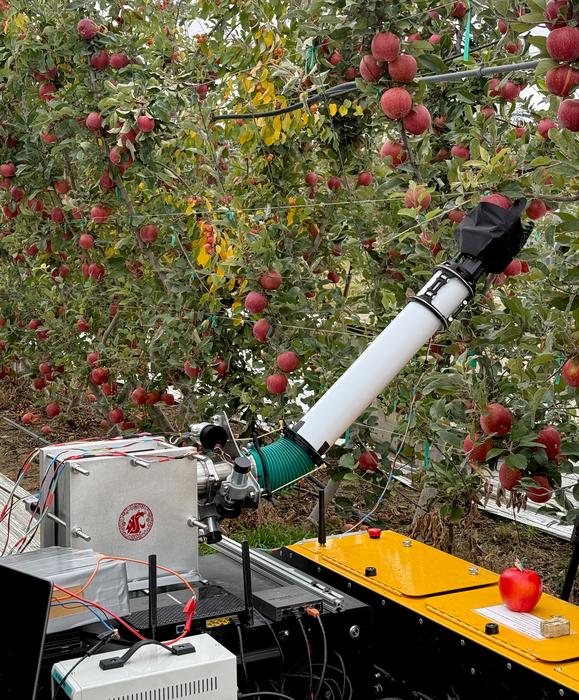
Ripe apples rotting on Washington orchard floors have become an expensive symptom of America’s agricultural labor shortage. With fewer workers available during critical harvest windows, growers are losing fruit they cannot physically pick, threatening an industry worth over $2 billion annually in the state alone. The solution might arrive not as a rigid industrial machine, but as something closer to a fabric tube that inflates and deflates like a breathing limb.
Researchers at Washington State University have developed an everting inflatable fabric manipulator, a soft robotic arm that uses pneumatic pressure to extend and retract while picking fruit. Made from Oxford fabric coated in thermoplastic polyurethane, the arm weighs less than 50 pounds including its base and stretches roughly two feet when fully extended. Unlike traditional agricultural robots built from metal and motors, this design turns itself inside out through a process called eversion, growing forward like a vine and then collapsing back just as quickly.
The system can spot a target apple, extend its fabric body, grasp the fruit, and retract in approximately 25 seconds. That’s considerably slower than a human picker who can harvest an apple every three seconds, but the research team published in Smart Agricultural Technology argues that speed alone misses the broader picture. The robot’s physical compliance allows it to bump into branches without causing damage, something rigid arms struggle to manage in dense orchard environments.
Design Built for Messy Conditions
Modern orchards increasingly use V-shaped trellises that create fruit walls, an arrangement well-suited to robots working from fixed positions. When the inflatable arm encounters an obstacle, it doesn’t snap wood or bruise fruit. Instead, the soft fabric simply deforms around the barrier and regains its shape once pressure clears. This resilience pairs with a payload capacity of 10.6 Newtons, more than sufficient for hefty Honeycrisp varieties.
The prototype costs about $5,500 in materials, a fraction of industrial-grade alternatives that have contributed to previous agricultural robotics failures. PhD candidate Ryan Dorosh, the study’s lead author, points to this simplicity as the design’s core advantage in unpredictable outdoor settings.
“The uncomplicated nature of the design makes it low-cost, easy to maintain, and highly reliable for a soft robot,” Dorosh explains.
There’s no grinding of gears when the arm moves, only the soft hiss of air and fabric rustling against leaves. The team envisions deploying multiple units simultaneously to compensate for individual picking speed, an approach made feasible by the low per-unit cost. Assistant professor Ming Luo, who leads the research, witnessed the waste problem firsthand during orchard visits where perfectly good fruit sat unpicked simply because no workers were available.
Three Years to Commercial Orchards
The current bottleneck isn’t the arm itself but the basic vision system used to locate fruit. Upgrading detection capabilities could dramatically reduce cycle times. The researchers are already refining mechanical motors and integrating the arm with automated mobile platforms that can navigate orchard rows independently.
Beyond harvesting, the team is adapting the inflatable design for pruning, flower thinning, and spraying tasks that occupy workers throughout growing seasons. Making one inexpensive platform capable of multiple jobs could let growers deploy robot fleets that handle repetitive, physically demanding work while human oversight focuses on skilled decision-making.
Field testing has begun at Allan Brothers Fruit in Prosser, Washington, with support from the National Science Foundation, USDA, and Washington Tree Fruit Research Commission. WSU’s Office of Innovation and Entrepreneurship is now helping move the technology toward commercialization. The aging workforce and declining migrant labor numbers that affect Washington’s apple and cherry industries mirror challenges facing tree fruit growers worldwide, making solutions applicable far beyond the Pacific Northwest.
The inflatable arm won’t replace farm workers overnight. What it offers is a path for farms adapting to scarcer labor by blending human expertise with machines capable of tedious physical tasks. If the next three years of commercial integration succeed, these fabric helpers might ensure that future harvests reach stores rather than decomposing between orchard rows.