

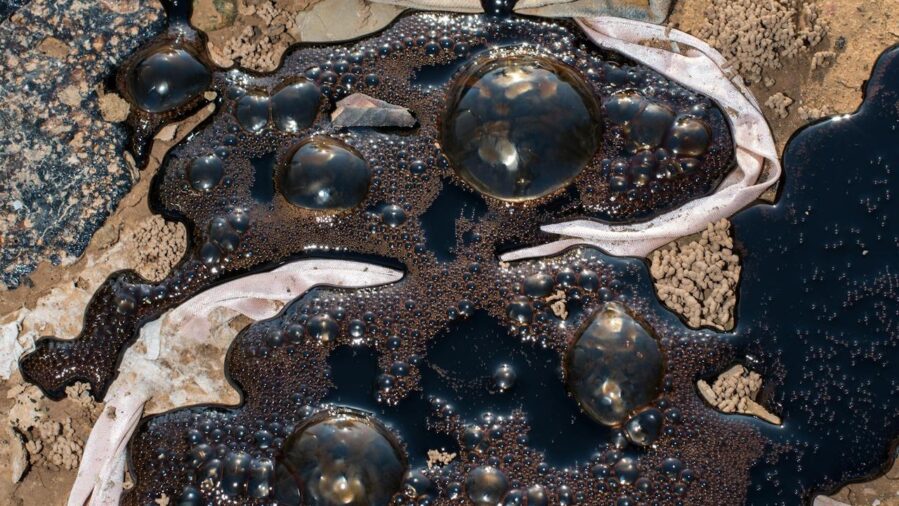
The black sludge was thick enough to feel. Volunteers picking up trash on Palm Beach in 2020 kept finding bottles crusted with oil, sometimes in layers several millimeters deep. The labels were in Portuguese. There was no local spill to blame.
Chemical analysis has traced that oil back to Brazil’s massive 2019 mystery spill, which blackened over 3,000 kilometers of South American coastline. The debris drifted more than 5,200 miles across the equator, carried by the North Brazil Current and Gulf Stream over roughly eight months. What makes the journey remarkable isn’t the distance. It’s that oil, which typically breaks down within a few hundred miles of a spill, survived the crossing by clinging to plastic.
According to findings published in Environmental Science & Technology, floating debris acts as a protective shield. Sunlight and microbes normally degrade spilled oil quickly, but when it adheres to capped bottles and rubber blocks, those smooth surfaces keep it intact. Computer models showed the items could reach Florida in about 240 days, though exact timing depends on when they entered the water off South America. The study’s lead author, Bryan James of Northeastern University, used high-resolution molecular fingerprinting to match the Florida residues to samples collected during the Brazilian spill.
Rubber bales and a sunken warship
Some of the debris included heavy rubber blocks suspected to come from the SS Rio Grande, a German supply ship that sank during World War II and may still be leaking somewhere off the coast. That connection remains unproven. But it points to how old pollution sources can overlap with new ones in ways that make tracing contamination back to a single event nearly impossible.
The breakthrough came from consistency. Friends of Palm Beach, a volunteer cleanup group, surveys the same stretch almost daily. They noticed the oiled items arriving in a sudden influx and flagged the pattern before the evidence washed back out or got buried in sand.
“The research findings of our study would not have been possible without the dedication of the Friends of Palm Beach,” Bryan James explains.
Christopher Reddy at Woods Hole Oceanographic Institution points out that regional spills can now be understood as inherently global problems, moving through currents that link distant coastlines in ways that complicate both cleanup and accountability.
When two pollution crises converge
The term “petroplastic” describes this hybrid threat. Plastic debris doesn’t just pollute on its own. It extends the lifespan and range of oil contamination, ferrying it across ocean basins that would otherwise act as natural barriers. The phenomenon may be far more common than currently documented, especially where oil slicks and plastic accumulation zones intersect.
The sheer volume of plastic floating in the ocean is creating a transport network for other contaminants. A spill off one continent can resurface months later on another, disguised as ordinary beach trash. Ocean currents function as highways, and what enters the water in Brazil doesn’t stay there.
The rubber bales are still a mystery. So is the full extent of how far oil can travel when it has plastic to ride on. What’s clear is that monitoring oil spills now requires tracking debris across multiple countries and ocean basins, not just the coastline where contamination first appears.