

Your liver handles roughly 500 jobs, from scrubbing bacteria out of your blood to breaking down every paracetamol you’ve ever swallowed. Lose it and you’re in deep trouble. More than 10,000 Americans sit on the transplant waitlist for one right now, and plenty of those who need a new liver will never qualify for the surgery because they’re simply too sick to survive it.
That catch-22 has driven Sangeeta Bhatia’s lab at MIT to ask a different question entirely. What if you didn’t replace the organ at all, but instead scattered backup copies of its working cells around the body?
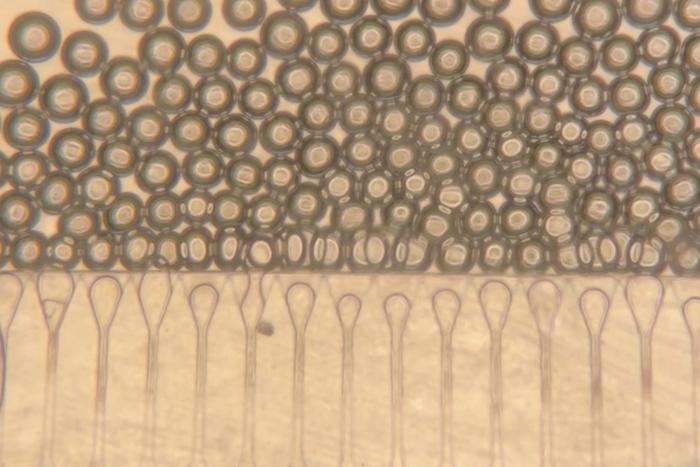
In a study published today in Cell Biomaterials, Bhatia’s team describes tiny injectable constructs they call “satellite livers,” built from human hepatocytes (the cells that do most of the liver’s heavy lifting) packed alongside hydrogel microspheres about a tenth of a millimetre across. The spheres are the clever bit. When squeezed through a syringe needle they behave like a liquid, flowing freely; once inside the body they jam together into a spongy scaffold riddled with pores. Blood vessels creep into those gaps within days, hooking the transplanted cells up to the host’s circulation and keeping them fed. “We think of these as satellite livers,” Bhatia says. “If we could deliver these cells into the body, while leaving the sick organ in place, that would provide booster function.”
The approach, which the team calls INSITE, sidesteps a problem that has nagged the field for years. Earlier attempts to inject hepatocytes on their own mostly ended in failure; without a physical niche to anchor them the cells scattered, failed to engraft and quietly died off.
Vardhman Kumar, the MIT postdoc who led the work, says the microspheres solve that. “If the cells are injected in the absence of these spheres, they would not integrate efficiently with the host, but these microspheres provide the hepatocytes with a niche where they can stay localized and become connected to the host circulation much faster.” And because the whole package can be delivered through a needle under ultrasound guidance, there is no scalpel involved. The team even used ultrasound to track the grafts over time, watching as new blood vessels threaded their way into the scaffold.
In tests on immunodeficient mice, the researchers injected the hepatocyte-microsphere slurry into abdominal fat tissue. Over eight weeks the cells stayed put, produced human albumin and other liver proteins, and showed no signs of dying off. Meanwhile, grafts made from hepatocytes injected without the microspheres dispersed almost immediately, leaving only scattered clusters with far less function. “The new blood vessels formed right next to the hepatocytes, which is why they were able to survive,” Kumar says. “They were able to get the nutrients delivered right to them, they were able to function the way they’re supposed to, and they produced the proteins that we expect them to.”
The team also found they could tune the scaffold’s behaviour by tweaking how tightly the hydrogel was crosslinked. A version that degraded faster actually performed better; it encouraged larger blood vessels to invade the graft and boosted albumin output at four weeks. The trade-off was that the scaffold itself began disappearing, which is probably fine if the cells have already woven themselves into the host tissue. Probably.
One thing worth noting: the graft doesn’t have to sit anywhere near the actual liver. “For a vast majority of liver disorders, the graft does not need to sit close to the liver,” Kumar says. Future versions could be tucked into the spleen, near the kidneys, wherever there’s room and a decent blood supply. The researchers even suggest that multiple small grafts scattered across different sites might outperform a single large one, because smaller deposits avoid the oxygen-starved dead zones that can form in the middle of thick tissue.
Kumar sees the technology as both an alternative and a stopgap. “The way we see this technology is it can provide an alternative to surgery, but it can also serve as a bridge to transplantation where these grafts can provide support until a donor organ becomes available,” he says. “And if we think they might need another therapy or more grafts, the barriers to do that are much less with this injectable technology than undergoing another surgery.”
There are caveats, of course. The mice were immunodeficient, which means the team sidestepped the question of immune rejection. In real patients, immunosuppressive drugs would almost certainly be needed, at least initially. Bhatia’s group is already exploring hepatocytes engineered to dodge the immune system, and the microspheres themselves could potentially deliver immunosuppressants locally rather than flooding the whole body. Whether any of that pans out remains to be seen.
Still, the broader vision is striking. The same injectable scaffold could, in principle, support transplanted pancreatic islet cells for people with type 1 diabetes, or perhaps other cell types that currently require open surgery to implant. For the 10,000-odd people waiting on the liver transplant list, the idea of a procedure done with a needle and an ultrasound screen rather than a six-hour operation is a long way from clinical reality. But it’s no longer just theoretical, either.
Study link: https://www.cell.com/cell-biomaterials/fulltext/S3050-5623(26)00034-6