

Engineers at North Carolina State University have built something that looks like a paper craft and behaves like a pocket transformer.
The team reports a polymer structure that resembles a Chinese lantern and can rapidly snap into more than a dozen three dimensional shapes when nudged by compression, twisting, or a magnetic field. The hook is not just the flourish. Speed, control, and reprogrammability are the point, and the group frames this as a general blueprint for mechanical metamaterials that store and release elastic energy on cue.
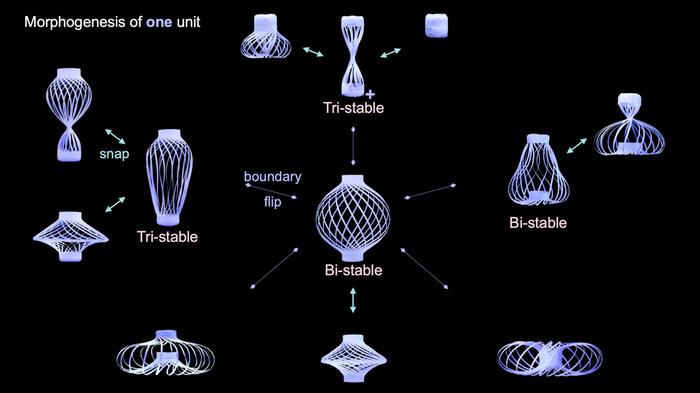
The basic unit is deceptively simple. Start with a thin polymer sheet cut into parallel ribbons that remain connected at top and bottom, then paste the ends together so the sheet forms a sphere like lantern. Geometry does the rest. By tuning one intrinsic angle that sets how the ribbons skew, and two extrinsic angles that determine flipping and twisting, the team programs both shape and stability. The result is a catalog of morphologies that include vase, sandglass, cone, spinning top, compact yarn, and a garlic like bulb. Some states are stable, others are multistable, and several snap between configurations with a flicker of stored energy.
“In other words, it has two stable forms. It is stable in its lantern shape, of course.”
That observation, from the project authors, captures the underlying physics. Bistability lets the unit hold its shape without power, then release energy quickly when triggered. In tests, increasing the skew angle loads more elastic energy into the ribbons, shifting behavior from torsion dominated to curvature dominated responses. Past a threshold, compression pushes the lantern through a critical point where it snaps into a spinning top shape. Remove the load, and it stays put until a reverse action flips it back. No motors, no wires, just elastic energy shuttled between states.
Magnets turn snapping into remote control
Because the team can add a thin magnetic film to one end of the structure, twisting and compressing can be done at a distance. Rotate the magnetic field, and the ribbons coil inward as energy accumulates. Pass a critical angle, and the shape snaps shut into a spherical bud in a fraction of a second. Reverse the rotation, and the bud reopens into a bloom just as fast. The group demonstrates gentle but firm grasping of delicate targets underwater, including live fish and eggs, where the closing shell protects the payload during extraction. That same paradigm becomes a switchable valve. In the open, vase like state, flow continues through a tube. Snap into the sandglass configuration, and the tube kinks shut, blocking the water until the field is relaxed.
The skeptical question is whether this is lab theater or a platform. The authors argue for the latter. They provide phase diagrams that map the three governing angles to stability regimes, which is an engineer friendly way to move from showpiece to design rule. The math connects shapes to stored energy, predicts critical points for snapping, and matches the experiments closely. It also explains why flipping the boundary strips, essentially reorienting ribbon endpoints, redistributes energy enough to enable tri or even quadrastability in some variants.
“Each of these variations is also multistable. Some can snap back and forth between two stable states.”
That claim is supported by prototypes that can shuttle among two, three, or four resting states depending on the chosen angles and triggers. The richness comes from the cluster of interacting ribbons, which autonomously select deformation pathways that single ribbon systems cannot access without external torques. In short, the lantern is not just pretty. It is a compact machine for storing elastic energy and releasing it as controlled motion.
From solo units to metamaterials
As a single unit, the lantern suggests soft robotic grippers, deployable mechanisms, and flow controllers suited to tight or delicate environments. As an array, it hints at mechanical logic and architected materials that can switch stiffness, volume, or permeability. The parts are thin plastic and a magnetoresponsive elastomer, the actuation is a rotating field, and the response is fast, reversible, and power frugal once a state is reached. The authors say the snapping framework scales across sizes and materials, which, if borne out, would make it easier to integrate these units into real devices.
There is still distance between an elegant phase diagram and a medical implant or industrial valve. Fatigue, fouling, and long term reliability will matter, and energy barriers must be tuned so devices resist accidental triggers. But the core idea is both clear and surprisingly tactile. By cutting and joining ribbons to create coupled bending and torsion, the team turned a sheet into a storehouse of elastic energy that can be programmed, reprogrammed, then unleashed exactly when needed. It is a lantern that blooms, captures, and releases on command, which is a fine definition of useful.