

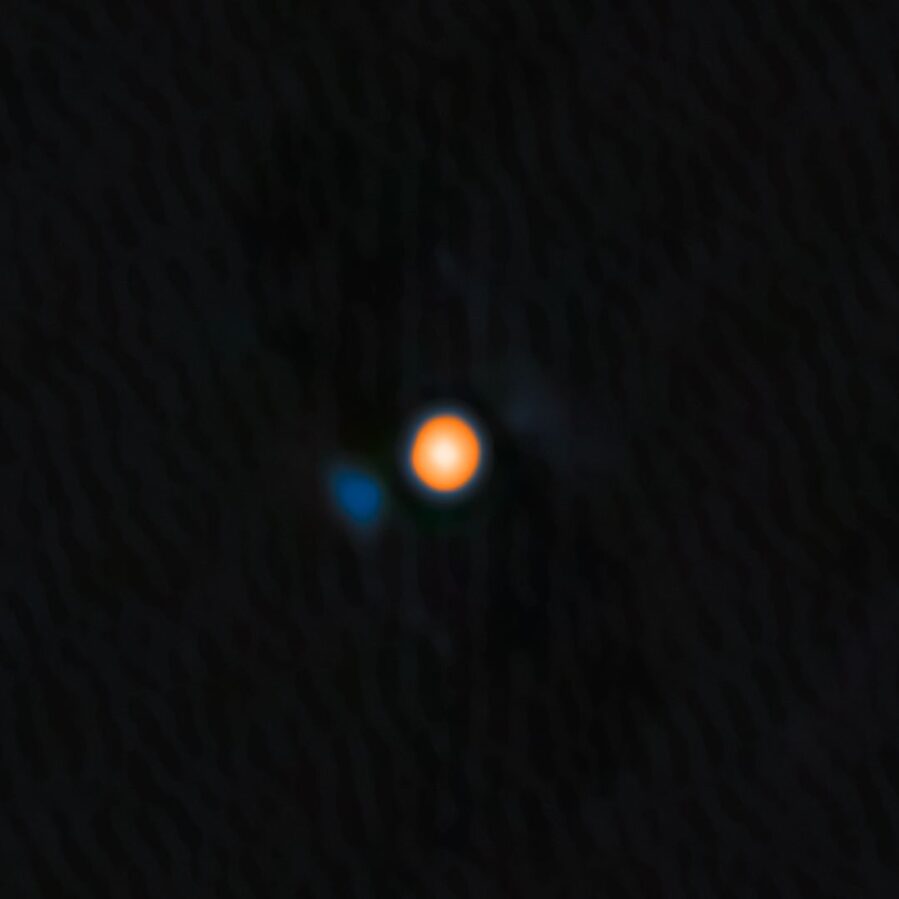
A century-old mystery surrounding Betelgeuse, the red supergiant glowing in Orion’s shoulder, may finally be solved. Astronomers using one of the world’s largest telescopes have likely spotted the star’s long-predicted companion.
Their observations, published July 24 in *The Astrophysical Journal Letters*, suggest this elusive stellar partner may explain Betelgeuse’s puzzling long-term fluctuations in brightness. The find marks the first probable direct imaging of a close orbiting star around Betelgeuse and could help unravel how massive stars evolve in their final stages before supernova.
The Case of the Flickering Giant
Betelgeuse, the 10th brightest star in the night sky, has fascinated astronomers for centuries. Its light wavers with strange rhythms that simple pulsation models couldn’t fully explain. A possible answer emerged long ago: perhaps the red giant had a smaller companion star, gravitationally nudging it and triggering periodic dimming. But proving that theory was tricky.
Betelgeuse is a massive star, more than 700 times the Sun’s diameter, and its blinding brightness makes it difficult to detect nearby fainter objects. Telescopes struggled to distinguish any stellar partner hidden in its overwhelming glare.
That changed in December 2024 when Steve Howell, a senior scientist at NASA’s Ames Research Center, used the Gemini North telescope in Hawai’i. The observatory’s high-resolution ‘Alopeke speckle camera allowed his team to bypass atmospheric blur by rapidly capturing thousands of split-second exposures, later combined to filter out noise and sharpen the image.
Timing Was Everything
Two prior studies had predicted that if a companion existed, it would briefly emerge from behind Betelgeuse in late 2024, reaching maximum separation before swinging back behind the giant. This narrow observational window gave Howell and his colleagues just days to attempt a direct image.
Their strategy worked. On December 9, 2024, the team imaged a faint object just 52 milliarcseconds from Betelgeuse, in exactly the spot models had forecast. That proximity, along with its predicted brightness and orbit angle, strongly suggests it is not a background star but a true gravitational partner.
“We find a separation of 52 milliarcseconds and a position angle of 115 degrees,” the researchers wrote. “The companion is not detected in 2020 — as expected — and is detected in 2024 at the separation and position angle predicted.” The detection had a signal-to-noise ratio of roughly 1.6, which is modest, but the match with five independent predictions strengthens the case.
What Kind of Star Is It?
Based on its estimated brightness and proximity, the team believes the companion is a young, roughly 1.6 solar mass star. Likely a pre–main sequence F-type star, it is about 6 magnitudes fainter than Betelgeuse and may never reach full maturity. Betelgeuse itself is only 10 million years old and expected to explode as a supernova in the relatively near cosmic future.
Other models have suggested a smaller companion, possibly just 0.6 solar masses. However, the newly imaged object appears too bright for that lower estimate, favoring a slightly heavier classification.
A Bracelet Around the Giant’s Hand
The team gave the companion a name: “Siwarha,” derived from Arabic and meaning “her bracelet.” Betelgeuse’s own name also traces back to Arabic and refers to the “hand” of the giant figure in Orion. The poetic pairing adds cultural resonance to the scientific discovery.
Looking Ahead
This detection opens the door to deeper investigations of red supergiants and their companions. Continued monitoring is planned, especially when Siwarha reaches its next point of maximum separation in November 2027. At that time, the view should again offer a rare chance to image the star free of Betelgeuse’s blinding influence.
“I hope our discovery excites other astrophysicists about the robust power of ground-based telescopes and speckle imagers,” said Howell. “This can help unlock the great mysteries in our universe.”
Key Findings
- NASA scientists likely imaged a long-predicted companion star to Betelgeuse.
- The detection occurred during a narrow orbital window predicted by past studies.
- The faint companion, named Siwarha, lies just 52 milliarcseconds from Betelgeuse.
- Siwarha may help explain Betelgeuse’s strange long-period dimming cycles.
- The discovery relied on ground-based speckle imaging to overcome atmospheric distortion.
Journal Information
Study: “Probable Direct Imaging Discovery of the Stellar Companion to Betelgeuse”
Authors: Steve B. Howell et al.
Published in: The Astrophysical Journal Letters, Volume 988, Number 2 (July 24, 2025)
DOI: 10.3847/2041-8213/adeaaf