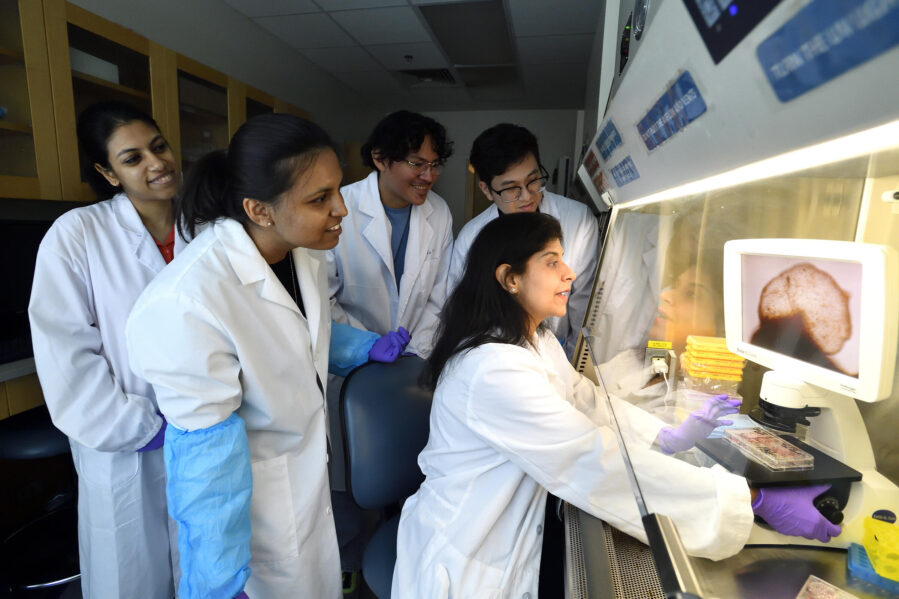
Scientists at Johns Hopkins University have created a lab-grown “whole-brain” organoid, an astonishingly complex mini-brain that could reshape how we study schizophrenia, autism, Alzheimer’s, and other whole-brain neurological disorders.
Unlike earlier models that replicate only one region, this new multi-region brain organoid (MRBO) includes connected tissues from across the brain, rudimentary blood vessels, and even signs of a blood-brain barrier. It is a leap forward in modeling how the human brain develops, malfunctions, and responds to treatment, all without ever entering a human skull.
A Brain in a Dish, Rewired for Realism
“We’ve made the next generation of brain organoids,” said Annie Kathuria, lead author of the study and an assistant professor of biomedical engineering at Johns Hopkins. “Most brain organoids that you see in papers are one brain region, like the cortex or the hindbrain or midbrain. We’ve grown a rudimentary whole-brain organoid; we call it the multi-region brain organoid (MRBO).”
The achievement, published in Advanced Science, marks one of the first times scientists have successfully integrated cerebral, mid/hindbrain, and vascular components into a single organoid. The resulting structure reflects roughly 80% of the cell types found in a 40-day-old human fetal brain, including neural progenitors, mature neurons, pericytes, and endothelial cells.
How to Grow a Brain
To build the MRBO, Kathuria’s team grew individual brain region organoids and vascular tissues separately from human induced pluripotent stem cells. These were then fused together using sticky proteins and Matrigel to form a cohesive whole. As they matured, the tissues began to communicate electrically, resembling coordinated brain activity.
In effect, they assembled a working brain-like structure from scratch, with electrical bursts, regional patterning, and even signs of early blood-brain barrier formation.
Why It Matters: Diseases That Don’t Stay in One Region
Neurological diseases like autism and schizophrenia don’t confine themselves to one part of the brain. Traditional models, often limited to animal brains or isolated brain regions, fail to capture this complexity. MRBOs may change that.
- MRBOs replicate neural and vascular interactions across cerebral, midbrain, and hindbrain regions.
- The organoids show development of the blood-brain barrier, a critical interface in many neurological diseases.
- Electrophysiology tests revealed complex network activity patterns across brain regions.
- Endothelial cells influenced hindbrain development but not cerebral regions, suggesting regional dependencies.
- Gene expression patterns matched 80% of the cellular makeup of a human fetal brain at Carnegie stages 12–16.
“We need to study models with human cells if you want to understand neurodevelopmental disorders or neuropsychiatric disorders,” Kathuria explained. “But I can’t ask a person to let me take a peek at their brain just to study autism.”
One Brain, Many Possibilities
The MRBO model opens new paths for testing drug effects in human-like systems, especially since more than 90% of neuropsychiatric drugs fail in early trials. With the ability to watch disorders unfold in real time, researchers could eventually use patient-specific organoids to tailor treatment strategies, particularly for complex, region-spanning conditions like bipolar disorder or vascular dementia.
“Whole-brain organoids let us watch disorders develop in real time, see if treatments work, and even tailor therapies to individual patients,” Kathuria said.
Future Directions and Caveats
While this organoid does not yet replicate long-range brain wiring or a fully functional blood-brain barrier, it gets far closer than previous models. Ongoing work aims to incorporate microglia and additional immune cells to increase realism. In the future, MRBOs might help bridge the gap between basic lab research and clinical trials.
For now, this lab-grown mini-brain is not thinking, feeling, or dreaming. But it is responding. And it just might change how we respond to some of the brain’s most confounding diseases.
Journal Reference
Title: Multi-Region Brain Organoids Integrating Cerebral, Mid-Hindbrain, and Endothelial Systems
Authors: Anannya Kshirsagar, Hayk Mnatsakanyan, Sai Kulkarni, John Guo, Kai Cheng, Luke Daniel Ofria, Oce Bohra, Ram Sagar, Vasiliki Mahairaki, Christian E Badr, Annie Kathuria
Journal: Advanced Science
DOI: 10.1002/advs.202503768
Published: July 8, 2025