

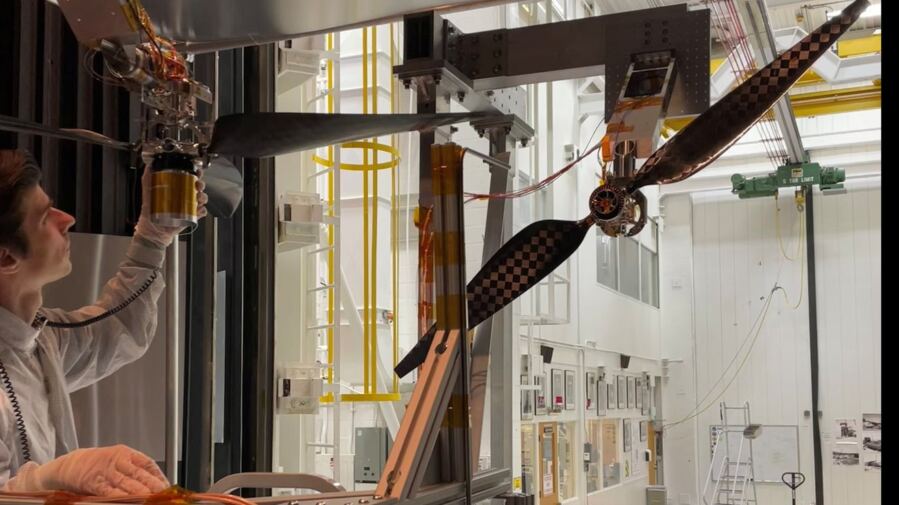
The tip of a rotor blade is a small thing to hang a mission on. Moving faster than any other part of the aircraft, it does the real work: slapping at molecules of air, trading kinetic energy for lift. On Mars, where the atmosphere is roughly 1% as dense as Earth’s, those molecules are scarce enough that the blade tip has to move extraordinarily fast just to keep anything airborne at all. Engineers at NASA’s Jet Propulsion Laboratory have now pushed prototype rotor blades for the next generation of Mars helicopters past Mach 1, demonstrating that the sonic barrier, long treated as a hard boundary for Martian flight, is not as impassable as everyone assumed.
The tests took place over 137 runs inside JPL’s 25-Foot Space Simulator, a cavernous cylindrical chamber where the air was evacuated and replaced with just enough carbon dioxide to approximate the Martian atmosphere. Engineers then blasted the spinning rotors with headwinds, ratcheting up wind velocity between runs. Tip speeds reached Mach 1.08. Nobody’s quite done that before, not on purpose, not in a controlled setting, not while gathering data they could actually use.
Why the Sound Barrier Matters on a Thin-Air Planet
The physics are counterintuitive and worth unpacking. On Earth, rotor blades don’t normally need to approach the sound barrier because there are enough air molecules available at lower speeds to generate useful lift. Mars removes that luxury. With gravity at roughly 38% of Earth’s but an atmosphere only about 1% as dense, a helicopter is essentially flying in a near-vacuum, which means rotor tips must move extremely fast or the vehicle simply drops. Ingenuity, the small drone that made history in April 2021 as the first powered aircraft to fly on another world, ran its composite-skinned foam rotors at no more than 2,700 rpm during its 72 flights, keeping blade tips at around Mach 0.7. That safety margin was deliberate. “If Chuck Yeager were here, he’d tell you things can get squirrely around Mach 1,” said Jaakko Karras, the rotor test lead at JPL, referring to the unpredictable aerodynamics that cluster around the sonic threshold. The team kept well below it, so that even a strong Martian headwind, say from a passing dust devil, couldn’t push the tips into dangerous territory. Future missions have less tolerance for that kind of conservatism.
The SkyFall project, which NASA announced recently with a planned December 2028 launch, is designed to carry three next-generation Mars helicopters to the Red Planet. Unlike Ingenuity, which carried no science instruments whatsoever, these aircraft are meant to work: deploying sensors, gathering data, possibly scouting terrain for human missions further down the line. Heavier payloads mean heavier aircraft, and heavier aircraft need more lift, which means faster rotors. So the question, put bluntly, was whether materials and aerodynamics could hold together once blade tips crossed the sound barrier.
Sheet Metal Precautions and a Pleasant Surprise
The engineers were cautious enough about what might happen to line part of the chamber with sheet metal. If the blades broke apart at supersonic speeds, the metal cladding would catch the debris. From a control room a few yards away, Karras and his team watched displays showing rpm, wind velocity, and a live view inside the chamber as the rotor spun up to 3,750 rpm, putting tip speeds at Mach 0.98 before the headwind fan was even switched on. Introducing headwinds pushed the tips over the line. They reached Mach 1.08 on the final runs, and nothing broke apart. The sheet metal, it seems, was unnecessary.
A second rotor, the two-bladed SkyFall design, was slightly longer than the three-bladed version and required only 3,570 rpm to approach the same near-supersonic tip speed before the headwind test began. Both configurations survived. Pushing beyond Mach 1 increased the lift capability of future Mars vehicles by roughly 30%, meaning the next-generation helicopters could carry significantly heavier instrument packages than previously thought possible.
“The successful testing of these rotors was a major step toward proving the feasibility of flight in more demanding environments, which is key for next-gen vehicles,” said Shannah Withrow-Maser, an aerodynamicist from NASA’s Ames Research Center who was part of the test team. “We thought we’d be lucky to hit Mach 1.05, and we reached Mach 1.08 on our last runs. We’re still digging into the data, and there may be even more thrust on the table.”
That last sentence is the one worth sitting with. Engineers typically celebrate a successful test, tick a box, move on. The suggestion that Mach 1.08 might not be the ceiling, that the data could reveal additional performance headroom, points to something genuinely open-ended about where this technology is headed.
The Distance Between Ingenuity and What Comes Next
Ingenuity’s achievement, five years ago now, was thrilling precisely because it was so constrained. The helicopter weighed about 1.8 kilograms, carried no instruments, and its job was simply to prove that controlled powered flight was possible in the Martian atmosphere. It did that job 72 times before going quiet early in 2024, its rotor blade damaged by a hard landing. What it demonstrated was possibility; what the SkyFall mission and its successors are being asked to demonstrate is utility.
Al Chen, Mars Exploration Program manager at JPL, put the challenge in terms that do not invite understatement. “Flying there is just about the hardest thing you can do,” he said. “That’s because its atmosphere is so incredibly thin that it is hard to generate lift, and yet Mars has significant gravity.” The gap between Ingenuity and what follows is not merely a matter of scale. It requires a fundamental rethink of what rotorcraft on Mars can tolerate, including, apparently, crossing a barrier that most aircraft engineers spend their careers trying to avoid.
The 137-test dataset from the JPL chamber now feeds directly into SkyFall’s performance specifications. Three next-generation helicopters, riding a carrier spacecraft toward Mars, are meant to touch down in late 2028 or thereabouts. Each one will carry science instruments. Each one will have rotor tips capable of pushing past the speed of sound, in an atmosphere where sound itself travels more slowly than it does here, about 540 mph compared with roughly 760 mph at sea level on Earth. The physics conspire oddly in Mars’s favour, at least in that narrow respect. Whether they conspire oddly enough to make aerial science at the Red Planet routine is, still, an open question, though the answer is beginning to look more plausible than it did before March.
https://science.nasa.gov/mars/
Frequently Asked Questions
Why is flying a helicopter on Mars so much harder than on Earth?
Mars has an atmosphere only about 1% as dense as Earth’s, which means rotor blades have far fewer air molecules to push against to generate lift. At the same time, Martian gravity is still about 38% of Earth’s, so there is meaningful weight to overcome. The combination forces engineers to spin rotors at much higher speeds than would ever be needed on Earth, pushing blade tips toward and eventually past the speed of sound.
What does “Mach 1.08” actually mean for a rotor blade on Mars?
Mach 1 is the speed of sound in a given medium, and on Mars that works out to roughly 540 mph because the atmosphere is cold and thin and composed mostly of carbon dioxide. A rotor tip moving at Mach 1.08 is therefore travelling at just over 583 mph. The significance is that supersonic airflow around a blade behaves differently from subsonic airflow, with shock waves forming at the tip that can generate unpredictable forces and stress the blade structure. The JPL tests confirmed the prototype blades can tolerate those forces without failing.
What happened to Ingenuity, the first Mars helicopter?
Ingenuity completed 72 flights between April 2021 and early 2024, far exceeding its planned five-flight technology demonstration. Its final mission ended when a rotor blade was damaged during a hard landing in January 2024, leaving the helicopter unable to fly again. It carried no science instruments and was always intended as a proof-of-concept. The next-generation aircraft being developed under projects like SkyFall are designed to carry actual science payloads and conduct meaningful data gathering.
What is the SkyFall mission and when will it launch?
SkyFall is a NASA mission designed to deliver three next-generation Mars helicopters to the Red Planet. It is currently planned for a December 2028 launch. Unlike Ingenuity, which flew alone, the SkyFall helicopters will carry science instruments and sensors, making them operational tools for exploration rather than technology demonstrators. The rotor blade tests completed in March 2026 have directly informed the performance specifications for those aircraft.
Could supersonic rotor blades be used on other planets or moons?
Possibly, though the engineering challenges vary considerably with each environment. Titan, Saturn’s largest moon, is often cited as a candidate for aerial exploration because its dense atmosphere and low gravity make flight comparatively easy, and NASA’s Dragonfly mission is already in development to fly a rotorcraft there. Pushing rotor tips to supersonic speeds is a problem specific to thin-atmosphere worlds like Mars. The techniques and materials developed for these tests could, in principle, inform future designs for any environment where lift generation is unusually difficult.