

If there are Martian microbes frozen in the Red Planet’s ice, they might stay surprisingly fresh. New experiments suggest that protein fragments from bacteria could remain intact for over 50 million years in pure ice, despite constant bombardment by cosmic radiation. That’s far longer than scientists expected, and it means future missions hunting for life on Mars should probably skip the rocks and head straight for the ice.
The findings come from researchers at Penn State and NASA Goddard Space Flight Center, who essentially created miniature Mars conditions in their lab. They froze E. coli bacteria in test tubes, blasted them with gamma radiation to simulate cosmic rays, and checked what remained. The results were striking: in pure water ice, more than 10% of the amino acids, the building blocks of proteins, survived what amounts to 50 million years of space radiation. In samples mixed with Mars-like soil and minerals, however, amino acids degraded ten times faster.
“Fifty million years is far greater than the expected age for some current surface ice deposits on Mars, which are often less than two million years old, meaning any organic life present within the ice would be preserved.”
That’s Penn State geosciences professor Christopher House, and he’s pointing to something important. Most of Mars’ surface ice is actually pretty young, geologically speaking, less than a couple million years old. If microbes or their remains got trapped in that ice somehow, maybe hitching a ride on dust particles or sitting dormant in the frozen ground, they’d have plenty of time before radiation erased all trace of them.
Why Ice Protects Better Than Dirt
The protection mechanism appears counterintuitive at first. You might think that minerals would shield fragile organic molecules, but the opposite seems true. When radiation hits ice mixed with soil particles, it creates a thin film of liquid water where ice meets mineral surfaces. Even at minus 60 degrees Fahrenheit, the temperature used in the experiments, these molecular-thin water layers stay liquid because water molecules bond more strongly to mineral surfaces than to the surrounding ice.
These liquid films act like highways for destructive particles. Radiation breaks apart water molecules, creating hydroxyl radicals and other reactive species that tear through amino acids. In pure ice, those radicals get frozen in place. They can’t move around to cause much damage. Lead researcher Alexander Pavlov from NASA Goddard, who did his doctorate at Penn State two decades ago, explained the finding caught them off guard.
“Based on the 2022 study findings, it was thought that organic material in ice or water alone would be destroyed even more rapidly than the 10% water mixture. So, it was surprising to find that the organic materials placed in water ice alone are destroyed at a much slower rate than the samples containing water and soil.”
Where to Dig on Mars
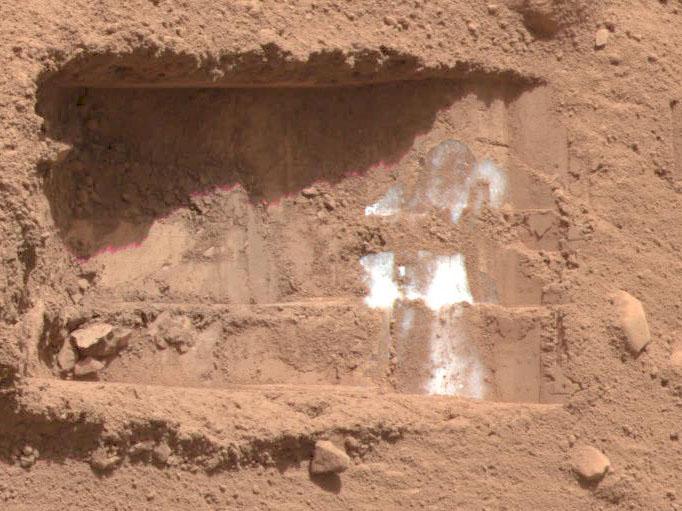
The implications ripple outward to mission planning. NASA’s 2008 Phoenix lander already confirmed there’s ice just below the surface in Mars’ arctic regions. There’s actually a lot of frozen water on the Red Planet, though most sits just beneath the dusty surface. Getting to it requires serious excavation equipment, something like Phoenix’s robotic arm but probably more powerful for deeper drilling.
The research team also tested how organic materials would fare on Jupiter’s moon Europa and Saturn’s moon Enceladus, both of which have even colder ice than Mars. The frigid temperatures there slowed degradation rates further, good news for NASA’s Europa Clipper mission launched in 2024, currently making its 1.8-billion-mile journey to arrive at Jupiter in 2030.
For Mars, the message seems clear: if you’re looking for traces of life, recent or ancient, target the ice. The amino acids won’t last forever, cosmic radiation sees to that, but 50 million years gives biology a fighting chance to leave evidence behind. Future Mars missions searching for extant life should consider ice-dominated regions as priority sampling locations, steering clear of clay deposits and rocky terrain where organic molecules degrade far more rapidly.
The study modeled radiation exposure by freezing bacteria samples and transferring them to a gamma radiation chamber at Penn State’s Radiation Science and Engineering Center, cooled to Mars-like temperatures. After blasting samples with radiation equivalent to 20 million years of cosmic ray exposure, researchers sealed and transported them back to NASA Goddard for amino acid analysis, then mathematically modeled an additional 30 million years.
Mars’ surface ice distribution constantly evolves as the planet’s axial tilt changes over millions of years. The last Martian ice age ended somewhere between 2.1 and 0.4 million years ago, with ice sublimating from lower latitudes and redepositing at the poles. Any amino acids that landed in that ice during the past few million years, whether from meteorites, dust, or hypothetical Martian organisms, would likely still be there, chemically intact and waiting to tell their story.