

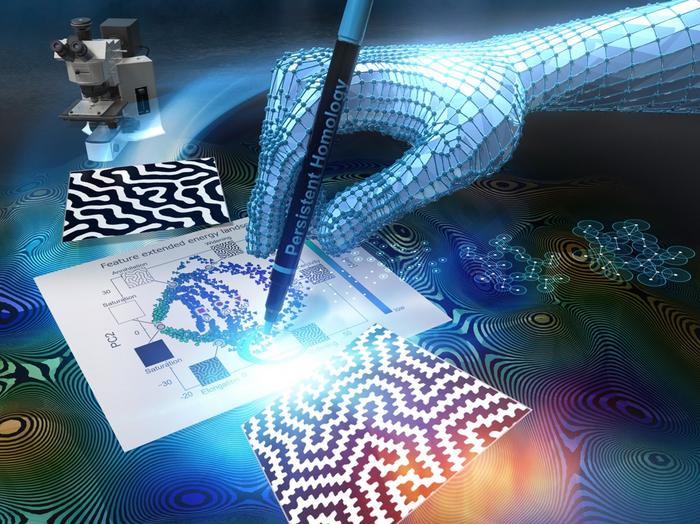
Heat the iron core of an electric motor past 60 degrees Celsius and something strange begins to happen at the microscopic scale. The magnetic domains, those tiny regions where billions of atomic spins point in lockstep, start rearranging themselves into patterns that look, under a Kerr microscope, uncannily like the hedge mazes you might wander through at a stately home. Narrow corridors of magnetisation snake and branch. The walls between domains grow jagged, zigzagging at increasingly violent angles as the temperature climbs. And with each cycle of the magnetic field, energy that should be propelling your car forward is instead lost to the churning of these submicroscopic labyrinths. Iron loss, as engineers rather drily call it, accounts for roughly 31 percent of total motor energy dissipation. That’s not a small number.
The problem has been sitting there for decades: everyone could see the maze forming, but nobody could quite explain why it behaved the way it did, or where exactly the energy was going. The two main theoretical tools available to researchers, Ginzburg-Landau theory and the Landau-Lifshitz-Gilbert equation, each captured part of the picture. Neither captured enough.
Masato Kotsugi, a materials physicist at Tokyo University of Science, has spent years being frustrated by this gap. Ginzburg-Landau theory, which traces its lineage back to superconductivity research, handles thermal contributions reasonably well but assumes the material is spatially uniform, which real magnets emphatically are not. The alternative, the LLG equation, manages inhomogeneous domains with some precision but largely ignores the thermal fluctuations that grow increasingly important as motors heat up during operation. “Conventional simulations oversimplify real materials, while experiments reveal complexity without a clear way to quantify cause and effect,” Kotsugi says. In practice, researchers were stuck watching the maze form while being largely unable to say, in quantitative terms, what was driving it.
Adding Entropy to the Equation
The new approach Kotsugi’s team have developed, published this February in Scientific Reports, tries to thread the needle between those two inadequate frameworks by doing something conceptually audacious: adding entropy directly into the free energy equation.
Entropy is perhaps the most slippery concept in physics; the tendency of systems toward disorder, the thermodynamic cost of complexity. In a magnetic material approaching coercivity, the point at which the net magnetisation is close to zero, entropy peaks. The domain walls become longer and more jagged. The maze, in other words, is at its most mazey precisely when entropy is highest, and that, the team suspected, was not a coincidence. What they needed was a way to formalise that relationship mathematically and trace it back to specific features of the microstructure.
Their solution combined three techniques that had each been used independently in other contexts: persistent homology, principal component analysis, and conventional free energy decomposition. Persistent homology (a branch of algebraic topology that was originally applied to studying the structure of amorphous solids and polymers) works by scanning a binary image at different thresholds and recording where structural features, the “holes” between magnetic domains, appear and disappear. The result is a persistence diagram, a kind of topological fingerprint of the maze that captures whether the domain walls are smooth and stripe-like or convoluted and necked. It’s an elegant trick: you reduce a visually complex image to a cloud of data points, then do your physics in that data space rather than in real space.
“Our physics-based explainable artificial intelligence framework addresses these limitations and is designed to mechanistically explain temperature-dependent magnetization reversal process,” Kotsugi says. The key word there, perhaps, is explainable. Much recent work applying machine learning to materials science produces predictions without mechanistic insight. What the team wanted, and what they reckon they’ve achieved, is something closer to the old ideal: a model whose workings you can actually read.
Reading the Landscape
Working with a rare-earth iron garnet sample, a material well known for producing particularly clear and complex maze domains, the team photographed its magnetic structure at five temperatures between 0 and 80 degrees Celsius, cycling an external field back and forth 400 times at each temperature. That’s 2000 domain images in total. They fed those images through the persistent homology pipeline, projected the resulting topological features into a low-dimensional space using PCA, and then mapped the free energy, decomposed into its demagnetisation, exchange, and entropy components, onto that same space. The result is something they call an extended Landau free energy landscape: a terrain where each point corresponds to a domain configuration and altitude corresponds to energy cost. Four prominent peaks in that landscape stand out as outliers, steep energy barriers where something abrupt happens to the domain structure. At the first barrier, nucleation kicks in; all three energy components are negative simultaneously, meaning the system is absorbing energy from the external field to start building reversal domains. At the second, the domains stop elongating and begin widening, a mode transition that costs exchange energy and entropy. The third and fourth barriers are where things get particularly interesting. Here, demagnetisation energy is released and transferred into exchange and entropy in a coupled fashion. The domain walls get longer, and as they get longer, the maze gets more complex. Entropy and exchange, it turns out, are locked together: you cannot increase one without the other obligingly following along.
That coupling is the key finding, and it is, in a sense, the answer to a question that motor engineers have been asking for a while. Energy is not just being lost to magnetisation reversal in some vague, undifferentiated way. It is being routed through a specific microscopic mechanism: the proliferation of domain walls, driven by the coupling of exchange interactions and configurational entropy, and that proliferation becomes more pronounced as temperature rises. The model can even pinpoint, in the original domain images, the specific regions where entropy spikes are concentrated.
From Model Material to Motor Steel
Whether this translates quickly into better motor cores is a separate question. The current model relies on certain assumptions, chiefly the Ising approximation, that hold well for rare-earth iron garnet but need adaptation for the silicon steel actually used in most motors. Kotsugi’s group has already made some progress on that front; a related analysis of non-oriented electrical steel was published separately last year. And since free energy is, as Kotsugi notes, a universal thermodynamic metric, the underlying framework could in principle be applied to any material that undergoes phase-like transitions, not just magnets. Crystal growth, mechanical failure, perhaps even biological pattern formation. The maze, it seems, is everywhere you look.
“Our eX-GL approach effectively automates the interpretation of complex magnetization reversal process and enables identification of hidden mechanisms, difficult to discern using conventional methods,” Kotsugi says. Future work will likely push towards more complex magnetic textures, including skyrmions, those exotic spin structures that have attracted considerable interest as candidates for next-generation data storage. The broader ambition is a general-purpose analytical framework capable of reading the energy landscape of any mesoscale structure and explaining, not just predicting, what it finds. Getting there will take time. But the maze, at least, is no longer quite so opaque.
Source: Masuzawa K. et al., “Explainable analysis of the complex maze magnetic domain structure through extension of the Landau free energy model by adding an entropy feature,” Scientific Reports (2026). DOI: 10.1038/s41598-026-39617-x
Frequently Asked Questions
Why do electric motors lose energy to magnetic domains?
Every time the magnetic field inside a motor reverses, the tiny magnetic domains in the iron core have to flip their orientation. That process isn’t perfectly efficient: energy gets consumed in moving domain walls around and lost as heat. At operating temperatures, the domain walls become longer and more jagged, which increases this loss. Iron loss of this kind accounts for roughly 31 percent of total motor energy dissipation, making it one of the primary targets for efficiency improvements in electric vehicles.
What is a maze magnetic domain and why does it matter?
In certain soft magnetic materials, the boundaries between oppositely magnetised regions form intricate, branching zigzag patterns that resemble a maze when viewed under a microscope. These maze domains are particularly problematic because their behaviour changes abruptly with temperature: the walls become more convoluted as the material heats up, increasing energy losses at exactly the conditions motors operate under. Understanding how these patterns form and evolve is a prerequisite for designing materials that resist forming them.
How does persistent homology help analyse magnetic structures?
Persistent homology is a mathematical technique borrowed from topology that converts a complex image into a compact set of data describing the shape and connectivity of structures within it. Applied to magnetic domain images, it tracks where “holes” between domains appear and disappear as a threshold is varied, producing a fingerprint that distinguishes smooth stripe domains from convoluted zigzag ones. This fingerprint can then be correlated with physical quantities like energy, enabling the kind of quantitative causal analysis that direct visual inspection cannot provide.
Could this research lead to better materials for electric vehicle motors?
Potentially, yes, though there are steps between the current findings and practical application. The study used a rare-earth iron garnet, a well-understood model material, rather than the silicon steel used in most motors. The team has separately applied related methods to electrical steel, and the framework is in principle adaptable to a wide range of materials. By identifying which specific microstructural features drive energy loss, and where in a sample those features originate, the model could eventually guide the design of alloys and processing routes that minimise maze formation.
What does it mean that entropy and exchange energy are “coupled” in this context?
Exchange energy in a magnet scales with the total length of domain walls; the longer and more convoluted the walls, the higher the exchange cost. The new findings show that entropy, which measures the disorder or configurational complexity of the domain pattern, tracks the exchange energy closely as magnetisation reverses. This means the two cannot be varied independently: making domain walls longer inevitably increases both the exchange energy and the entropy. The coupling explains why maze domains become more complex at higher temperatures, and provides a direct quantitative link between microscopic structural changes and macroscopic energy loss.