

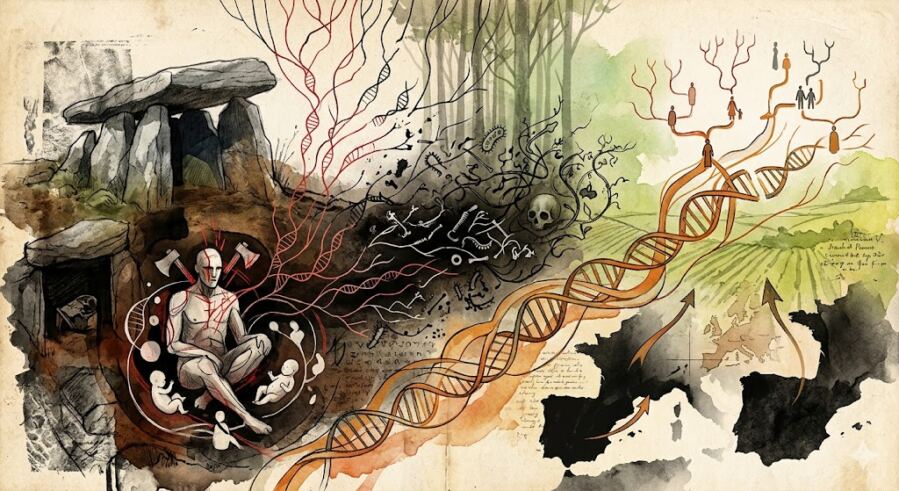
He was seated in the corner, at the rear of the tomb. Three blows to the skull, each one from something heavy and bladed, probably an axe. Around him, deliberately arranged, lay the bones of three children and a newborn. Researchers working on the megalithic gallery grave at Bury, about 50 kilometres north of Paris, have taken to calling this individual the founder, partly because of where he was placed (at the very back, the starting point of the monument’s construction) and partly because the DNA now confirms it: he is in the first generation of the largest family group buried at this site, the patriarch of a lineage that would place dozens of its dead in this stone chamber over the next century or so. His name, obviously, is lost. He is known as BUR174.
What happened to BUR174’s descendants is the subject of a study published in Nature Ecology & Evolution, and the answer turns out to have implications that reach well beyond a single Neolithic tomb.
The Bury grave held the remains of 316 individuals across two distinct burial phases, separated by a hiatus of perhaps a couple of centuries when nobody was placed here at all. Seersholm and his colleagues sequenced 132 ancient genomes from the site, making this one of the most densely sampled genetic studies of a single Neolithic monument yet attempted. What they found was not continuity. “We see a clear genetic break between the two periods,” he said. The people buried in Phase 1, roughly 3200 to 3000 BC, were genetically typical of Stone Age farming communities from northern France and Germany. The people buried in Phase 2, from around 2900 BC onward, were largely strangers, carrying ancestry that traced back overwhelmingly to southern France and the Iberian Peninsula.
Something had happened in between. The question the study grapples with is what.
Signs of a Community in Collapse
The evidence points to crisis, and a bad one. The demographic profile of the Phase 1 burials is, as Laure Salanova, research director at France’s National Centre for Scientific Research, put it, “a strong indicator” of something having gone badly wrong. There are far too many children and young people among the dead. The ratio doesn’t match a population dying at normal rates from ordinary causes; it suggests elevated mortality, a community under acute stress. On top of that, the DNA carries traces of Yersinia pestis, the bacterium responsible for plague. Three individuals from Phase 1 tested positive, along with one from Phase 2. The researchers also found Borrelia recurrentis, the pathogen behind louse-borne relapsing fever, a disease with an untreated mortality rate somewhere between 15 and 40 percent, one historically linked to catastrophic events like famine or war.
Martin Sikora, associate professor at Copenhagen and senior author on the paper, is careful not to overstate the plague angle. “We can confirm that plague was present, but the evidence does not support it as the sole cause of the population collapse,” he said. “The decline was likely driven by a combination of disease, environmental stress and other disruptive events.” Pollen records from the Paris Basin support this reading: between about 2900 and 2500 BC, the region shows clear signs of forest regrowth, the kind of rewilding that follows when farmers abandon fields and let the land go. The same signal appears in Scania, in Zealand, across northern Germany. A whole agricultural landscape going fallow, more or less simultaneously.
Strangers in an Inherited Tomb
The genetic data are stark. Simulations run by the team ruled out any scenario in which the Phase 1 and Phase 2 populations were directly continuous, in which one simply shaded into the other. The two groups shared more DNA with distant Neolithic populations elsewhere in Europe than they did with each other. By the time the tomb came back into use, the people placing their dead inside it were essentially immigrants, carrying more than 80 percent Iberian ancestry, part of a northward movement of populations from southern France and the peninsula that appears to have accelerated, perhaps because a demographic vacuum was opening up ahead of them. “The earlier group resembles Stone Age farming populations from northern France and Germany, while the later group shows strong genetic links to southern France and the Iberian Peninsula,” Seersholm said.
The society that replaced the original builders was organised quite differently. Phase 1 at Bury is dominated by large, sprawling family networks; the biggest pedigree the researchers reconstructed, centred on BUR174’s brother BUR222, spans five generations and 29 sequenced individuals, with perhaps 19 more inferred from kinship patterns. Around three quarters of Phase 1 individuals have at least one close relative buried alongside them. Phase 2 is more selective, more patrilineal, structured around a single male line in which one brother in each generation has offspring who enter the record and the other apparently does not. Only 40 percent of Phase 2 individuals are closely related to anyone else in the tomb. “This indicates that the population change was accompanied by a shift in how society was structured,” Seersholm said. The tomb seems to have been repurposed, adopted by a people who had not built it, its original social meaning presumably opaque to those now placing their dead within its walls.
The End of the Monument Builders
There is a wider argument embedded in the study’s findings, one that redraws the map of European prehistory somewhat. The so-called Neolithic decline, a period of population contraction that archaeologists have long identified in Scandinavia and northern Germany around 3000 BC, turns out to have extended further south and west than previously appreciated. The end of megalith construction across continental northwestern Europe, a phenomenon that has never had a fully convincing explanation, now looks like something more than a cultural shift. “We now see that end of these monumental constructions coincides with the disappearance of the population that built them,” Seersholm said. The builders didn’t change their minds about building monuments; they mostly ceased to exist, or at least ceased to exist in these places.
That said, the picture is complicated, as these things always are. The plague prevalence at Bury, around 4 percent in Phase 1, is considerably lower than at some Scandinavian sites where rates above 25 percent have been reported. And the plague-positive individuals don’t cluster neatly in the final generations of the Phase 1 pedigrees, which is what you’d expect to see if a single outbreak had finished the community off. The tomb represents only a fraction of the actual population; the evidence for a catastrophic plague event might simply not have survived, or might be buried elsewhere entirely.
What the study does establish, with unusual clarity for this sort of work, is sequence: farmers build tombs, their population collapses, forests regrow, and then a different farming population moves in from the south and repurposes the abandoned architecture. Several centuries later, around 2500 BC, groups with steppe ancestry arrive from further east and mix with this Iberian-inflected population, gradually producing the genetic profile associated with Bell Beaker communities across Europe. The Bury grave is a record of two replacements, not one.
BUR174 sits at the beginning of all of this. Seated in his corner, axe-wounds in his skull, children arranged around him. Whether those children were his victims or his mourners, nobody can say; the excavators have speculated about a founding sacrifice, a ritual beginning. What’s certain is that his DNA survives, and that within a few generations, the population his family was part of had largely vanished, absorbed into silence and forest. The people who came after them had no memory of who had built the tomb, or what it had meant. They simply found it standing, and began to put their own dead inside.
Source: https://doi.org/10.1038/s41559-026-03027-z
Frequently Asked Questions
Did plague wipe out the Neolithic farmers who built France’s megalithic tombs?
Plague was present, but probably wasn’t the sole culprit. DNA analysis of the Bury tomb found traces of Yersinia pestis in about 4 percent of Phase 1 individuals, well below the rates seen at some Scandinavian sites during the same period. The researchers think a combination of disease, environmental stress, and other disruptions drove the collapse, with pollen records showing widespread forest regrowth across the Paris Basin as farmland was abandoned around 2900 BC.
If the original population disappeared, who were the people burying their dead in the same tomb centuries later?
Genetically, they were largely newcomers from southern France and the Iberian Peninsula, carrying ancestry quite distinct from the original builders. The data suggest a northward movement of farming populations into a demographic vacuum left by the collapse; by the time the tomb came back into use, over 80 percent of the new occupants’ ancestry traced back to Iberia. This migration predates the more famous Bell Beaker expansion by several hundred years.
What does this tell us about why megalithic tomb-building stopped across Europe around 3000 BC?
The most direct answer the study offers is that the people who built these monuments disappeared before they could keep building them. The genetic and archaeological evidence at Bury, combined with similar patterns in Scandinavia, Germany, and Denmark, suggests the cessation of megalith construction wasn’t a change in fashion or ritual preference; it tracked a real and widespread demographic collapse. The monuments outlasted the societies that created them.
How different were the two communities using the same tomb?
Substantially different, both genetically and socially. The first community buried large, multigenerational family networks together, with women marrying in from outside and men tracing descent through the same lineages across five or more generations. The second was more selective, organised around a single patrilineal line, with a higher proportion of unrelated individuals. The researchers found no detectable genetic links between the two phases at all, suggesting the second group had no biological connection to the original builders.