

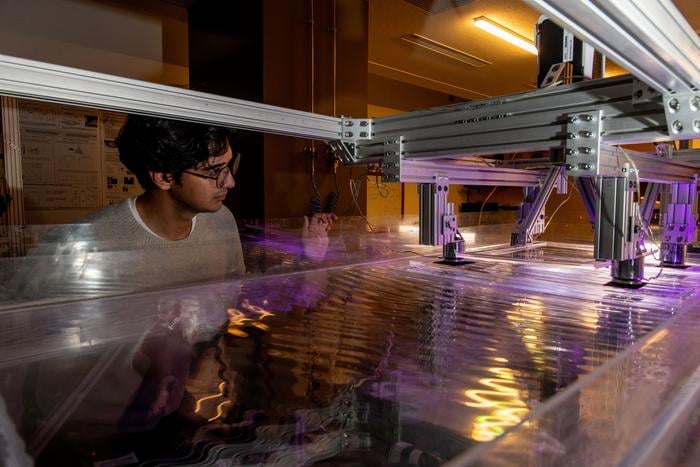
The tank itself is unremarkable. A metre wide, two metres long, five centimetres deep, filled with ordinary water in a lab in Okinawa. Beneath it, a light tablet glows. Above it, a high-speed camera waits. At the centre, water drains through a 4-millimetre tube, building a stable whirlpool. Then the transducers kick in, sending ripples from opposite ends, and the waves meet in the middle. What happens next is something the researchers did not anticipate: lines of momentarily still water, perfectly flat amid the churning surface, radiating outward from the vortex and rotating, almost hypnotically, in the opposite direction to the whirlpool’s spin.
Nobody expected this. That, roughly, is the point.
The experiment, published this week in Communications Physics by physicists from the Okinawa Institute of Science and Technology (OIST), the University of Oslo, and Universidad Adolfo Ibanez, was designed to probe one of the stranger corners of quantum mechanics, the Aharonov-Bohm effect. First predicted in 1959, it describes how an electron can be affected by a magnetic field it never actually passes through. The field is confined inside a tightly wound coil of wire; the electrons travel outside it, where the field is zero. And yet they are changed, their quantum wave properties shifted in ways that show up, if you’re patient and clever enough, in interference patterns. It took experimentalists more than two decades to confirm this, and even then only indirectly.
Classical analogues offer a way around that reticence. In 1980 the British physicist Michael Berry showed you could mimic the effect using a draining bathtub: the whirlpool stands in for the coil of wire, water waves stand in for electrons, and the wave distortions that emerge around the vortex, a characteristic forked pattern, stand in for the quantum phase shifts. The physics is not identical (water is not electrons, and the vortex strength is continuous rather than quantised), but the correspondence is close enough to be genuinely useful. Berry’s experiment sat in the literature for four decades while researchers studied individual waves travelling past a vortex in one direction.
What nobody had tried, or perhaps nobody had thought to try, was sending waves from both directions simultaneously.
“The question for us was: what happens if you send waves from both directions at the same time? We thought that the patterns might cancel each other out, or both pitchfork-like patterns would be visible, but our intuition was completely wrong,” says Jonas Ronning, co-first author and former postdoc in the OIST unit. He and his colleagues built their custom tank, set up the acoustic transducers, got the vortex spinning, and watched. “With waves travelling the opposite direction, you see a mirror image pattern,” he adds, describing what Berry’s setup would have predicted. But superimpose the two? Something else entirely happens.
What emerges, when opposing wave trains collide in the presence of a vortex, is a standing wave, a wave that appears frozen in place rather than travelling. Under normal conditions, standing waves produce stationary nodal lines, lines of zero wave height. Predictable, exactly what you’d calculate in an undergraduate physics course. But add a vortex, and the nodal lines develop a personality. They rotate. They multiply as the vortex spins faster. They always turn opposite to the whirlpool, at a rate set by the wave frequency and the vortex’s strength. The whole pattern is system-spanning, reaching from the vortex core to the edges of the tank, and the number of lines is precisely quantised, snapping to whole numbers governed by the vortex’s dimensionless circulation parameter.
Dropping Everything
“When we first saw these lines, we thought they were an experimental artefact,” says Aditya Singh, a PhD student in the OIST unit and co-first author. It looked, perhaps, like a trick of the light tablet, or some imperfection in the water surface. “But when we also saw them in our simulations, we dropped everything and quickly worked out the mathematics underlying how they arise.” The mathematics, it turns out, requires nothing exotic. The team mapped the shallow-water wave equations onto the Schrodinger equation for a charged particle in a magnetic field and found that superimposing two opposing waves introduces a crucial change in the angular structure of the scattering solution. That change forces the nodal lines to spread across the whole system rather than staying near the vortex core. “This was something new and unexpected,” Singh says. “That’s what makes this fluid analogue system so valuable. It reveals topological effects, wave behaviors that occur across the whole system, that can’t be seen in quantum experiments.”
Topology is perhaps the key word here. It refers to properties that survive continuous deformation, the kind of thing that distinguishes a sphere from a doughnut regardless of how you squash or stretch either. In physics, topological effects don’t depend on local details but on the global, system-wide structure of the wave. The Aharonov-Bohm effect is a topological phenomenon, which is part of why it seems so strange: the electron doesn’t touch the magnetic field, it only travels around it, accumulating a phase shift that encodes information about the field’s existence. The nodal lines here are the water-wave version of that non-local character made directly visible, rotating across a tank you could fit in a small kitchen.
What a Tank of Water Might Teach Quantum Physics
There is, admittedly, a limit to how far the analogy stretches. In the quantum version, the magnetic flux threading the solenoid is quantised, locked to discrete values. In water, the vortex circulation varies continuously, so researchers can dial it up or down, nudging the system from one number of nodal lines to the next. That is a difference, not a bug: the fine control it offers is precisely what makes the setup useful for probing phenomena that are theoretically possible in quantum systems but difficult to arrange experimentally, including Aharonov-Bohm caging, a process in which interference from the AB phase causes a quantum wave to become completely localised. It has been glimpsed in photonic lattices; coaxing it into other systems is considerably harder.
The next step Mahesh Bandi, the unit head and senior author, has in mind involves adding more vortices. “One direction is to make the system more complex by introducing multiple vortices and arranging them into a lattice,” he says. “That setup would mirror conditions in some superconducting materials, with the water waves behaving like a supercurrent. We don’t yet know what we’ll see, and that’s exactly what makes it worth doing.” A vortex lattice in water, behaving like a superconductor. It sounds faintly absurd, and also rather marvellous.
What the OIST team has demonstrated, more broadly, is that a simple, open, easily observable classical system can expose topological physics that quantum experiments are structurally unable to reveal. The quantum wave function is not directly measurable; everything must be inferred from statistics across thousands of experimental runs. Here, you watch the topology unfold in real time on a lit surface, track the nodal lines with a camera, compare them against predictions with no free parameters. “Theorists might predict these effects, but quantum experiments wouldn’t see them,” Bandi says. “With analogues like this, we can.”
There is something quietly satisfying about that: the deepest features of quantum mechanics made visible in a tank of water. The waves rotate. The mathematics agrees. And nobody yet knows what will emerge when you add a second vortex.
Source: Singh, A., Ronning, J., Liu, C-C. et al. Topology made visible through standing waves in a spinning fluid. Communications Physics 9, 123 (2026). https://doi.org/10.1038/s42005-026-02603-w
Frequently Asked Questions
What is the Aharonov-Bohm effect and why does it matter?
The Aharonov-Bohm effect, predicted in 1959, describes how an electron’s quantum wave properties can be altered by a magnetic field it never directly enters. This was deeply puzzling because classical physics says a particle should only respond to fields it actually passes through. The effect confirmed that in quantum mechanics, the electromagnetic potential (not just the field) has real physical consequences, and it became a cornerstone of how physicists think about gauge theories and topology in physics.
How does a water tank actually mimic something quantum?
Water waves and quantum particles both obey wave equations, and in specific conditions the shallow-water wave equations map closely onto the Schrodinger equation for a charged particle in a magnetic field. A draining vortex in a water tank plays the role of the solenoid (the coiled wire through which the magnetic flux runs), and ripples on the surface play the role of the electron’s wave function. The correspondence isn’t perfect, but it is close enough to capture the topological features of the effect, in ways that are directly visible rather than inferred from statistical measurements.
What exactly are the rotating nodal lines and why are they surprising?
Nodal lines are lines of zero wave amplitude, places where the water surface is momentarily flat. In a normal standing wave (without a vortex), these lines are stationary. The surprise in this experiment is that the vortex causes them to rotate, always in the opposite direction to the whirlpool, and to extend across the entire tank rather than staying near the vortex core. The number of lines is also quantised, jumping between whole-number values depending on the vortex’s strength. This kind of global, system-spanning response is a hallmark of topological physics, and it had not been seen in this type of classical fluid experiment before.
Could this research have practical applications?
It’s early days, and the team is candid about that. The immediate value is as a research platform: the fine control over the vortex strength lets physicists probe phenomena, like Aharonov-Bohm caging (the complete freezing of a wave through destructive interference), that are theoretically predicted but difficult to arrange in quantum or photonic systems. Further down the line, insights from water-wave analogues have historically fed into the design of acoustic and photonic metamaterials, so there may be engineering applications, though nobody is promising those just yet.
What comes next for this research?
The team plans to scale up the complexity by creating a lattice of multiple vortices. That configuration would roughly mimic the conditions inside certain superconducting materials, where vortices of magnetic flux arrange themselves into ordered arrays. Whether water waves in such a lattice genuinely reproduce superconducting-like behaviour remains to be seen. The researchers also note that the viscosity and capillarity of water introduce dissipation effects absent in ideal quantum systems, which raises its own interesting questions about how non-Hermitian (lossy) physics modifies the Aharonov-Bohm effect.