

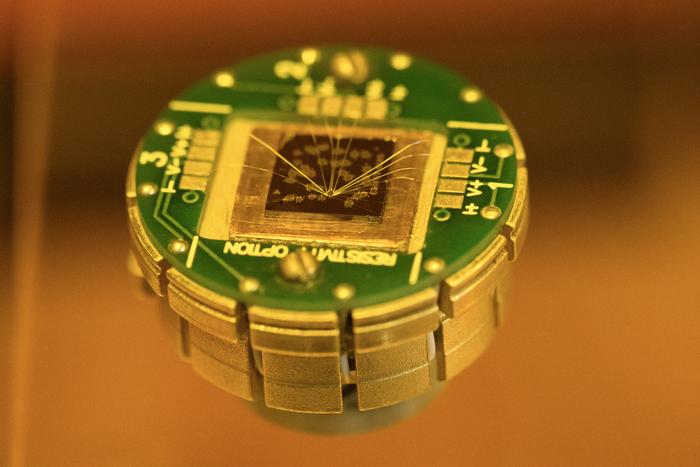
Swedish researchers have developed an atomically thin material that could dramatically slash the energy consumption of computer memory chips, potentially addressing one of technology’s fastest-growing environmental challenges.
The team at Chalmers University of Technology discovered that a novel magnetic alloy can reduce power requirements in memory devices by a factor of ten, while simplifying manufacturing processes that have long plagued the semiconductor industry.
A Material That Defies Conventional Physics
The breakthrough centers on (Co0.5Fe0.5)5-xGeTe2, abbreviated as CFGT, which achieves something previously thought impossible: hosting two opposing magnetic forces within a single material structure. Traditional memory chips require complex multilayer arrangements to achieve similar effects, leading to manufacturing headaches and reliability issues.
“Finding this coexistence of magnetic orders in a single, thin material is a breakthrough. Its properties make it exceptionally well-suited for developing ultra-efficient memory chips for AI, mobile devices, computers and future data technologies.”
The material combines ferromagnetism, the familiar magnetism of everyday magnets, with antiferromagnetism, where magnetic forces cancel each other out. This creates what researchers describe as a “tilted” magnetic alignment that allows memory cells to switch states without external magnetic fields – the energy-hungry component in current designs.
Digital data storage already consumes about 4% of global electricity, with projections suggesting this could reach 30% within decades as artificial intelligence and cloud computing expand. The timing of this discovery could not be more critical.
Beyond the Laboratory Bench
Unlike many materials breakthroughs that remain confined to research settings, CFGT maintains its unusual properties at room temperature and above – a crucial requirement for practical applications. The material’s Curie temperature of 429K (156°C) ranks among the highest for any two-dimensional magnetic material.
The researchers demonstrated their concept by creating memory devices that switch states using electrical pulses alone, eliminating the need for power-hungry magnetic fields. These proof-of-concept devices operated with switching current densities around 8 million amperes per square centimeter, competitive with existing technologies while requiring significantly less total energy.
“This tilt allows electrons to switch direction rapidly and easily without the need for any external magnetic fields. By eliminating the need for power-hungry external magnetic fields, power consumption can be reduced by a factor of ten.”
The manufacturing advantages could prove equally significant. Current magnetic memory production requires precise alignment of multiple material layers, creating interfaces that often fail or degrade over time. CFGT’s single-material approach eliminates these problematic boundaries.
Dr. Bing Zhao, the study’s lead author, explained that the material’s unique properties stem from carefully controlled atomic vacancies – missing atoms that create asymmetries in the crystal structure. These vacancies can be tuned during growth to optimize the magnetic behavior.
The research team used advanced computational modeling to understand how different arrangements of cobalt and iron atoms within the crystal lattice produce the coexisting magnetic states. They tested hundreds of possible configurations to identify the most promising arrangements.
While the technology shows promise, significant hurdles remain before commercial deployment. Manufacturing CFGT at semiconductor industry scales presents unknown challenges, and long-term reliability under real-world conditions requires extensive testing.
The semiconductor industry’s notorious resistance to new materials could slow adoption, despite potential benefits. Previous magnetic memory technologies have taken decades to reach market maturity.
Nevertheless, the environmental stakes continue rising. With data centers consuming electricity equivalent to entire countries, and mobile devices proliferating globally, any technology offering dramatic energy savings warrants serious attention.
The research appears to offer a rare combination: fundamental scientific insight with clear practical applications. Whether CFGT can navigate the complex path from laboratory to factory floor may determine its ultimate impact on our increasingly digital world’s energy footprint.