

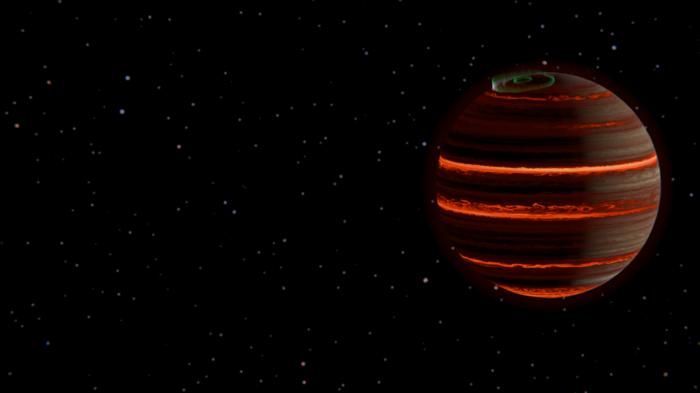
Scientists have delivered the first detailed weather forecast from a world beyond our solar system, and the conditions are decidedly hostile. The target of their meteorological investigation is SIMP-0136, a rogue planet drifting through space without a host star, where temperatures reach 1,500°C and powerful aurora-like phenomena heat the upper atmosphere by hundreds of degrees.
Using the James Webb Space Telescope’s unprecedented precision, astronomers from Trinity College Dublin tracked minute changes in the planet’s brightness as it completed a full 2.4-hour rotation. These subtle variations, smaller than 3% in total brightness, revealed a complex atmospheric system driven by magnetic forces rather than the cloud coverage changes that scientists initially expected.
Auroral Heating Creates Temperature Inversions
The most striking discovery was evidence of powerful auroral activity heating SIMP-0136’s stratosphere. Similar to Earth’s Northern Lights but far more intense, these phenomena create temperature inversions where the upper atmosphere becomes dramatically hotter than lower regions.
“These are some of the most precise measurements of the atmosphere of any extra-solar object to date, and the first time that changes in the atmospheric properties have been directly measured,” said Dr Evert Nasedkin, the study’s lead author from Trinity College Dublin.
The temperature inversion peaks at pressures about 300 times thinner than Earth’s atmosphere, reaching temperatures roughly 265 Kelvin warmer than would occur without auroral heating. This extreme heating requires an estimated 4 × 10^19 watts of power – about 0.5% of the planet’s total energy output and vastly more powerful than Jupiter’s aurora.
The auroral heating mechanism differs significantly from solar system examples. SIMP-0136’s estimated magnetic field strength of 3,000 Gauss far exceeds Jupiter’s 4 Gauss field, potentially accelerating electrons to energies between 100 and 1,000 keV before they precipitate into the stratosphere and deposit their energy.
Chemical Weather Patterns Emerge
Beyond the thermal dynamics, the research revealed chemical weather systems rotating across the planet’s surface. As SIMP-0136 spins, the abundances of carbon dioxide and hydrogen sulfide vary systematically, suggesting localized storms or chemical processing regions similar to Jupiter’s Great Red Spot.
The planet’s overall atmospheric composition shows a metallicity 0.18 times greater than the Sun, with a carbon-to-oxygen ratio of 0.54 when accounting for oxygen locked in silicate clouds. Methane and carbon monoxide exist in chemical disequilibrium, indicating vertical mixing processes transport these molecules from deeper, hotter regions where they form.
Temperature variations of about 5 Kelvin occur across the planet’s surface during each rotation, with the effective temperature ranging from 1,243 to 1,248 Kelvin. These changes correlate with the varying chemical abundances, painting a picture of dynamic atmospheric circulation.
Perhaps most surprisingly, the silicate clouds that shroud much of the planet show no detectable variations with rotation. Unlike the patchy cloud coverage that drives variability in similar objects, SIMP-0136’s sand-like silicate particles maintain constant coverage at roughly 87% across the observed hemisphere.
“Different wavelengths of light are related to different atmospheric features. Similar to observing the changes in colour over the surface of the earth, the changes in the colour of SIMP-0136 are driven by changes in the atmospheric properties,” Nasedkin explained.
The research utilized novel time-resolved atmospheric retrieval techniques, essentially performing 24 separate atmospheric analyses corresponding to different rotational phases. This approach revealed that temperature structure changes, rather than cloud variations, drive the observed spectroscopic variability.
SIMP-0136, located just 6.12 parsecs from Earth, represents an ideal laboratory for studying atmospheric processes on isolated substellar objects. With a mass estimated between 12-18 Jupiter masses and an age of 200 million years, it serves as an analog for directly imaged exoplanets around other stars.
The findings challenge conventional wisdom about L-T transition objects, a class of brown dwarfs caught between stellar and planetary characteristics. Rather than cloud coverage driving atmospheric changes, magnetic and thermodynamic processes appear to dominate the weather patterns on this particular world.
Professor Johanna Vos, who leads Trinity College’s Exo-Aimsir atmospheric research group, noted the broader implications: “Understanding these weather processes will be crucial as we continue to discover and characterise exoplanets in the future.” Future observations with next-generation telescopes may extend such detailed atmospheric studies to rocky exoplanets potentially harboring life.
The research represents a milestone in exoplanetary science, demonstrating that astronomical weather forecasts can now achieve the precision needed to track atmospheric dynamics on distant worlds. As Webb continues its observations, scientists anticipate mapping weather patterns across an ever-growing catalog of exotic atmospheric systems.