

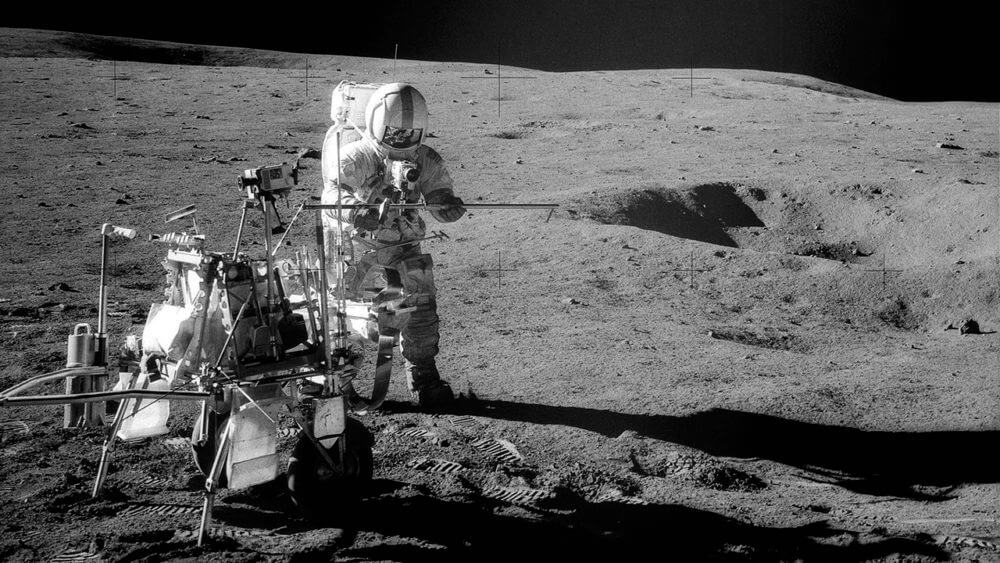
When NASA sealed a tube of lunar soil in 1972 and locked it away for future scientists, they were making a bet on tomorrow’s technology. That gamble just paid off in an unexpected way.
Researchers analyzing samples from Apollo 17’s final moonwalk have discovered sulfur compounds in the lunar mantle that don’t match anything found on Earth. The findings, published this week, suggest the Moon either recycled its early crust in ways scientists didn’t think possible, or it still carries chemical fingerprints from whatever cosmic collision created it 4.5 billion years ago.
Fingerprints That Don’t Match
The anomaly lies in sulfur-33, one of four stable varieties of sulfur atoms. Apollo 17 astronauts Gene Cernan and Harrison Schmitt drove a hollow metal cylinder 60 centimeters into the Taurus Littrow valley, unknowingly capturing volcanic rock with sulfur ratios wildly different from terrestrial samples.
James Dottin, the Brown University planetary scientist who led the analysis, had assumed lunar sulfur would mirror Earth’s. Both bodies share similar oxygen isotopes, after all, and sulfur was expected to tell the same story of shared origins.
Before this, it was thought that the lunar mantle had the same sulfur isotope composition as Earth. That’s what I expected to see when analyzing these samples, but instead we saw values that are very different from anything we find on Earth.
His reaction was less academic:
My first thought was, ‘Holy shmolies, that can’t be right.’ So we went back to make sure we had done everything properly and we had. These are just very surprising results.
The depleted sulfur-33 signature is something you see when sulfur interacts with ultraviolet light in a thin atmosphere, a condition Earth hasn’t experienced in billions of years. The Moon, however, might have briefly hosted such an atmosphere shortly after its formation.
Two Stories, Both Strange
Dottin’s team offers two possible explanations, and neither fits comfortably with existing lunar models.
The first involves crustal recycling on the early Moon. If volcanic material carried this photochemically altered sulfur from the surface down into the mantle, it means the Moon had some mechanism for cycling materials between layers, something like a primitive version of Earth’s plate tectonics.
That would be evidence of ancient exchange of materials from the lunar surface to the mantle. On Earth, we have plate tectonics that does that, but the Moon doesn’t have plate tectonics. So this idea of some kind of exchange mechanism on the early Moon is exciting.
The second explanation reaches back to the Moon’s violent birth. The leading theory holds that a Mars-sized object called Theia slammed into the young Earth, and the debris eventually coalesced into our satellite. If Theia carried sulfur with a dramatically different isotopic signature, the lunar mantle could still preserve that alien chemistry.
Waiting for Better Tools
The samples sat sealed in helium for over 50 years through NASA’s Apollo Next Generation Sample Analysis program, waiting for technology that could extract their secrets. Secondary ion mass spectrometry, the technique Dottin used, didn’t exist when the samples came home.
Brown’s LunaSCOPE consortium supported the work through a competitive application process that has recently opened more pristine Apollo samples to researchers. Dottin specifically targeted sulfur with textures suggesting it erupted with the volcanic rock rather than arriving through later contamination.
Whether the anomalous sulfur speaks to ancient lunar processes or primordial cosmic chemistry remains unclear. Dottin hopes future sulfur isotope studies of Mars and other solar system bodies might eventually point toward an answer. Understanding how these isotopic signatures distributed themselves across planets could illuminate how the entire solar system assembled itself.
For now, those carefully preserved samples have done exactly what NASA hoped they would: they’ve revealed something no one in 1972 could have imagined finding.
Journal of Geophysical Research Planets: 10.1029/2024JE008834