

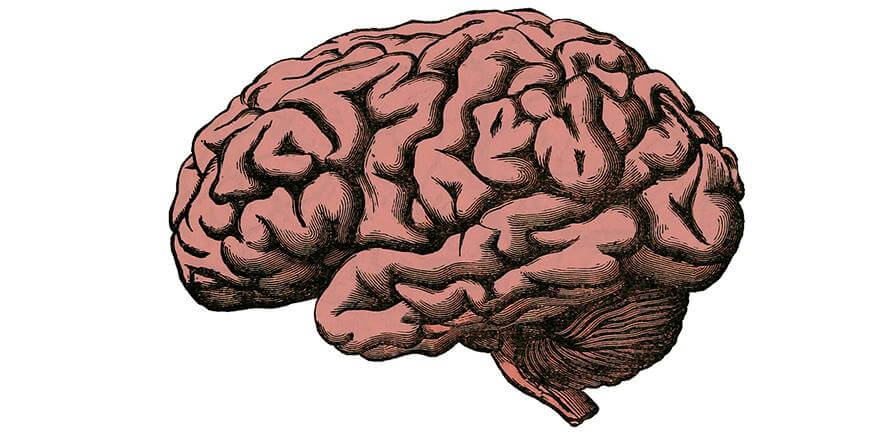
The human ability to tune into one voice at a crowded party while tuning out others (a phenomenon scientists have puzzled over for decades) appears to happen entirely in the brain’s cortex, not in the earlier processing stages researchers had long suspected.
A new study from the University of Michigan and University of Rochester used innovative electrode technology to simultaneously track neural responses across the entire auditory pathway, from the ear’s nerve fibers through the brainstem and into the cortex. What they found surprised them: when people focused on one of two competing audiobooks, their auditory nerves and brainstems processed both stories identically. The filtering happened later, in the cortex.
What we found is that the subcortical parts of the auditory system respond to speech you’re paying attention to in exactly the same way as the speech you’re ignoring.
Ross Maddox, associate professor of otolaryngology at Michigan and senior author on the paper published in PLOS Biology, said this differs sharply from cortical processing, which neurally “turns up the volume” on attended sounds.
Breaking From Artificiality
Previous research into selective attention typically relied on artificial sounds – beeps, clicks, or isolated vowels – which made it difficult to design tasks that genuinely engaged people’s natural attention mechanisms. The Michigan-Rochester team took a different approach, having 28 participants listen to audiobooks read by different narrators while recording their brain activity.
In one experiment, both audiobooks played simultaneously in both ears. In another, each audiobook played in a separate ear, which theoretically should have made selective attention easier by providing a spatial cue. Neither approach revealed any attention effects in subcortical processing, though both showed strong cortical effects consistent with previous studies.
The researchers went further, using Bayesian statistical analysis to distinguish between “absence of evidence” and “evidence of absence.” For the brainstem response known as wave V, they found moderate evidence against an attention effect, not just a failure to detect one.
Settling a Controversy
The findings contradict several recent papers that reported subcortical attention effects using similar natural speech paradigms. To resolve this discrepancy, the Michigan-Rochester team conducted a third experiment using stimuli from those earlier studies – but with a crucial difference. Instead of asking people to attend to specific stories, they let participants watch silent movies or read books while the audiobooks played in the background.
The results were revealing: even during this passive listening, the stories that were meant to be “attended” in the original experiments produced larger neural responses than the “unattended” stories. This suggested that acoustic differences between the specific story recordings – not attention – had driven the earlier reported effects.
I think what we’ve shown here is that for human studies, there is no subcortical attention effect that can be measured with the tools we have available.
The finding does not rule out subcortical involvement entirely. Small populations of neurons that lack the spatial alignment needed to generate measurable electrical signals at the scalp could still play a role. The auditory system contains extensive feedback pathways from cortex to brainstem to ear, and these connections serve important functions – just not, it seems, the selective filtering of competing speech streams.
The study employed an electrode that rests on the eardrum, providing unprecedented signal quality from the auditory nerve during natural speech listening. Combined with new analysis techniques adapted for the speed of subcortical processing, this approach allowed the researchers to isolate responses from different processing stages that had previously been difficult to separate.
Maddox noted that the team had to develop new experimental methods specifically for this study. As technology continues to advance, he said, future studies may reveal finer-grained details about how attention shapes auditory processing – but for now, the evidence points clearly to the cortex as the first site where the brain’s remarkable cocktail party trick takes effect.