

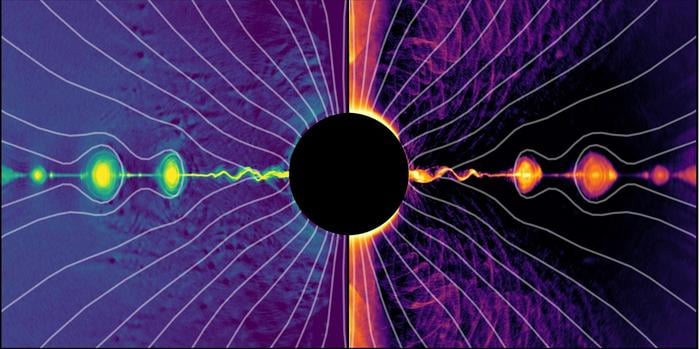
For nearly 140 years, astronomers puzzled over the brilliant jet streaming from what Charles Messier catalogued as “87: Nebula without stars.” The answer lay hidden at the heart of galaxy M87, where a black hole containing six and a half billion solar masses spins furiously and launches particles at nearly light speed across 5,000 light-years of space.
Now, physicists at Goethe University Frankfurt have revealed that black holes use not one but two mechanisms to power these cosmic particle accelerators. Their simulations, which consumed millions of CPU hours on German supercomputers, show that magnetic reconnection works alongside the previously known Blandford-Znajek mechanism to extract rotational energy from spinning black holes.
The finding challenges half a century of assumptions. Since 1977, astrophysicists have credited the Blandford-Znajek mechanism with converting a black hole’s spin into electromagnetic power via strong magnetic fields. The Frankfurt team’s FPIC code (Frankfurt particle-in-cell code for black hole spacetimes) tracked vast numbers of charged particles and extreme electromagnetic fields under crushing gravitational forces, revealing something unexpected in the equatorial plane.
Plasma Bubbles Racing at Light Speed
The simulations exposed intense reconnection activity where magnetic field lines break and reassemble, creating what researchers call plasmoids: condensed plasma bubbles that shoot outward at 70% light speed. These energetic structures form a steady wind accompanying the jet, carrying particles accelerated to relativistic velocities.
Simulating such processes is crucial for understanding the complex dynamics of relativistic plasmas in curved spacetimes near compact objects, which are governed by the interplay of extreme gravitational and magnetic fields.
Dr. Claudio Meringolo, who developed the code, notes the calculations required solving Maxwell’s equations and tracking electron-positron motion according to Einstein’s general relativity. The team ran 12 high-resolution simulations spanning black hole spin rates from sluggish to near-maximal, building the most comprehensive portrait yet of how these objects generate jets.
The reconnection process generates particles with negative energy inside the ergosphere, the region just outside the event horizon where spacetime itself rotates. These particles fall into the black hole, potentially enabling the Penrose process, another theoretical energy extraction mechanism proposed in 1969 but rarely observed in simulations.
Mathematical Precision Meets Computational Power
What makes the work particularly satisfying to the researchers is the agreement between their complex simulations and rigorous mathematical predictions. Professor Luciano Rezzolla, who led the team, measured the power output of jets as a function of black hole spin and found excellent correspondence with high-order analytic calculations.
With our work, we can demonstrate how energy is efficiently extracted from rotating black holes and channeled into jets. This allows us to help explain the extreme luminosities of active galactic nuclei as well as the acceleration of particles to nearly the speed of light.
The simulations also matched data from fluid-based magnetohydrodynamic models after applying a simple rescaling factor. This convergence of different computational approaches, all pointing toward the same physical picture, strengthens confidence that scientists understand the basic machinery.
The research has implications beyond M87. Rotating black holes exist across mass scales, from stellar remnants to supermassive giants. The dual extraction process could help explain gamma-ray bursts from collapsing stars and the phenomenal power output of active galactic nuclei billions of light-years away. Jets from these objects influence galaxy evolution by dispersing energy and matter throughout the universe.
Dr. Filippo Camilloni, who worked on the project, emphasizes the broader significance: the Blandford-Znajek mechanism may not be the only astrophysical process tapping a black hole’s rotational reservoir. Magnetic reconnection contributes its own distinct channel for energy extraction.
The team’s spacetime diagrams reveal plasmoids colliding and merging, sometimes splitting apart under tidal forces near the most rapidly spinning black holes. In those extreme cases, one fragment falls inward while another escapes with tremendous angular momentum, behavior reminiscent of the Penrose process operating through magnetic reconnection rather than particle interactions alone.
The calculations tracked up to 300 million particles at each time step, following their trajectories as they spiraled through warped spacetime. The researchers observed reconnection rates peaking inside the ergosphere and declining with distance from the event horizon. They derived an analytic formula describing this behavior as a function of spin and distance, a tool that theorists can now use to model reconnection in black hole environments.
Future work will extend these two-dimensional simulations into three dimensions, where richer dynamics await discovery. The researchers also plan to include protons and ions alongside the electron-positron pairs, creating a more realistic multispecies plasma. Higher resolutions may clarify fine details like the splitting plasmoids and their role in generating negative-energy particles.
For now, the dual extraction mechanism stands as the best explanation for how black holes convert their angular momentum into the most powerful particle beams in the universe.