

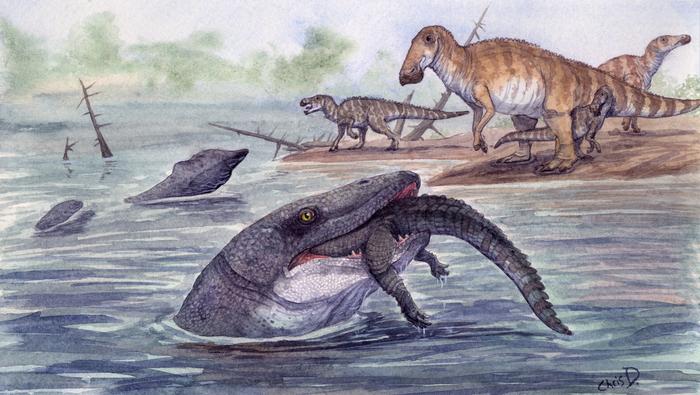
A single dark tooth, nearly as long as your thumb, sat in a brown mudstone bed in North Dakota for 66 million years. When paleontologists finally pulled it from the Hell Creek Formation in 2022, they realized they were holding something that shouldn’t exist: proof that mosasaurs, the ocean’s apex predators, were also patrolling inland rivers.
The discovery, published in BMC Zoology, centers on one isolated tooth crown found at a floodplain site in Morton County, far from any ancient coastline. Lead researcher Melanie A. D. During and her colleagues didn’t just rely on location. They ran the tooth through a battery of chemical tests, analyzing carbon, oxygen, and strontium isotopes locked in its enamel. The isotopic signature was unambiguous: this animal lived in freshwater, not the sea.
For decades, mosasaurs have been framed as strictly marine reptiles, massive lizard-like predators that could reach 11 meters long and dominated Cretaceous oceans. If some of them could push into rivers as the Western Interior Seaway shrank and changed, it rewrites how adaptable these animals actually were.
A Worn Tooth In A River Graveyard
The specimen, catalogued as NDGS 12217, was found in a bone-rich mudstone layer interpreted as a floodplain near a stream channel. Terrestrial carcasses accumulated there, scavenged and torn apart, leaving disarticulated bones with feeding traces scored and pitted by teeth. The tooth sat among remains of a Tyrannosaurus, crocodilians, and hadrosaurs.
The crown itself is laterally compressed, about 30 millimeters tall, covered with fine ridges and wrinkles that give it a distinctive veined texture. Its tip is blunted and worn smooth from use, the cutting edges lacking the prominent serrations you’d expect on dinosaur teeth. That wear pattern suggests a lifetime spent crushing hard prey, maybe the bones of river-dwelling animals or carrion washed into channels.
The research team spent considerable effort ruling out lookalikes. Could it be from a tyrannosaurid or a crocodilian? The morphology didn’t match. Instead, it best fit a mosasaurine in the tribe Prognathodontini, a group previously known only from marine deposits and associated with robust dentition built for powerful bites.
The tooth showed minimal evidence of transport or reworking from older rocks, which matters because it suggests the animal died right there, in that river system, rather than being washed inland from the coast.
Chemistry Reveals A Freshwater Hunter
Shape and location can only tell you so much. To nail down the habitat, the team used multi-proxy geochemical analysis, comparing stable isotope ratios from the tooth enamel against samples from time-equivalent marine, brackish, and freshwater deposits.
The strontium isotope ratios were the smoking gun. They landed far below the ranges expected for open ocean or even brackish ecosystems of that period, matching instead with freshwater signatures from other Hell Creek fossils. The pattern held across carbon and oxygen isotopes too, all pointing to the same conclusion.
“The discovery of a mosasaurine tooth (NDGS 12217) in the Hell Creek Formation, Morton County, North Dakota, adds to the growing evidence that mosasaurs, traditionally considered marine reptiles, could inhabit freshwater environments.” – Melanie A. D. During, study co-author
The timing fits a broader environmental shift. The Western Interior Seaway, that vast inland sea that once split North America in two, was gradually desalinating toward the end of the Cretaceous. As salinity dropped and the seaway receded, it may have created new opportunities for large aquatic predators willing to follow the changing water.
The researchers compare the mosasaur’s ecological role to modern saltwater crocodiles, which are equally comfortable ambushing prey in rivers, estuaries, or open ocean. Both are opportunistic killers that go where the food is, tolerating a wide range of salinity levels.
But one tooth can only carry so much weight. The study is cautious but provocative, acknowledging it’s based on a single specimen from one site. The team calls for more isotopic analysis of other mosasaur teeth and regional fossils to test how widespread freshwater use really was. Was this animal an outlier, or were river-hunting mosasaurs more common than anyone suspected?
For now, the Hell Creek tooth stands as the clearest evidence yet that the largest predators of the Late Cretaceous weren’t confined to the coast. Some had earned a new title: king of the riverside.