

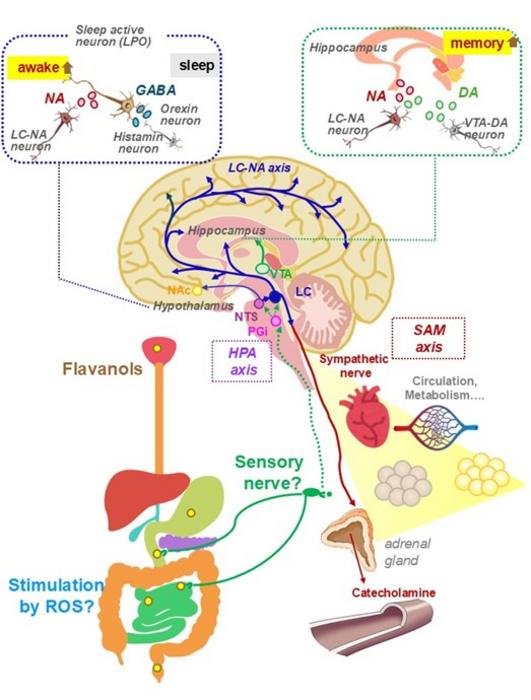
A sharp taste can wake the tongue, but new research shows it can also wake the brain. Scientists at the Shibaura Institute of Technology in Japan have found that astringent flavanols, compounds known for their dry and puckering sensation, directly activate brain circuits involved in alertness, stress response, and memory. The study, published in Scientific Reports, reveals how this sensory cue may help maintain wakefulness and enhance cognitive performance.
Flavanols are polyphenols found in foods such as tea leaves, cocoa, and unripe persimmons. Their astringent quality comes from their ability to bind to proteins in saliva, creating a dry or tightening feeling in the mouth. Dr. Yasuyuki Fujii and colleagues wondered whether that oral stimulation might trigger deeper physiological effects in the central nervous system. To test the idea, they administered purified astringent flavanols to mice and monitored neural activity, hormone release, and behavior.
From Mouth To Mind
Within minutes of ingestion, the team observed activation in the hypothalamic neurons that produce corticotropin-releasing hormone (CRH), a master regulator of the stress response. These neurons, in turn, stimulated the locus coeruleus, the brain’s main source of noradrenaline, which promotes alertness and supports memory formation. The researchers also detected downstream effects in the hippocampus, where noradrenaline and dopamine enhance learning and recall.
“A single oral administration of astringent flavanols stimulated the central nervous system, activating the hypothalamic CRH neurons,” said Dr. Fujii. “The secreted CRH activated the noradrenaline neural network in the locus coeruleus, enhancing wakefulness and memory.”
Physiological measurements confirmed the neural findings. Mice receiving the compounds showed increased sympathetic nerve activity, higher circulation, and greater exploratory behavior. Sleep-promoting pathways in the preoptic area were simultaneously suppressed, indicating that the brain was shifting into a wakeful and alert state. These effects were seen after a single oral dose, suggesting that the body rapidly interprets astringent sensations as cues for readiness.
The researchers propose that the taste of astringency evolved as an adaptive signal for environmental awareness. Many plants that produce astringent compounds also contain bioactive molecules that can affect metabolism or defense. Detecting those molecules through taste might have served as an early warning system, priming the body for heightened attention. In that sense, astringency could act as a sensory shortcut between the mouth and the brain.
Implications For Diet And Cognition
The study’s second phase compared astringent flavanols with non-astringent flavanol derivatives to isolate the role of taste. Only the astringent version produced measurable activation in CRH neurons and the noradrenergic system. According to the authors, this highlights a physiological connection between oral texture and neural function that extends beyond flavor.
“Our results suggest that the sensory property of astringency is not only a matter of taste perception but also a physiological activator of central nervous functions,” the researchers wrote in the paper. “Astringent flavanols may help maintain wakefulness and cognitive performance by engaging the CRH-noradrenaline system.”
The discovery opens new questions about how other taste sensations, such as bitterness or pungency, might influence the brain’s arousal and motivation networks. It also points toward potential nutritional strategies for maintaining mental alertness through naturally occurring compounds. Foods rich in astringent flavanols could one day be harnessed for cognitive support or fatigue management, though human studies will be needed to confirm these effects.
For now, the research adds a new twist to the familiar sensation of a dry mouth after sipping strong tea or dark chocolate. That sharp edge on the tongue may be doing more than signaling flavor; it might be quietly tuning the brain for focus.