

People who eat doenjang soup regularly know when something’s off. The broth might taste fine, even savory, but it doesn’t coat the mouth the way it should. It lacks that lingering fullness that makes you want another spoonful. Turns out, monosodium glutamate does something specific to create that sensation, and it’s not just about umami.
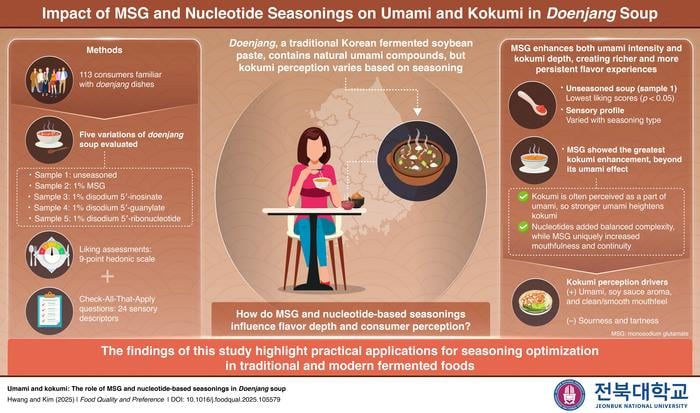
Researchers at Jeonbuk National University tested how different seasonings affect doenjang soup’s perceived richness. They recruited 113 consumers familiar with the dish and had them taste five versions: one unseasoned, one with MSG, and three with nucleotide-based umami enhancers like disodium inosinate. The MSG version consistently ranked highest for both umami and kokumi, a Japanese term describing mouthfulness, continuity, and flavor persistence. The nucleotide seasonings boosted taste, but MSG produced a more complete sensory effect.
The unseasoned soup performed poorly across every measure. Adding any seasoning helped, but the type mattered more than expected. MSG didn’t just make the soup taste stronger; it changed how the flavor lingered and filled the mouth. That’s kokumi at work, and it’s harder to pin down than basic taste.
What Kokumi Actually Means in Practice
Kokumi isn’t a taste receptor phenomenon like umami. It’s more of an amplification effect, often described as richness or thickness without adding fat. Fermented foods naturally contain kokumi-active compounds, which develop during aging. But modern food science has mostly focused on umami enhancement, leaving kokumi’s drivers less explored.
In this study, specific sensory attributes drove kokumi perception. Soups rated high for umami, soy sauce aroma, and smooth mouthfeel also scored high for kokumi. Sourness and tartness worked against it. The MSG sample hit all the positive drivers more strongly than the nucleotide versions, which produced a more balanced but less pronounced effect.
“The addition of seasonings significantly enhanced umami and kokumi characteristics, with MSG showing the most pronounced effect on kokumi perception compared to nucleotide-based seasonings,” the researchers noted.
One complication emerged: consumers struggled to separate umami from kokumi when tasting. When umami intensity increased, kokumi ratings often rose in parallel. The perceptual overlap makes sense given that umami compounds likely interact with kokumi-active molecules in fermented paste, creating a synergistic effect that feels like more than just stronger taste.
Implications Beyond the Bowl
Doenjang is made from naturally fermented soybean blocks called meju, aged with salt but without koji. The fermentation produces complex savory compounds that vary by batch and season. Adding MSG doesn’t override that complexity; it seems to amplify what’s already there.
For food manufacturers, the findings suggest that combining MSG with nucleotide seasonings might balance tradition with modern expectations for bold, satisfying flavor. Nucleotides create complexity and harmony, while MSG adds depth and persistence. The study used 1% concentrations across all seasonings, but real-world formulations could adjust ratios based on desired outcomes.
Beyond Korean cuisine, the implications reach any food system that values depth and richness. Aged cheeses, long-simmered stocks, soy sauce, and miso all rely on kokumi to feel complete. Understanding how different seasonings selectively enhance that sensation could help reduce sodium while maintaining satisfaction, or develop plant-based products that deliver the mouthfeel consumers expect from fermented animal products.
The study appears in Food Quality and Preference, offering a rare consumer-focused look at how seasoning choices shape sensory experience in traditional foods.