

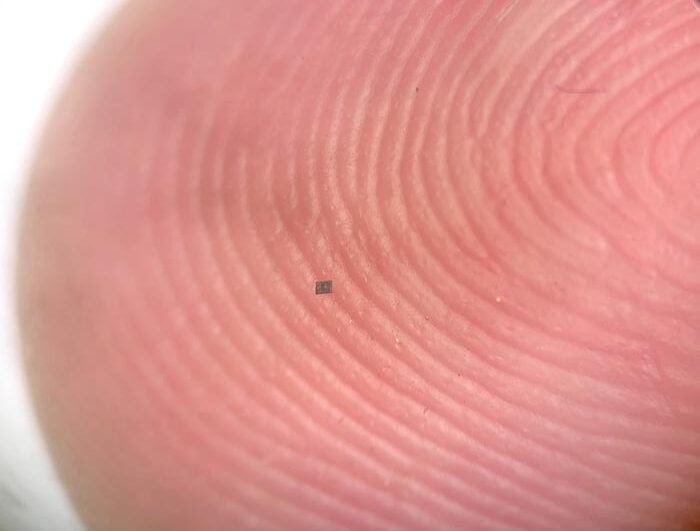
A robot small enough to balance on a fingerprint ridge can sense its surroundings, decide what to do next, and swim through liquid on its own. No wires, no remote control, no external magnetic fields telling it where to go.
The achievement comes from teams at the University of Pennsylvania and the University of Michigan, who have built what they’re calling the world’s smallest fully programmable, autonomous robots. Each measures roughly 200 by 300 by 50 micrometers, smaller than a grain of salt, and carries its own computer, sensors, and power system. They operate at the same scale as single-celled organisms, but with the ability to make decisions and execute complex behaviors for months at a time.
The work, published in Science Robotics and Proceedings of the National Academy of Sciences, solves a problem that’s frustrated roboticists for four decades. Electronics have shrunk steadily since the 1960s, but robots haven’t followed the same path. Below one millimeter, the usual strategies for building machines stop working entirely.
The Physics Problem Nobody Could Crack
At microscopic scales, the physical world transforms into something alien. Gravity and inertia fade to irrelevance, while drag and viscosity dominate everything. Water stops behaving like water and starts acting like tar. Moving through it, according to the researchers, feels like “pushing through syrup.”
That shift renders conventional robotic approaches useless. Tiny legs and joints are fragile, difficult to fabricate, and hopeless against the drag forces. Motors consume far too much power for the minuscule energy sources available at this scale. For years, microrobots have relied on external magnetic fields, acoustic waves, or physical tethers to function, which essentially means they’re puppets controlled by bulky laboratory equipment rather than independent machines.
Marc Miskin’s team at Penn tackled locomotion by abandoning moving parts altogether. Their robots use electrokinetic propulsion—generating tiny electric fields that push ions in the surrounding fluid, which drag water molecules along with them. The robot rides its own self-created current, reaching speeds of about one body length per second. Because there are no mechanical joints to break, the devices prove remarkably durable. They survive repeated transfers with a micropipette and can operate continuously for months when illuminated by LED light.
Computing on 75 Nanowatts
Motion alone doesn’t make a robot autonomous. True independence requires an onboard computer, memory, sensors, and power—all squeezed into a volume barely visible to the naked eye. That challenge fell to David Blaauw’s lab at the University of Michigan, which holds the record for the world’s smallest computer.
The power budget is brutal. The robots’ tiny solar cells generate only 75 nanowatts—more than 100,000 times less than a smartwatch uses. To make computation possible at all, the Michigan team designed ultra-low-power circuits operating at extremely low voltages, cutting power consumption by more than 1000 times. Even with those gains, the solar panels occupy most of the robot’s surface area.
What remains barely fits a processor and memory. The solution required rethinking how computer programs work at a fundamental level. Instead of conventional instruction sets requiring long sequences of code, the team created compressed commands that pack complex behaviors into single instructions—things like “sense temperature” or “move for N cycles.” With just a few hundred bits of memory, the robots can execute meaningful tasks.
“We’ve shown that you can put a brain, a sensor, and a motor into something almost too small to see, and have it survive and work for months.” – Marc Miskin, University of Pennsylvania
The robots sense temperature with a resolution of about one-third of a degree Celsius and can alter their motion in response—moving toward warmer regions, for example. To report measurements back to researchers, they encode data in their movement patterns, performing what the team calls “a little dance” that can be decoded under a microscope. Each robot can also be programmed using light pulses and assigned a unique address, making it possible to deploy multiple robots simultaneously, each performing different roles.
Miskin describes the current machines as a general-purpose platform. Future versions could carry additional memory, integrate new types of sensors, or operate in more complex environments. Applications range from monitoring individual cellular health to assembling microscopic devices. At scale, the researchers estimate production costs could drop to about a penny per robo, low enough to make microscopic autonomous machines practical outside specialized research labs for the first time.