In hollowed holes of
Knotted cells,
Tensile echoes
Bubble beneath the surface –
Frothing with potential
As they wait to break
Free from the confines
Of their cellular walls.
Synthetic solutions:
Nurtured in nature.
Tangled webs of
Dew-lined geometries
Glimmer gently,
Their native silks
Bearing broken bodies
That belay their
Precious cargo betwixt
Fragile manacles
Of suppurating steel.
Synthetic solutions:
Nurtured in nature.
In empty clean rooms
Dexterous fingers replicate
Acidic glands,
Weaving matrices of artificial silk
Through interlocking fibrils;
Small and slender fibres
That stitch together proteins
To form structural assemblies
That blend into the landscape
From which they were taken.
Synthetic solutions:
Nurtured in nature.
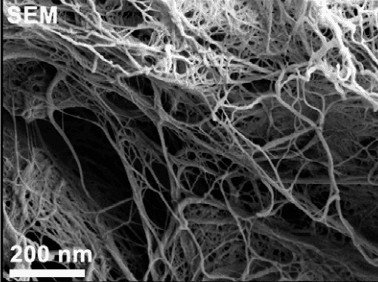
An image of a cellulose nanofibril, taken by a Scanning Electron Microscope (SEM); 200 nm = 200 nanometres, roughly one-thousandth the width of a human hair (Image Credit: Pezhman Mohammadi et al.)
This poem was inspired by recent research, which has investigated how a combination of wood fibres and spider silk could be used as a possible replacement for plastic.
A material’s strength refers to its ability to carry a load, while its toughness relates to how much energy is needed to break it, and typically these two properties tend to be mutually exclusive. Consider, for example, a porcelain plate: it is strong enough to carry food (high strength), but shatters if it is dropped (low toughness). Similarly, a tennis ball is easily squashed out of shape (low strength), but it doesn’t break if it is dropped (high toughness). Creating materials with both a high strength and a high toughness has been a great challenge in material engineering. However, new research has shown that nature offers potential solutions.
In this study, researchers were able to combine protein based on spider silk (high toughness) with the cellulose taken from plant walls (high strength) to create a material that outperforms most of today’s synthetic materials by simultaneously providing high strength and high toughness. A further advantage of these materials is that they are fully biodegradable, and so they do not damage nature in the same way as plastics and other synthetics.
An audio version of this poem can be heard here:
Bloggers

Natural Building Blocks
In hollowed holes of Knotted cells, Tensile echoes Bubble beneath the surface – Frothing with potential As they wait to break Free from the confines Of their cellular walls.